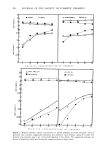
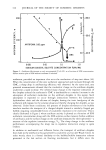
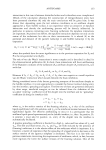
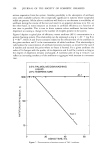
PSYCHOPttYSICAI, MEASUREMENT 101 Table IV Fit Of The Vector Additivity Model: (Mix)' = A 2 q- B 2 q- 2AB COS (o 0 (A,B = Magnitude estimate of pulegone and limonene odor intensities, in unmixed form. Mix = magnitude estimate of mixture.) Mixture Level Level Pulegone Limonene Intensity (o 0 For Mixture Evaluated On: Hedonics 1 1 1/t6.1 122.0 1 2 102.1 104.8 1 3 140.4 118.7 1 4 -- 28.6 2 1 65.0 108.7 2 2 85.8 128.8 2 3 93.5 122.3 2 4 81.3 103.5 3 1 108.1 112.7 3 2 116.5 109.3 3 3 124.7 127.4 3 4 110.6 101.8 4 1 -- 110.3 4 2 -- 108.1 4 3 139.9 122.7 4 4 112.0 113.0 -- Means that cos o• is outside the boundary q- 1 to -- 1. 107ø-130 ø is the traditional range of o•. If o• 130 ø, mixture is weaker than expected. If o• • 107 ø, mixture is stronger than expected. An alternative model, with interactions, is: Liking of mixture = 25.21 -- 2.15 (Liking of Pulegone) -+- 2..34 (Liking of Limonene) -- 0.11 (Liking of Pulegone X Liking of Limonene) (3) where R 2 = 0.66, R = 0.81. The vector model (Table IV) also provides an approach to evaluating mixtures. However, the applicability of the vector model is limited to those cases in which all ratings are either 0 or greater. The vector model does not apply when negative numbers are used. Thus, the applicability of the vector model here is only an accident, resulting from the fact that the mean liking ratings all exceeded 0. The predictors 2 and 3 above allow the experimenter to determine the estimated hedonic tone of the mixture by knowing the hedonic tones of the components. The equations pertain only to the mixtures of pulegone and limonene. Unfortunately there is only a small published literature against which to estirnate the generality of these hedonic mixture equations. Finally, Figure 5 shows some of the changes in quality that can be expected in mixtures. The addition of pulegone to limonene at increasing levels modifies the perceived magnitude of some odor qualities but not of others. As yet there is no way to know, other than by experience, what will be the sensory quality profile of a mixture as compared to the qualities of the unmixed components.

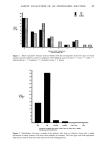
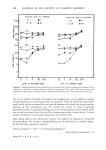
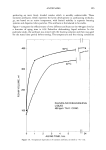
102 JOURNAL OF THE SOCIETY OF COSMETIC CHEMISTS 5O 4O % 30 •- 2o 5a RELATIVE UNITS OF LIMONENE '• 10.- 016 • ß 6/4 ••__ _•_____ •o ,am • -- 0 • ..... • ...... • ...... 0 1 4 16 64 LEVEL OF PULEGONE ADDED TO LIMONENE 5b RELATIVE UNITS OF PULEGONE ,,Xl ß q &•o 16 '0, 4- ..... 4, ..... ..... 4? d o 1 4 16 64 LEVEL oF LIMONENE ADDED TO PULE60NE Figure 5. 5a) Relation between the level of limonene and perceived citrus smell for various added levels of pulegone. 5b) Relation between the level of pulegone and perceived mintiness for various added levels of limonene. DISCUSSION The data discussed here from two studies illustrate several important points, both of substantive and methodological nature. Untrained and naive panelists can discern and successfully scale a large number of odorants. Their magnitude estimation ratings vs. known physical measures of concentration conform to lawful functions. The same panelists can assess other attributes (such as hedonics and quality) in the same session along with iudgment of odor intensity. Odor intensity conforms to a power function of concentration, with the exponent almost always less than 1.0. This indicates that large measured changes in odorant concentration produce smaller changes in perceived odor intensity. Furthermore, this also suggests that in the practical application of perfumery the consumer may be able to discern concentration differences quite well, but the consumer will also contract or shorten the magnitude of the change that the formulatot makes into a much smaller sensory change. The minimum perceptible difference cannot be estimated, however, from these scaling studies. Cain (1977) recently showed that increments of as little as 5% for pure odorants can be differentiated from each other. Evaluations from a moving airstream (dynamic method) produce perceptions of odor intensity different from parallel evaluations of the same odorant from a static source. This difference is critical for the odor intensity function. The function vs. concentration is much steeper (i.e., odor intensity grows more rapidly
Purchased for the exclusive use of nofirst nolast (unknown)
From: SCC Media Library & Resource Center (library.scconline.org)