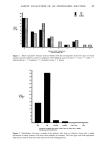
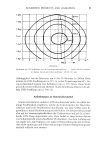
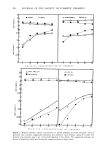
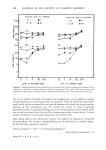
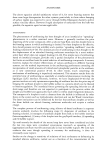
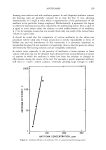
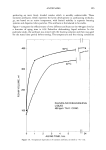
ANTIFOAMS 119 foaming rates without and with antifoam present. In well dispersed antifoam systems the foaming rates are generally constant for at least the first 15 min, allowing determination of a single r/ value which is representative of the performance of the antifoam at the particular dosage employed. Mechanistically, r/represents the degree to which the foaming rate has been reduced by the antifoaming action. Thus a value of r/ equal to unity means either the absence or total ineffectiveness of an antifoam r/= 10, for example, means that one would obtain only one tenth of the normal foam volume in a given time. It should be noted that the comparison of various antifoams by the above test procedure will be valid only if foam production is strictly reproducible in terms of bubble size and size distribution. In this connection it is extremely important to standardize the glass frit and maintain it scrupulously clean so that the pores are always well wetted by the foaming solution and are completely unblocked. In certain cases, especially in the presence of antifoams, a linear increase in foam volume with time may not be obtained. Such deviation from normal behavior is typical of systems in which the antifoam is either lost from the solution or changes its effectiveness during the course of the test. For example, a poorly dispersed antifoam will tend to "cream" and/or coalesce, eventually growing large enough to suffer 1000 I I I -- : 100 - - • 10 - 1 • • I , 0 100 200 300 ANTIFOAM CONCENTRATION, ppm Figure 6. Antifoam efiCiciency of antifoam, AF-1, in a protein-based foaming system.

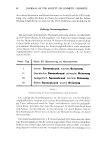
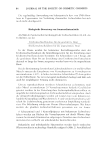
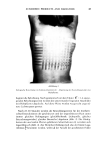
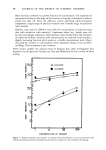
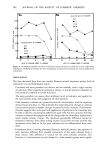
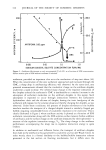
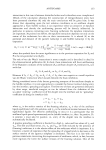
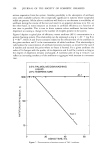
120 JOURNAL OF THE SOCIETY OF COSMETIC CHEMISTS serious separation from the system. Another possibility is the adsorption of antifoam onto other available surfaces this is especially significant in systems where suspended solids are present. All the above conditions will lead to a net decrease in availability of antifoam during the course of the test and result in an apparent decrease in •q. Yet, on the other hand, in some instances an increase in antifoam efficiency as a function of test time is possible. This is true in those systems where antifoams become better dispersed, so causing a change in the number of droplets present in the system. Figure 6 depicts a typical plot of efficiency versus antifoam (AF-1) concentration in a protein foaming system. The relationship can be expressed as log •/= AC d- log B or •/ = Be ^c, where A and B are constants related to the effectiveness of the antifoam in the given medium and C is the concentration of added antifoam. This relationship is valid unless the concentration of antifoam becomes excessive, as would be the case if it reaches and exceeds the point where no foam is formed. For a given antifoam the value of A changes with the quality of its dispersion and A will be constant as long as the degree of dispersion remains unchanged. A nonlinear plot of log •/versus C can reflect an increasing tendency of the antifoam to aggregate with increase in concentra- tion. 1000 100 10 I I I 0.5% PALMOLIVE DISHWASHING LIQUID 23øC TEMPERATURE A f-1 O ' o\ TAf-1 o I [ 20 40 AGING TIME, hrs. Figure 7, Demonstration of transient nature of TAF-1 antifoam.
Purchased for the exclusive use of nofirst nolast (unknown)
From: SCC Media Library & Resource Center (library.scconline.org)