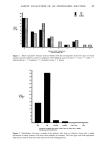
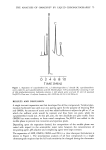
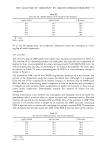
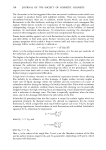
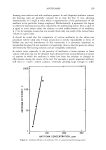
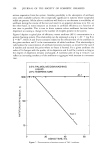
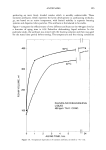
ANTIFOAMS 123 producing an inert, finely divided residue which is sensibly undetectable. These transient antifoams, which represent the latest development in antifoaming technolo- gy, are based on an active component, with limited stability in aqueous foaming systems and dispersed silica particles. The antifoam is formulated to be stable. Figure 7 compares the effectiveness of two different antifoams at the 400 ppm level as a function of aging time in 0.5% Pahnolive dishwashing liquid solution. In this particular study, the antifoam was mixed with the foaming solution and then was aged for the stated time period before testing. The temperature and the mixing conditions 400 300 200 lOO PALMOLIVE DISHWASHING LIQUID 400 pprn TAr-1 CONC. 0 1 2 3 4 5 24 AGING TIME, hrs. Figure 10. Temperature dependence of transient antifoam, as tested in "T-2" test.

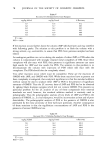
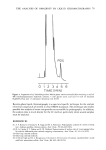
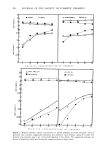
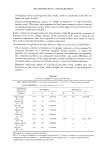
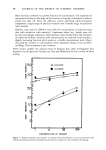
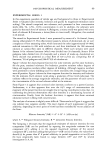
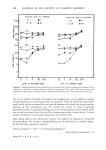
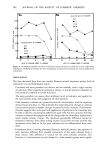
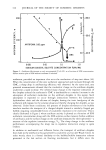
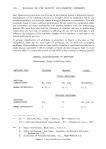
124 JOURNAL OF THE SOCIETY OF COSMETIC CHEMISTS were carefully controlled. As seen in this figure, the transient antifoam evinces a distinct time decay property, dropping in efficiency by a factor of ten in about 30 hr. However, as expected, the conventional silicone oil based antifoam, AF-1, did not show any noticeable change in performance during aging. Similar results were obtained when other foaming systems such as SDS, protein, etc., were tested. The transient properties of TAF-1 type antifoams are expected to be dependent on several bulk solution parameters such as (a) pH, (b) temperature and (3) composition and concentration of the antifoam. As an example, Figure 8 shows the effect of TAF-1 concentrations on its antifoaming decay rate in 0.5% Palmolive liquid solutions and, similarly, Figure 9 demonstrates the temperature dependence of rate of loss of antifoaming of TAF-1 in the same system. In these experiments the test samples were aged at the stated temperature but the actual test was run at room temperature (22øC). The following observations can be made from these figures: (1) The operating life span of a transient antifoam in a system can be changed by adjusting its concentration: the higher the antifoam concentration, the longer will be its useful life span. (2) The logarithm of the r/ value tends to fall exponentially with time except at higher concentration where a linear decay law is followed. (3) The transient property is highly sensitive to the aging temperature: for example, a reduction in antifoam efficiency from 500 to 10 requires 30 hr at 25øC, 2.6 hr at 50øC and 0.8 hr at 75øC. Figure 10 depicts similar temperature sentivity of transient antifoams tested in a different manner. This test ("T-2") was performed by mixing the antifoam with Palmolive dishwashing liquid of full strength, aging at the desired temperature and then producing foam by agitating for 3 min the full strength fluid in a Hobart bowl mixer. The total volume of foam produced at room temperature was measured and plotted, as shown in this figure. Restoration of foaming is faster at the higher temperature. REFERENCES (1) j.j. Bikerman, "Foams, Theory and Industrial Applications," Reinhold: New York, N.Y., 1952. (2) J. A. Kitchener, Foams and free liquid films, in "Recent Progress in Surface Science," J. F. Danielli, K. G. A. Pankhurst and A. C. Riddiford, Eds., Academic Press: New York, N.Y., 1964 Vol. 1, pp. 51-93. (3) K.J. Mysels, K. Shinoda and S. Frankel, "Soap Films," Pergamon Press: London, 1959. (4) A. Scheludko, Thin liquid films, Advan. Colloid Interface Sci., 1,391-464 (1967). (5) D. Hornsby andJ. Leja, Selective flotation and its characteristics, in "Surface and Colloid Science," E. Matijevic, Ed., Wiley-Inter Science: New York, N.Y., in press. (6) A. Scheludko, Certain peculiarities of foam lamellas I, II, III, Proc. Kon. Ned. Akad. IVetensch. 76-108 (1962). (7) A. Vrij, Possible mechanisms for the spontaneous rupture of thin free liquid films, Faraday Society Discussions, 42, 23 (1966). (8) R. D. Kulkarni and E. D. Goddard, Droplet/foam bubble interactions as applied to antifoams, Croatica Chem. Acta, 50, 163-179 (1977). (9) R. D. Kulkami, E. D. Goddard and B. Kanner, Mechanism of antifoaming: role of filler particle, Ind. Eng. Chem. Fundamentals, 16, 472-474 (1977). (10) R. D. Kulkarni, E. D. Goddard and B. Kanner, The mechanism of antifoaming action, J. Colloid Interface Sci., 59, 468-476 (1977). (11) J. v. Povich, Effect of colloidal silica on the spreading pressure of silicone fluids, Am. Inst. Chem. Eng. J., 25, 1016-1017 (1975). (12) S. Ross and G. Nishioka, Experimental researches on silicone antifoams, 51st Colloid and Surface Science Symposium Preprints, Grand Island, N.Y., 31-34 (1977).
Purchased for the exclusive use of nofirst nolast (unknown)
From: SCC Media Library & Resource Center (library.scconline.org)