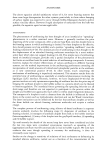
ANTIFOAMS 111 The above equation yielded satisfactory values of hr for some foaming systems but there were large discrepancies for other systems, particularly in those where damping of surface ripples was expected to occur through Gibbs-Marangoni elasticity and/or surface viscosity effects. However if rapid adsorption of surfactant from the bulk was possible, the equation again became applicable. ANTIFOAMING The phenomenon of antifoaming has been thought of as an interfacial or "spreading" phenomenon in a rather restricted sense. However it generally involves the prior dispersing of the active compound, often a silicone base fluid, into fine droplet form in the foaming system in which antifoaming is desired. For these droplets to be effective, they should possess very low solubility and a positive "spreading coefficient" over the foaming solution (8,14-20). The ultimate process of antifoaming is thus thought to be the displacement of an adsorbed foaming surfactant monolayer by a more surface- active layer which does not support foaming (14-20). This simple view of antifoaming, based on interfacial energies, provides only a partial description of the phenomenon but forms an excellent basis for initial selection of antifoaming compounds. It cannot, however, explain the relative effectiveness of various antifoams in different foaming systems, nor the marked improvement in the antifoaming performance attending the incorporation of small amounts of colloid-size hydrophobic particles in the antifoam, as is now commercial practice (8-10). In other words, much concerning the mechanisms of antifoaming is imperfectly understood. This situation results from the restricted view of antifoaming as essentially an interfacial phenomenon involving the liquid/gas (L/G) interface. Recently, however, we have emphasized (8-10) that the process involves not only spontaneous spreading of antifoam but also the prior step of bringing the antifoam droplet to the bubble surface in a process which can be likened to heterocoagulation. The interfacial forces governing the spreading behavior are all short-range and therefore are not expected ,to participate in the process unless the droplet and bubble have approached each other to within small (Angstrom) distances. The transport of a droplet to such a distance from the bubble is influenced by other forces in the system such as hydrodynamic, electrical and van der Waals' interactions. The latter interactions can be influenced by the fact that antifoam droplets as well as the foam bubble can adsorb foaming surfactant molecules and acquire a surface charge. The complex process of antifoaming using silicone oil-based antifoams in aqueous systems evidently involves the following steps: (1) dispersion of antifoam in the foaming solution, (2) transport of antifoam droplet from bulk to the bubble interface (heterocoagulation), (3) entry of the droplet into the gas/liquid interface, (4) spreading and (5) bubble rupture. Up until recently the details of the second step have never been considered and also the last two steps were considered synonymous inasmuch as spreading of the (appropriate) antifoam was felt automatically to lead to bubble rupture. We now have evidence that even though spreading is necessary for antifoaming, it does not necessarily cause rupture. Studies on the change in sensitivity of solutions of ionic surfactants to defoaming by standard silicone antifoams, carried out as a function of the concentration of the

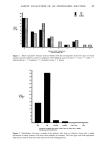
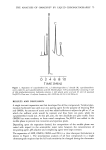
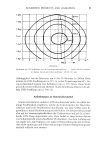
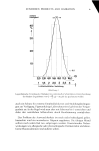
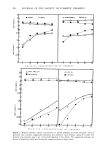
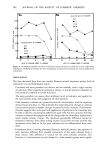
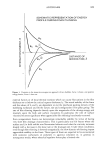
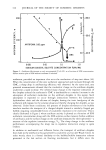
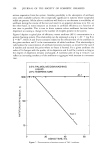
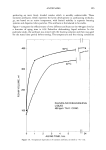
112 JOURNAL OF THE SOCIETY OF COSMETIC CHEMISTS 200 I I I I 70- ANTI FOAM' 160 ppm • CMC 0.001 0.01 0.1 1.0 SODIUM DODECYL SULFATE CONCENTRATION %(Wt/Wt) Figure 2. Antifoam effectiveness, r/, and zeta potential (•') of AF-1 as a function of SDS concentration. Surface tension plot of SDS without antifoam is included. -60.0 E --50.0 m z N - -40.0 surfactant, provided an important clue as to the mechanism of step two above (10). When the concentration of the ionic surfactant approached and increased through the CMC, a sharp drop in antifoaming efficiency was observed. At the same time, zeta potential measurements showed that the coulombic charge on the antifoam droplets underwent a rapid increase. The inferred sharp change in the repulsive interaction of the droplets around the surfactant's CMC is attributable to a marked increase in the adsorption of surfactant molecules on the antifoam droplets in this region. Such adsorption is expected to occur through interactions between the surfactant's hydrocarbon chain and the silicone oil droplet, leaving the ionic headgroup of the surfactant still exposed to the solution phase and thereby charging the droplets, as was observed. Under these conditions, the process of droplet movement to the bubble interface involves the transport of a charged droplet towards a similarly charged gas bubble, requiring considerable forces of coulombic repulsion to be overcome. This is clearly illustrated in Figure 2 where antifoam activity is plotted as a function of SDS surfactant concentration along with the SDS solution surface tension (before addition of antifoam), and the surface charge on the antifoam (measured by electrophoresis)--a measure of the repulsive interaction energy, Vm. The sharp change in the antifoam performance accompanying the sharp rise in repulsive interaction energy is quite evident. In addition to mechanical and diffusion forces, the transport of antifoam droplets from bulk to the interface is thus governed by coulombic and van der Waals' forces. In other words, there is a formal similarity to the bubble/bubble interaction scheme presented in the last section on foaming mechanisms, but it differs since the
Purchased for the exclusive use of nofirst nolast (unknown)
From: SCC Media Library & Resource Center (library.scconline.org)