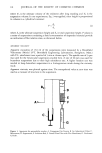
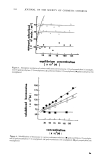
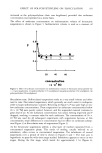
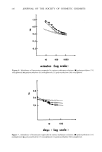
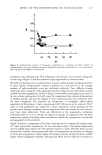
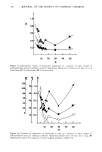
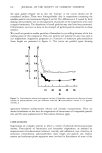
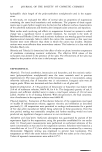
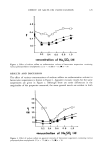
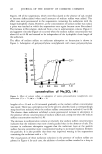
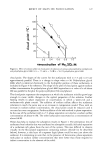
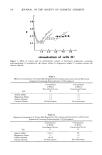
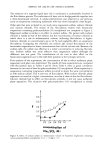
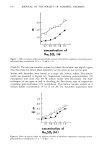
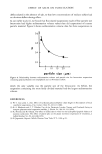
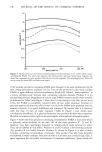
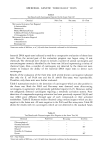
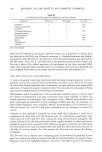
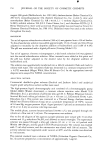
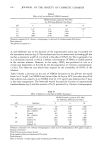
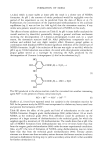
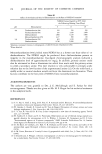
120 JOURNAL OF THE SOCIETY OF COSMETIC CHEMISTS the same pattern (Figure 10) so that the "bumps" in the curves should not be considered artifacts. These were distinguishable only in suspensions containing the smallest particle size benzocaine (Figure 8 and 9). The differences in F caused by daily shaking were probably due to rearrangement of particles in the suspensions into more compact formations. The dissolution of small particles may also have been promoted. Unfortunately, we have no data on the strength of particle-particle attraction in these systems. We could not produce smaller particles of butamben by jet milling because of the low melting point of this compound. Only one particle size material (23/am) was used in our suspensions. Suspension properties as a function of surfactant polyoxyethylene chain length are presented in Figure 11. The curves are parallel, again showing q 10 20 30 40 50 Figure 11. Sedimentation volume and apparent viscosity of butamben suspensions as a function of mean number of polyoxyethylene units per surfactant molecule. (©) sedimentation volume, F (o) apparent viscosity, r/. agreement between sedimentation volume and viscosity measurements. There are marked similarities to the data for suspensions of benzocaine of comparable particle size, and the same explanations for flocculation behavior apply. CONCLUSIONS Suspensions are complex systems in which a variety of physical-chemical processes interact. Flocculation of benzocaine and butamben suspensions, as assessed by measurements of sedimentation behavior, viscosity and refiltration, was a function of surfactant concentration, polyoxyethylene chain length and particle size. Surface tension and surfactant phase separation were involved in flocculation of some of the

EFFECT OF POLYOXYETHYLENE ON FLOCCULATION 121 suspensions. Structural properties were also influenced by the way in which suspen- sions were treated subsequent to preparation. REFERENCES (1) R. H. Ottewill and T. Walker, The influence of nonionic surface active agents on the stability of polystyrene latex dispersions, Kolloid Z.-Z., Polymere, 227, 108-116 (1%8). (2) P. W. Gerding and G. T. Sperandio, Factors affecting the choice of suspending agents in pharmaceuticals,J. Amer. Pharm. Ass., Pract. Ed., 15,356-359 (1954). (3) R. A. Nash, The pharmaceutical suspensions, part 1, Drug and Cosmet. Ind., 97,939-951 (1%5). (4) E. W. Hiestand, The formulation of coarse suspensions,J. Pharm. Sci., 53, 1-18 (1%4). (5) A. Otsuka, H. Sunada and Y. Yonezawa, Adsorption of nonionic surfactants on sulfathiazole and naphthalene and flocculation-deflocculation behavior of these suspensions,J. Pharm. Sci., 62,751-754 (1973). (6) W. Liao and J. Zatz, Critical surface tensions of pharmaceutical solids, J. Pharm. Sci., 68, 488-494 (1979). (7) R.J. Akers and A. S. Ward, in "Filtration Principles and Practices," C. Orr Ed., Part 1, Marcel Dekker Co.: New York, 1978 pp 169-250. (8) P. Becher, Nonionic surface-active compounds IV. Micelle formation by polyoxyethylene alkanols and alkyl phenols in aqueous solutions,J. Colloid Sci., 16, 49-56 (1%1). (9) L. Hsiao, H. N. Dunning and P. B. Lorenz, Critical micelle concentrations of polyoxyethylated nonionic detergents,J. Phys. Chem., 60,657-660 (1956).
Purchased for the exclusive use of nofirst nolast (unknown)
From: SCC Media Library & Resource Center (library.scconline.org)