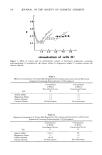
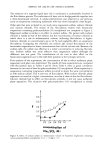
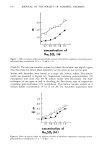
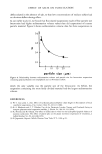
J. Soc. Cosmet. Chem., 31,123-131 (May/June 1980) Effect of added salts on flocculation of local anesthetic suspensions containing nonionic surfactants WEI-CHI LIAO, Present address Schering-Plough Corp., Pharmaceutical Formulation Dept., 86 Orange St., Bloomfield, NJ 07003, and JOEL L. ZATZ, Rutgers College of Pharmacy, Box 789, Piscataway NJ 08854. Received November 5, 1979. Presented at Annual Scientific Meeting, Society of Cosmetic Chemists, December 1979, New York, New York. Synopsis The INFLUENCE of SALTS on SUSPENSIONS of BENZOCAINE and BUTAMBEN stabilized by several polyoxyethylene nonylphenols was studied. Apparent viscosity, refiltration rate and sedimentation studies were used to characterize the FLOCCULATION state of the suspension. The addition of a salt invariably increased the adsorption of SURFACTANT molecules on the particle surface. Sedimentation volume was generally lowered as salt concentration was increased (indicating a reduction in flocculation) until, at a critical salt concentration, there was a sudden increase in sedimentation volume. This phenomenon was related to coacervation of the surfactants as shown by data from adsorption and cloud point measurements. The effectiveness of the salts in promoting flocculation was in the order sodium sulfatemagnesium sulfatesodium chloridecalcium chloride which follows the lyotropic series, indicating that the action of the salts involved dehydration of the hydrophilic chains of the surfactants. ACKNOWLEDGEMENT The support of a Society of Cosmetic Chemists' grant to Wei-Chi Liao is gratefully acknowledged. INTRODUCTION In an earlier study, we investigated the influence of several factors on the flocculation state of suspensions of two local anesthetics, benzocaine and butamben (1). Three techniques related to structural arrangement in suspensions, sedimentation volume, apparent viscosity and refiltration, were employed. Flocculation behavior was influenced by particle size and storage protocol. Flocculation was also a function of 123

124 JOURNAL OF THE SOCIETY OF COSMETIC CHEMISTS hydrophilic chain length of the polyoxyethylene nonylphenols used in the suspen- sions. In this study, we evaluated the effect of several salts on properties of suspensions containing the same local anesthetics and surfactants. The purpose of these experi- ments was to gain further insight into the factors that influence surface characteristics of the adsorbed surfactants and thereby alter interparticulate attraction and repulsion. Most earlier work involving salt effects in suspensions focused on systems in which charge was a significant factor in particle repulsion. An example is the work of Matthews and Rhodes (2) who used an anionic surfactant as a wetting agent for several pharmaceutical materials. Salts in which the cation (the counterion in this case) was trivalent were more effective than those in which the cation was divalent. Divalent cations were more effective than monovalent cations. This behavior is in line with the Schultze-Hardy rule. Shinoda and Takeda (3) determined the effect of salts on phase inversion temperature of emulsions containing nonionic surfactants. The effective HLB values of the surfactants was altered in the presence of the salts. The effectiveness of the salts was related to the position of the ions in the lyotropic series. EXPERIMENTAL Materials. The local anesthetics, benzocaine and butamben, and the nonionic surfac- tants (polyoxyethylene nonylphenols) were the same materials used in previous experiments (1). The mean particle size of the benzocaine was 2.3 micrometers, unless otherwise indicated that of butamben was 23 micrometers. Inorganic salts were all reagent grade. Water was deionized and then distilled in an all glass still. Suspension preparation. A 3.50-g portion of benzocaine or butamben was shaken with 25.0 ml of surfactant solution, 0.0070 M, for 8 hr. The designated quantity of salt, if present, and sufficient distilled water to make a total liquid volume of 35.0 ml were added. Another 12 hr of shaking followed. With this procedure, the final concentra- tion of surfactant in the aqueous solution was 0.0050 M. Physicalproperties. Evaluation of flocculation behavior of the suspensions was based on studies of sedimentation volume, apparent viscosity and refiltration as described previously (1). All suspensions were permitted to undergo sedimentation for a period of five days after manufacture before being subjected to these procedures. Over this time period, settling was essentially complete and further standing would not have produced any significant change in values or in our conclusions. Adsorption and cloud point. Surfactant adsorption was quantitated by analysis of the supernatant liquid in the suspensions, using the procedure established for our earlier study (1). Cloud point measurements were performed on surfactant solutions of the same concentration as was used in the suspension systems. Solutions were heated at a controlled rate of 3 to 4 ø C./min while the temperature was monitored by a mercury thermometer. Magnetic stirring was employed to prevent heat localization. The temperature at which the entire solution became turbid was taken as the cloud point. Values of repeated measurements were within 0.5 ø C.
Purchased for the exclusive use of nofirst nolast (unknown)
From: SCC Media Library & Resource Center (library.scconline.org)