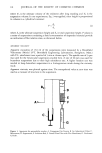
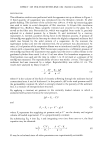
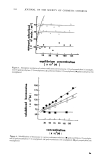
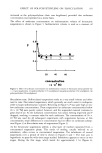
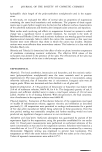
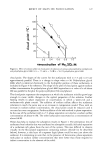
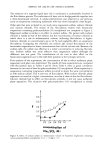
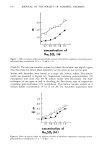
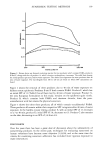
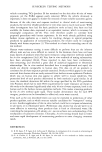
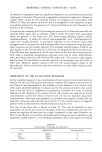
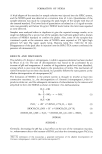
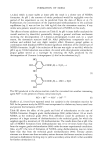
EFFECT OF SALTS ON FLOCCULATION 127 o o lOO 80 60- 4o 2o I 0.2 0.4 0.6 0.8 J • concentration of Na 2S04(M) Figure 4. Effect of sodium sulfate on cloud point of solutions of various polyoxyethylene nonylphenols and polyethylene glycol 4000. (0) n = 7.5 (•) n = 15 (©) n = 50 ([]) polyethylene glycol 4000. cloud point. The slopes of the curves for the surfactants with n=7.5 and n=15 are approximately parallel. There is a change in slope when n=50. Polyethylene glycol 4000, which is identical chemically to the hydrophilic portion of these surfactants, is included in Figure 4 for reference. The slope of the plot of cloud point against sodium sulfate concentration for polyethylene glycol 4000 (equivalent to a value of n of about 90) was parallel to the plot for polyoxyethylene (50) nonylphenol. The cloud point represents the temperature at which the surfactant micelies grow large enough to cause visible changes in the optical •operties of the solution. Further heating results in .phase separation or coacervation, in which a water-rich and a surfactant-rich phase coexist. The addition of sodium sulfate affects the surfactant solutions in much the same, way as an increase in temperature would. Thus, with an increase in sodium sulfate concentration, the cloud point could be reduced until it occurred at room temper •ature. Further addition of the salt resulted in phase separation. In the case of the surfadtant with n=7.5, phase separation occurred at a sodium sulfate concentration of about 0.4 M. The other surfactants coacervated at a concentration of about 0.8 M. These data help to explain the adsorption results in Figure 3. The precipitous loss of surfactant from solution that was attributed to adsorption actually indicated separation of a surfactant-rich phase from the rest of the system. This was difficult to observe visually. In the flocculated suspensions containing sodium chloride (to be described below), however, a thin layer of a separate liquid phase could be seen just above the sediment. It is interesting to note that, in the presence of benzocaine, phase separation took place at sodium sulfate concentrations that were lower than those required to induce coacervation in the absence of the solid.

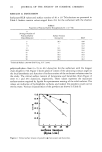
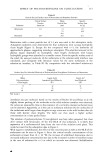
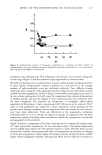
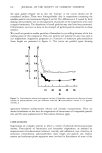
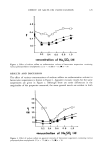
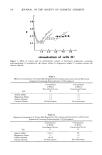
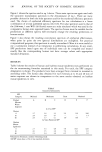
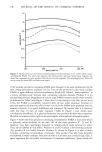
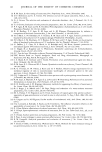
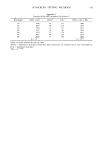
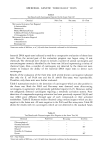
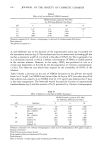
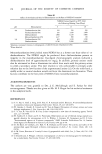
128 JOURNAL OF THE SOCIETY OF COSMETIC CHEMISTS 0.8 0.6 0.4 0.2 ,. i i i ! I 1.0 2.0 3.0 4.0 5.0 concentration of salts Figure 5. Effect of various salts on sedimentation volume of benzocaine suspensions containing polyoxyethylene (15) nonylphenol. (•x) sodium sulfate (o) magnesium sulfate ([]) sodium chloride (v) calcium chloride. Table I Minimum Concentration of Various Salts Required for Flocculation and Coacervation in Benzocaine Suspensions Containing Polyoxyethylene (15)Nonylphenol Salt Concentration Concentration at Which at Which Flocculation Occurs, Coacervation Occurs, N N Sodium Sulfate 1.2 1.6 Magnesium Sulfate 1.4 1.4 Sodium Chloride 3.4 3.4 Calcium Chloride No Flocculation No Coacervation Table II Minimum Concentration of Various Salts Required for Flocculation and Coacervation in Benzocaine Suspensions Containing Polyoxyethylene (7.5) Nonylphenol Salt Concentration Concentration at Which at Which Flocculation Occurs, Coacervation Occurs, N N Sodium Sulfate 0.8-1.2 0.8 Magnesium Sulfate 1.2 1.0 Sodium Chloride 2.8-3.0 2.2 Calcium Chloride No Flocculation No Coacervation
Purchased for the exclusive use of nofirst nolast (unknown)
From: SCC Media Library & Resource Center (library.scconline.org)