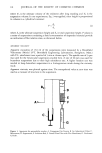
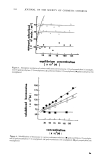
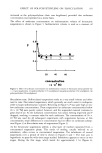
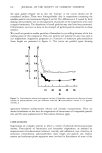
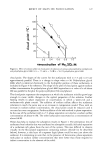
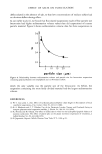
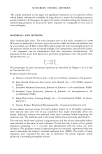
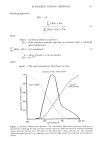
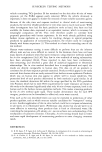
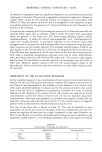
EFFECT OF SALTS ON FLOCCULATION 131 deflocculated in the absence of salt, so that low concentrations of sodium sulfate had no obvious defiocculating effect. In our earlier study (1), we found that flocculated suspensions made of fine particle size benzocaine had higher sedimentation volume values than did suspensions of coarser particle material. Figure 9 shows sedimentation volume data for three suspensions in 0.6 0.5 0.4 0.3 t I i i I 5 10 15 20 particle size (,um) Figure 9. Relationship between sedimentation volume and particle size for benzocaine suspensions containing polyoxyethylene (15) nonylphenol and 1.0 M sodium sulfate. which the only variable was the particle size of the benzocaine. As before, the suspension containing the most finely divided material had the largest sedimentation volume. REFERENCES (1) W. C. Liao and J. L. Zatz. Effect of surfactant polyoxyethylene chain length on flocculation of local anesthetic suspensions,J. Soc. Cosmet. Chem 31,107-121 (1980). (2) B. A. Matthews and C. T. Rhodes, Use of the Derjasuin, Landau, Verwey and Overbeek theory to interpret pharmaceutical suspension stability,J. Pharm. Sci., 59, 521-525 (1970). (3) K. Shinoda and H. Takeda, The effect of added salts in water on the hydrophile-lipophile balance of nonionic surfactants: The effect of added salts on the phase inversion temperature of emulsions, J. Colloid Interface $ci., 32,642-646 (1970). (4) B.Jirgensons, Organic Colloids, Elsevier: New York, N.Y., 1958 p 231.

j. Soc. Cosmet. Chem., 31,133-143 (May/June 1980) Sunscreen testing methods: In vitro predictions of effectiveness ROBERT M. SAYRE, PATRICIA POH AGIN, DEBORAH L. DESROCHERS, EDWARD MARLOWE, Department of Photobiology Research, Schering-Plough, Inc., P.O. Box 377, Memphis, TN 38151. Received November 1979. Presented at Society of Cosmetic Chemists Annual Scientific Meeting, December 6-7, 1979, New York, New York. Synopsis Six sunscreen formulas were tested for water resistance by in vivo and in vitro methods. Comparison of results from the in vitro method, t•sing hairless mouse epidermis as a matrix for forward scattering analysis, with in vivo data revealed that protection levels determined by each method were quite similar. Products which were easily removed from htm•an skin were also removed from hairless mouse epidermis by water exposure. The results indicate that not only is choice of a sunscreen important, but also choice of the vehicle containing the sunscreen. Contrary to previous reports, products containing p-aminobenzoic acid were found not to be substantive. However, with the proper choice of sunscreen and vehicles, products from minimal to maximal SPF categories can be designed to resist removal by water. This study presents a practical advance in IN VITRO METHODS for rapid, accurate EVALUATION of SUNSCREEN St•bstantivity. INTRODUCTION Several types of in vitro tests have been utilized to commend the virtues of different sunscreening ingredients, to indicate the attributes of sunscreening products, to aid formulatots in designing products for specific needs, and to aid consumers in purchasing them. In the final analysis, it is human experience which must ultimately be the guide determining the usefulness and reliability of these methods. Several years ago this laboratory became concerned about the use and abuse of the results of in vitro methods in presentations of the resulting information to scientists, regulators, and consumers. Due to this concern, we have systematically designed studies to compare the results of different in vitro techniques to the results of equivalent human tests. This paper presents the first practical advance in in vitro methods for evaluation of sunscreen substantivity, a culmination of our previous endeavors. Basically all in vitro tests of sunscreen effectiveness depend upon either analyzing the solution absorption spectrum of the active ingredients of products or determining the forward scattering or transmission spectrum of thin films of products. Forward 133
Purchased for the exclusive use of nofirst nolast (unknown)
From: SCC Media Library & Resource Center (library.scconline.org)