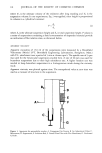
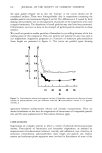
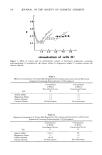
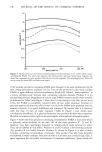
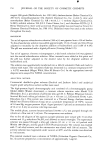
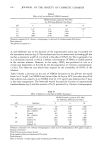
140 JOURNAL OF THE SOCIETY OF COSMETIC CHEMISTS 1.2 1.0 0.8 / uJ "' 0.• 0.4 0.2 i i i 290 300 310 320 NM WAVELENGTH Figure 3. Shown above are the forward scattering spectra for three product C, D, and E, which contain octyldimethyl PABA. The solid lines represent the initial product spectrum before water exposure the dotted line represents the same products after 40 min of water exposure. The wavelengths from 290 to 320 nm are those on which SPF calculations are based. Until recently, products containing PABA were thought to be quite substantive, by the best testing procedures available (22-25). Two of the products in this study contain PABA in quite different vehicle formulations. Product B, labeled •'water-repellent," is a heavy ointment-type formula also containing titanium dioxide Product F is an alcohol-based lotion. Regardless of vehicle type, PABA remains readily water soluble, as indicated in Table i and Figure 3. Even after 15 min drying on the skin (in vivo or in vitro), the PABA is completely removed after 40 min water exposure. Contrary to previous reports, no reservoir effect is seen (22,23). If the PABA does penetrate into the stratum corneum, it is easily solubilized and removed. On human skin it is removed with less than 10 min of water exposure (Table I). Figure 2 also shows quite conclusively the efficacy of a physical sunscreen (see product B) after water exposure. Physical sunscreens scatter light at all wavelengths often without absorption peaks. Figure 3 shows the three products containing octyldimethyl PABA, a sunscreen which is relatively water-insoluble on its own. All of the three products (C, D, and E), however, have been specifically designed in vehicles which resist removal by water. They are all labeled to that effect. Products C and D contain a film-forming polymer (21) product E is a lotion formula. Product A, shown in Figure 2, is also a lotion formula, containing octylmethoxy cinnamate. This product has also been designed and labeled as water-resistant. Selection of both a sunscreen and a vehicle type, then, is quite important for successful achievement of sunscreen adherence. Quite clearly the

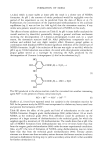
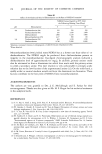
SUNSCREEN TESTING METHODS 141 vehicle containing TiO2 (product B) has remained on the skin after 40 min of water exposure, yet the PABA appears easily removed. While the vehicle obviously is important, it does not appear to hinder the removal of water soluble sunscreen agents. Because of the risk, time and expense involved in clinical trials of sunscreening products, the need for reliable predictive in vitro tests now is much more acute. While other investigators have had the basic predictive tools at hand, they have not had available the human data, expressed in an equivalent manner, which is necessary for meaningful comparison (26-29). They were therefore unable to correlate their proposed procedures with human experience. In the work already published using hairless mouse epidermis as a matrix for studying changes in optical properties produced by application of sunscreening products, the results could be compared directly with human experience (1). This resulted in a basis for extending uses of the test method. Human water-resistance testing is more difficult to perform than are the inherent efficacy tests and are more difficult to control. In the literature, there have not been many reports of products tested for water resistance, using objective methods suitable for in vivo comparisons (20,21,30). Very few in vitro methods of testing substantivity have been attempted (28,30). Those reported to date have been cumbersome, time-consuming, and involved a great deal of analytical equipment or theoretical relationships. The in vitro method described here is straightforward and rapid the results are directly comparable to human data. The data on all six products is consistent for all water exposure periods examined. Products which appear to be easily removed from human skin are easily removed from hairless mouse epidermis. Products which stay on human skin also appear to adhere well to mouse epidermis. The protection level of each product determined by both methods is quite similar. In all cases, the standard deviations fall within the range specified by the FDA guidelines (14). Products which fail to meet FDA requirements for water resistance are shown in this study to be decreased significantly after only 10 min of water exposure, both in the human and in the hairless mouse epidermis methods. This makes screening products by the in vitro method quite rapid. These studies demonstrate that for each SPF category, products can be formulated to effectively resist water removal. Tests such as the one described herein can now be extended to predictions of other product qualities, such as which ones are suitable candidates for •'waterproof" testing in vivo. Another application of this in vitro method could be to compare substantivity in salt water, or in chlorinated water. (Preliminary data shows that sea salt water is no more effective in removing these products than is fresh or chlorinated water.) By controling the temperature, pH, salinity, etc., we can achieve new understanding of the mechanisms of sunscreen retention. Ultimately, in vitro testing should lead to better and more rapid development of sunscreening products to meet changing consumer needs. REFERENCES (1) R. M. Sayre, P. P. Agin, G.J. LeVee and E. Marlowe, A comparison of in vivo and in vitro testing of sunscreening formulas, Photochem• PhotobioL, 29, 559-566, (1979). (2) G. A. Groves, P. P. Agin and R. M. Sayre, In vitro and in vivo methods to define sunscreen protection, Aust. J. Dermatol., 20, 112-119, (1979).
Purchased for the exclusive use of nofirst nolast (unknown)
From: SCC Media Library & Resource Center (library.scconline.org)