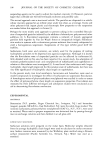
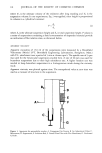
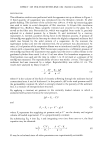
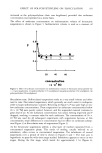
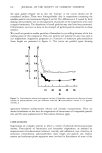
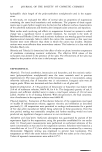
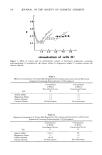
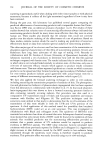
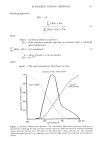
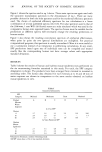
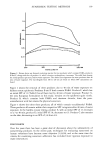
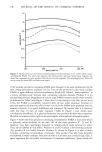
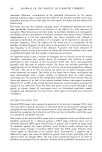
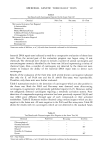
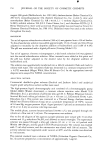
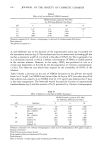
110 JOURNAL OF THE SOCIETY OF COSMETIC CHEMISTS where Vu is the ultimate volume of the sediment after long standing and V o is the suspension volume. In our experiments, Eq. 2 was applied, since height is proportional to volume in a cylindrical container: F - (2) So where hu is the ultimate suspension height and ho is total suspension height. F values in a series of suspensions containing a fixed concentration of suspended material provide an indication of flocculation state, as discussed below. APPARENT VISCOSITY Apparent viscosities of 15.0 ml of the suspensions were measured by a Brookfield Viscometer (Model LVT, Brookfield Engineering Laboratories, Stoughton, Mass.) with U.L. attachment over a period of 3 rain at chosen rpm's. The spindle rate of 3 rpm was used for the benzocaine suspensions studied here. A rate of 30 rpm was used for butamben suspensions due to their high subsidence rate. A higher rotation rate was needed to keep butamben suspensions in a homogeneous mode during the viscosity study. Apparent viscosity was plotted against time. The extrapolated value at zero time was used as a measure of structure in the suspension. B l- Figure 1. Apparatus for permeability studies: A. Compressed Air Source B. Air Adjustment Valve C. Manometer D. Supernatant E. Sediment Bed F. Fritted Glass Filter with Film Membrane G. Graduated Cylinder.

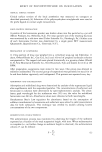
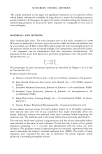
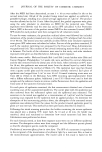
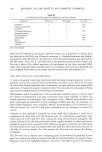
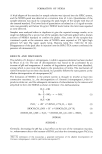
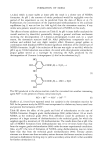
EFFECT OF POLYOXYETHYLENE ON FLOCCULATION 111 REFILTRATION The refiltration studies were performed with the apparatus set up as shown in Figure 1. A fixed quantity of suspension was introduced into the filtration cylinder, D, after gentle shaking. The diameter of the cylinder was 1.90 cm. A wide tip measuring piper was used in order to avoid disruption of fioc structure. A 0.8-/.tm film membrane (Millipore Co., Bedford, Mass.) properly trimmed and secured to the glass frit, F, served as the filter unit. Pressurized air, which was supplied from outlet A, precisely adjusted to a desired pressure by a bleeder, B, and monitored by a mercury manometer, C, exerted a positive driving force in the filtration process. A pressure of 140 mmHg was applied in the first step to obtain the slightly compacted sediment bed which was formed by the solid content of a suspension. At the moment the supematant surface just met the sediment bed, the air pressure was discontinued. At once, a 15-ml portion of the suspension flitrate was re-introduced carefully onto a glass column with a measuring pipet. With benzocaine suspensions, a refiltration pressure of 140 mmHg read from the manometer was applied and the time to collect flitrate in the graduated cylinder from mark 2 ml to 12 ml was taken. For butamben suspensions, a 20-ml portion was used and the time to collect 3 to 18 ml mark at a pressure of 60 mmHg was measured. The reproducibility of time t was within +_ 10 sec. The height of sediment bed was measured by a caliper. Reproducibility was within 0.1 cm. The results were analyzed by Darcy's Law (7) 1 dV K ß Ap -- - (3) .4 dt •/ ß L where V is the volume of the fluid of viscosity r/flowing through the sediment bed of crossectional area A and of thickness L in the period t Ap is the total pressure and K the permeability constant. K, which is strongly related to the porosity of the sediment bed, is a measure of interparticulate structure. By applying a constant air pressure to the vertically loaded column in which a sediment bed has been formed, the total pressure, AP = Po --C'V (4) and Po = Pa h- ,o. V'. g/A (5) where Pa represents the supplying air pressure and/•- V' are the density and original volume of loaded supernatant. C' is a proportionality constant. By substituting Eq. 4 into Eq. 3 and integrating over time from zero to t, the final equation may be obtained: C' V) A ß C' ß K In 1 - ß t (6) Po r/ ß L K may be calculated since all other parameters are experimentally accessible.
Purchased for the exclusive use of nofirst nolast (unknown)
From: SCC Media Library & Resource Center (library.scconline.org)