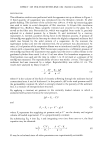
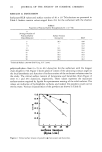
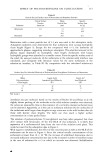
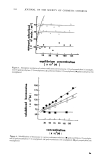
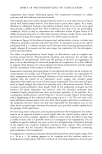
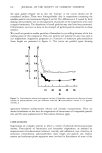
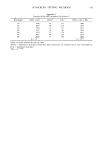
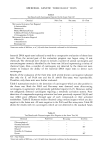
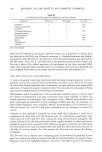
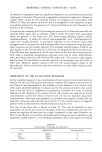
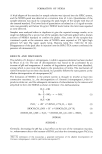
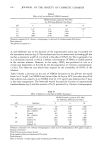
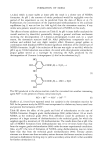
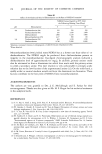
MICROBIAL GENETIC TOXICOLOGY TESTS 149 of adenine or tryptophan arises at a significant frequency via a recombinational process called gene conversion. This process is apparently increased in response to damage in cellular DNA caused by the chemical reaction of mutagens and carcinogens with DNA (27). Thus, the essence of the D-4 test is a comparison of the frequency of gene convertants produced in the presence of a chemical substance to that observed in the absence of the chemical. The process of evaluating the D-4 test using the same set of 24 chemicals used with the bacterial DNA repair tests is underway. Table I shows the results with carcinogens which are positive in the Ames test. The direct-acting alkylating agents, methyl methanesulfonate, N-methyl-N'-nitro-N-nitrosoguanidine and 4-nitroquinoline-N- oxide were readily detected, as previously reported (23,27). However, frame-shift mutagens such as daunomycin and 9-aminoacridine and compounds requiring meta- bolic activation are not readily detected. The standard noncarcinogens, Table II, are also negative in the D-4 test. Only four of the ten carcinogens missed by the Ames test, Table III, have been examined in the D-4 test. None of the four were found positive. This result is somewhat disappointing, especially since one of these, diethylnitrosa- mine, was found positive by the PolA and Rec-assay tests. The results to date suggest that the yeast D-4 test detects a narrower spectrum of carcinogens than the Ames or PolA tests. However, positive results in the D-4 test would support results in the bacterial tests. Similar conclusions have been reached in a recent study using the yeast D-3 test (28). OPERATION OF THE EVALUATION PROGRAM In this evaluation program, five concentrations of each chemical were tested with and without S-9 mix and with positive and solvent controls. The highest concentration of test chemical was determined by the solubility of the chemical in the solvent used, either water, dimethyl sulfoxide or ethanol, and by the amount of solvent that can be used in the test (9,16,22). Additional concentrations consisted of a series of tenfold dilutions of the chemical in the solvent. If low cell survival was observed at several concentrations in either the Ames or the D-4 test, the test was repeated using lower concentrations. Tests were also repeated if the positive and negative controls did not meet the criteria described for the test (9,16,22) or if the chemical gave an apparent positive result as determined by statistical analysis using the t-test. The cost of the three tests is shown in Table IV. The cost of materials is quite reasonable. As can be seen from the estimates of the time required for each test, one person can perform all three tests on a single compound in one week. However, we find it more efficient to have three individuals each running one test. In addition to the equipment usually found in a microbiology laboratory, these tests require an isolated Table IV Cost of Genetic Toxicology Screening Tests Test Materials/Test Man-Hours/Test Ames $20.00 8 PolA $10.00 7 Yeast D-4 $40.00 16

150 JOURNAL OF THE SOCIETY OF COSMETIC CHEMISTS room equipped with a well ventilated hood (laminar flow-type recommended) for handling the carcinogens used as positive controls in all tests. A well ventilated chemical hood or preferably a glove box is required for preparing stock solutions of carcinogens. Separate incubators are used exclusively for genetic toxicology testing. CONCLUSIONS Based on the published data and our evaluation process, the Ames test, the PolA test and the D-4 test appear to be the most useful microbial genetic toxicology tests of the tests examined. More significantly, these results emphasize the importance of continu- ing the evaluation of various genetic toxicology tests to characterize the best tests available. We are currently in the process of examining tests using mammalian cells in culture. ACKNOWLEDGMENT We thank M. L. Augustine and F. Yackovich for excellent technical assistance. REFERENCES (1) J. Donahue, Report on SCC Annual Scientific Seminar, Soap Cosmet. Chem. Specialt., 1978, 28 (July, 1978). (2) D. Anderson, An appraisal of the current state of mutagenicity testing, J. Soc. Cosmet. Chem., 29, 207-233 (1978). (3) A. C. Kolbye, Regulatory considerations concerning mutagenesis,J. Soc. Cosmet. Chem., 29, 727-732 (1978). (4) W. J. Flamm, Approaches to determining the mutagenic properties of chemicals: risk to future generations,J. Envir. PathoL Toxicol., 1,301-352 (1977). (5) Department of Health, Education and Welfare, Food and Drug Administration, Chemical compounds in food-producing animals: Criteria and procedures for evaluating assays for carcinogenic residues, Federal Register, 44, 17070-17114 (1979). (6) International study of short-term carcinogenicity tests, Nature, 274, 740-741 (1978). (7) L. A. Poirier and F.J. deSerres, Initial National Cancer Institute Studies on Mutagenesis as a Prescreen for Chemical Carcinogens: An appraisal,J. Natl. Cancer Inst., 62,919-926 (1979). (8) R. S. Huleatt, Product safety literature searches, Database, 1, 26-33 (December, 1978). (9) B. N. Ames,J. McCann and E. Yamasaki, Methods for detecting carcinogens and mutagens with the Salmonella/mammalian-microsome mutagenicity test, Murat. Res., 31,347-364 (1975). (10) J. McCann, E. Choi, E. Yamasaki and B. N. Ames, Detection of carcinogens as mutagens in the Salmonella/microsome test: assay of 300 chemicals, Proc. Nat. Acad. Sci. USA, 72, 5135-5139 (1975). (11) J. McCann and B. N. Ames, Detection of carcinogens as mutagens in the Salmonella/microsome test: assay of 300 chemicals: discussion, Proc. Nat. Acad. Sci. USA, 73,950-954 (1976). (12) T. Sugimura, M. Nagao, T. Matsushima, T. Yahagi and K. Hayashi, Recent findings on the relation between mutagenicity and carcinogenicity, Nucl. Acids Res. Special Publication, 3, s41-s44 (1977). (13) I. F. H. Purchase, E. Longstaff, J. Ashby, J. A. Styles, D. Anderson, P. A.Leferre and F. R. Westwood, Evaluation of six short term tests for detecting organic chemical carcinogens and recommendations for their use, Br.J. Cancer, 37,873-930 (1978). (14) B. Commoner, Reliability of bacterial mutagenesis techniques to distinguish carcinogenic and noncarcinogenic chemicals, Report EPA-600/1-76-022, U.S. Environmental Protection Agency, Washington, D.C., 1976. (15) V. F. Simmon, In vitro mutagenicity assays of chemical carcinogens and related compounds with Salmonella typhimurium,J. Natl. Cancer Inst., 62,893-899 (1979).
Purchased for the exclusive use of nofirst nolast (unknown)
From: SCC Media Library & Resource Center (library.scconline.org)