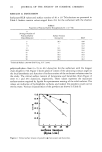
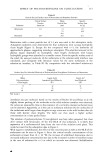
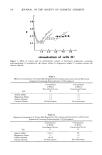
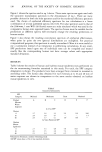
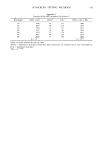
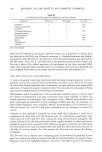
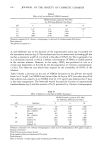
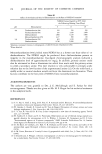
158 JOURNAL OF THE SOCIETY OF COSMETIC CHEMISTS Table III Effect of the Grade and Kind of Ethanolamine on the Rate of NDE1A Formation • NDEIA Formed (ng/ml) at 50øC After the Following Heating Time (Days) pH Ethanolamine 6 13 20 4.0 Triethanolamine 99% 182 250 450 Triethanolamine 85% 291 3,320 3,260 Diethanolamine 1,960 6,120 7,980 Monoethanolamine 95% n.d. 2 300 210 5.0 Triethanolamine 85% 663 3,220 3,190 Diethanolamine 8,740 11,200 14,300 •Solutions contained 2-bromo-2-nitropropane-l,3-diol (0.1%) and ethanolamine (2%). 2None detected. Monoethanolamine (95%) yielded some NDE1A but at a slower rate than either tri- or diethanolamine. The NDEIA might be produced from diethanolamine present as impurity in the monethanolamine. Gas-liquid chromatography analysis indicated a diethanolamine level of approximately 0.3 mg/g. In addition, primary amines could also be nitrosated to form a diazonium ion which then reacts with the primary amine to yield a secondary amine. This later reaction is very unfavorable in strongly acidic solution due to the low fraction of the unprotonated amine (12). On the other hand, a mildly acidic or neutral medium would not favor the diazonium ion formation. These factors contribute to the low yield of NDE1A fi'om monoethanolamine. ACKNOWLEDGMENTS The authors are very grateful to Drs. J. E. McCullough and E. Farkas for their encouragement. Thanks are also given to Mr. H. F. Hugar for his technical assistance in the analytical work. REFERENCES (1) T. Y. Fan, U. Goff, L. Song, D. H. Fine, G. P. Arsenault and K. Biemann, N-nitrosodiethanolamine in cosmetics, lotions and shampoos, Food Cosmet. Toxicol., 15,423-430 (1977). (2) W. Lijinsky, L. Keefer, E. Conrad and R. Van de Bogart, Nitrosation of tertiary amines and some biologic implications,J. Nat. Cancer Inst., 49, 1239-1249 (1972). (3) T. Y. Fan, R. Vita and D. H. Fine, C-nitro compounds: a new class of nitrosating agents, •bxicol. Lett., 2, 5-10 (1978). (4) W. Fiddler, R. C. Doerr and E.G. Piotrowski, Observations on use of thermal energy analyzer as a specific detector for nitrosamines, in E. A. Walker, L. Griciute, M. Castegnato and R. E. Lyle, "Environmental aspects of N-nitroso compounds," IARC Scientific Publications No. 19, Interna- tional Agency for Research on Cancer: Lyon, France, 1978 pp 33-40. (5) D. M. Bryce, B. Croshaw, J. E. 1-Hall, V. R. Holland and B. Lessel, The activity and safety of the antimicrobial agent Bronopol (2-bromo-2-nittopropane-l,3-diol), J. Soc. Cosmet. Chem., 29, 3-24 (1978). (6) A.M. Unrau, Reaction of 2-methyl-2-nitro-l,3-propanediol with alkali, Can. J. Chem., 42, 1741-1745 0946). (7) I. Schmeltz and A. Wenget, 2-Bromo-2-nitropropane-l,3-diol as a nitrosating agent for diethanolam.- ine: a model study, Food Cosmet. Toxicol., 17, 105-109 (1979).

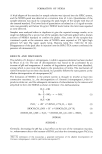
FORMATION OF NDE1A 159 (8) S.S. Mirvish, Formation of N-nitroso compounds: chemistry, kinetics and in vivo occurrence, Toxicol. AppL PharmacoL, 31,325-351 (1975). (9) T. Y. Fan and S. R. Tannenbaum, Factors influencing the rate of for•nation of nitrosomorpholine from morpholine and nitrite: acceleration by thicyanate and other anions, J. Agr. Food Chem., 21, 237-240 (1973). (10) B.C. Challis, A. Edwards, R. R. Hunma, S. A. Kyrtopoulos and J. R. Outram, Rapid formation of N-nitrosamines from nitrogen oxides under neutral and alkaline conditions, in E. A. Walker, M. Castegnaro, L. Griciute and R. E. Lyle, "Environmental aspects of N-nitroso compounds," op. cit., pp 127-142. (11) B.C. Challis, A. R. Butler, Substitution at an amino nitrogen, in S. Patai, "The Chemistry of the Amino group." Wiley Interscience: New York, New York, 1%8 Chapter 6, pp 277-345. (12) M. L. Douglass, B. L. Kabacoff, G. A. Anderson and M. C. Cheng, The chemistry of nitrosamine for•nation, inhibition and destruction,J. Soc. Cosmet, Chem., 29, 581-606 (1978).
Purchased for the exclusive use of nofirst nolast (unknown)
From: SCC Media Library & Resource Center (library.scconline.org)