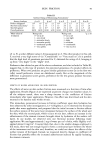
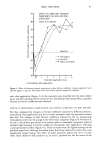
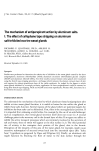
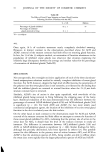
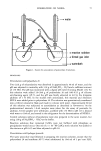
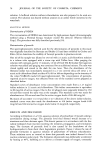
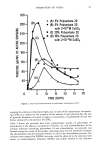
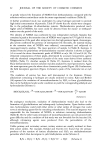
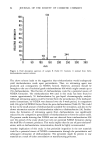
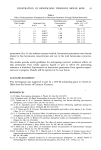
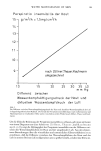
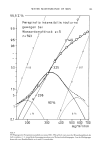
FORMATION OF NDE1A . 79 co 240 200 160 =. 120 IJ, J 40 o (A) 3% Polysorbate 20 ß (B) 3% Polysorbate 20 with 2x10'4M CuS04 ß (C) 20% Polysorbate 20 ß (D)10% Polysorbate 20 with 2x10'4M CuS04 0 5 10 15 2O 25 TIM E (DAYS) Figure 2. Rate of peroxide formation in polysorbate 20 solutions at 50øC. 30 exposing the solution to fluorescent light, and, in some of the experiments, incorporat- ing CuSO4 as a catalyst for the initiation of free radicals. It was observed that the rate of peroxide formation increased at higher concentration of polysorbate 20 and was further enhanced by the presence of CuSO4. Table I shows the peroxide data from representative studies of polysorbate 20 autoxidation in the absence and presence of mono-, di-, and triethanolamines. In the reaction solutions containing polysorbate 20 and ethanolamine, no peroxide was formed during the course of the studies, ind!cating some kind of interaction between the ethanolamine and the peroxide formed in situ by the autoxidation process. The solutions were assayed for NDEIA, but none could be detected in the solutions with mono- or triethanolamine. However, NDEIA was indeed formed in the solutions

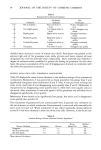
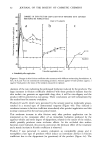
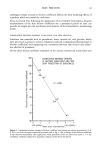
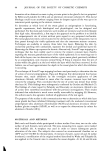
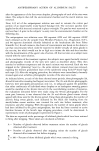
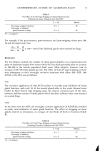
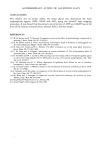
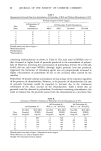
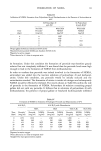
80 JOURNAL OF THE SOCIETY OF COSMETIC CHEMISTS Table I Representative Peroxide Data from Autoxidation of Polysorbate 20 With and Without Ethanolamine at 50øC Peroxide (mcg/ml of active oxygen) 3% Polysorbate 20 • Time Without (days) Ethanolamine MEA 2 3% Polysorbate 20 with Ethanolamine DEA 3 TEA 85% 4 TEA 98% 0 12 2 3 10 0 6 37 0 13 53 0 20 27 0 27 24 0 2 2 4 1 0 0 0 0 0 0 3 0 0 0 0 0 0 0 •Partially taken from data in Figure 2 2Monoethanolamine 3Diethanolamine 4Triethanolamine containing diethanolamine as shown in Table II. The total yield of NDEIA over 27 days increased at higher levels of peroxide produced in the autoxidation of polysor- bate 20. However, increasing the concentration of polysorbate 20 from 3% to 10% with CuSO4 did not yield more NDEIA, although higher peroxide level was produced. Apparently the formation of nitrosating agents was not proportionally increased in higher concentration of polysorbate 20 due to the inclusion effect exerted by the micelies. Polysorbate 20 should undergo autoxidation during storage of the solutions regardless of the presence of ethanolamines. However, in the presence of ethanolamines, the rate of peroxide formation would be expected to decrease due to the continuous termination of the chain reaction by the ethanolamines. Table I shows that no peroxide could be detected in polysorbate 20 solutions containing ethanolamine, this tends to indicate that the peroxide reacted with the ethanolamine at a rate faster than Table II Formation of NDEIA in Solutions of Polysorbate 20 and Diethanolamine at 50øC 3% Polysorbate 20 3% Polysorbate 20 With 2 x 10 -4 M Cu$O 4 10% Polysorbate 20 With 2 x 10 -4 M CuSO 4 No DEA With DEA No DEA With DEA No DEA With DEA Time Peroxide • NDEIA Peroxide • NDEIA Peroxide • NDEIA (days) (mcg/ml) (ng/ml) (mcg/ml) (ng/ml) (mcg/ml) (ng/ml) 0 12 ND • 14 ND 4 162 6 37 116 112 ND 285 290 13 53 186 110 334 125 310 20 27 218 75 416 67 288 27 24 224 33 462 57 382 34 -- -- 35 A 3 -- -- •Partially taken from data in Figure 2. Reported as active oxygen. •None detected at 3:1 noise-to-response ratio. 3Sample A for mass-spectrometric analysis.
Purchased for the exclusive use of nofirst nolast (unknown)
From: SCC Media Library & Resource Center (library.scconline.org)