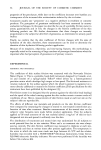
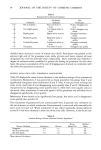
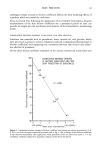
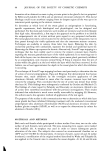
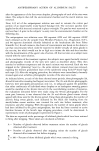
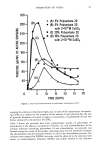
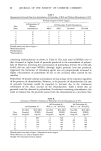
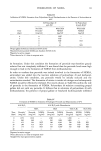
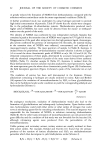
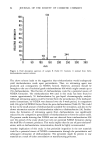
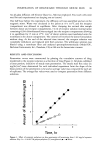
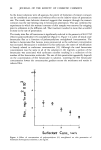
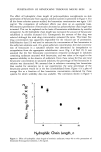
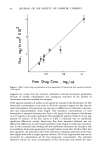
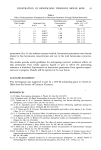
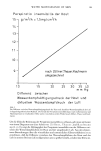
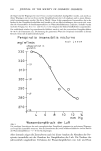
92 JOURNAL OF THE SOCIETY OF COSMETIC CHEMISTS I I I . 0.4 0'8 1.2 Free Drug Conc., mg/ml Figure 4. Effect of free drug concentration on skin penetration of benzocaine from aqueous solutions, 1.262 mg/ml. supports the notion that the nonionic surfactants reduced benzocaine penetration because of miceliar solubilization and consequent reduction of the number of benzocaine molecules available for transport. If the aqueous solutions of surface active agents are saturated with benzocaine, the free benzocaine concentration is the same in all of the solutions despite the fact that the total concentration of benzocaine can vary due to differences in surfactant concentra- tion and polyoxyethylene chain length. The estimated concentrations of total benzocaine in saturated solutions vary from 1.262 mg/ml in the absence of surfactant to 4.275 mg/ml in the polyoxyethylene (50) nonylphenol solution (Table I). A one way analysis of variance of the flux values in Table I confirmed that no statistically significant differences existed. Benzocaine flux from saturated solutions was not affected by differences in either polyoxyethylene chain length or surfactant concentra- tion. It was concluded that wetting and skin-surfactant interaction do not play a role in modulating benzocaine penetration through hairless mouse skin. If either effect had been operative, the penetration flux from solutions containing surfactant would have been higher than from a simple aqueous solution. All of the experimental data can be reconciled by consideration of the free benzocaine concentration. The saturated solutions contain the same concentration of free benzocaine and exhibit the same

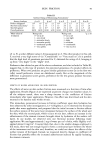
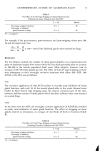
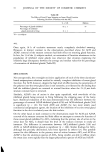
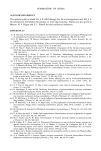
PENETRATION OF BENZOCAINE THROUGH MOUSE SKIN 93 Table I Effect of Polyoxyethylene Nonylphenols on Benzocaine Penetration Through Hairless Mouse Skin Polyoxyethylene Total Benzocaine Average Flux Chain Length, Surfactant Conc. Concentration, mg/hr. cm 2 x 10³ n % w/v M mg/ml _+ S.D. -- -- -- 1.262 60.0 _+ 3.9 9 1.4 0.0227 -- 59.1 ñ 3.2 15 0.2 0.00227 1.265 51.8 ñ 3.2 15 1.0 0.01135 2.168 67.5 - 8.3 15 2.0 0.0277 3.308 58.7 -+ 3.5 30 3.5 0.0227 -- 63.6 - 1.0 50 5.5 0.0227 4.275 58.5 _+ 7.0 penetration flux. In the solution systems studied, benzocaine penetration was directly related to free benzocaine concentration and not to the total benzocaine concentra- tion. Our studies provide useful guidelines for anticipating nonionic surfactant effects on skin penetration from totally aqueous liquids or gels in which the penetrating substance is dissolved. Experiments on benzocaine penetration from aqueous suspen- sions are in progress. Results will be reported in the near future. ACKNOWLEDGEMENT This investigation was supported in part by a 1979-80 scholarship grant to Umesh G. Dalvi from the Society of Cosmetic Chemists. REFERENCES (1) (2) (3) (4) (5) (6) (7) (8) (9) (lO) (11) B. Idson, Percutaneous absorption,J. Pharm. Sci., 64, 901-924 (1975). J. Scheuplein and I. M. Blank, Permeability of the skin, Physiol. Rev., 51,702-747 (1971). P. Grasso and A. B. G. Lansdown, Methods of measuring, and factors affecting, percutaneous absorption,J. Soc. Cosmet. Chem., 23,481-521 (1972). A. B. G. Lansdown and P. Grasso, Physico-chemical factors influencing epidermal damage by surface active agents. Brit. J. Dermatol, 86, 361-373 (1972). L.J. Vinson and B. R. Choman, Percutaneous absorption and surface active agents, J. Soc. Cosmet, Chem., 11,127-137 (1960). Z. T. Chowhan and R. Pritchard, Effect of surfactants on percutaneous absorption of naproxen I: Comparison of rabbit, rat and human excised skin. J. Pharm. Sci., 67, 1272-1274 (1978). A.J. Aguiar and M. A. Weiner, Percutaneous absorption studies on chloramphenicol solutions, J. Pharm. Sci., 58, 210-215 (1969). M. E. Stolar, G. V. Rossi and M. Barr, The effect of various ointment bases on the percutaneous absorption of salicylates. J. Amer. Pharm. Assoc. Sci. Ed., 49, 148-158 (1960). V. Shahi and J. L. Zatz, Effect of formulation factors on permeation of hydrocortisone through mouse skin,J. Pharm. Sci., 67, 789-792 (1978). H. Durrheim, G. L. Flynn, W. I. Higuchi and C. R. Behl, Permeation of hairless mouse skin I: Experimental methods and comparison with human epidermal permeation by alkanols,J. Pharm. $ci., 69, 781-786 (1980). R. B. Stoughton, "Animal models for in vitro percutaneous absorption", in Animal Models in Dermatology, M. I. Maibach, Ed. (Churchill Livingstone, New York, N.Y., 1975) p. 121-132.
Purchased for the exclusive use of nofirst nolast (unknown)
From: SCC Media Library & Resource Center (library.scconline.org)