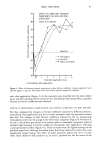
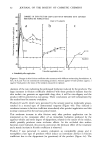
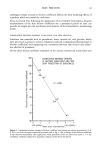
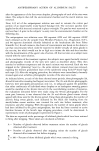
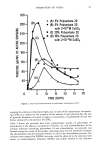
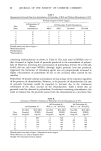
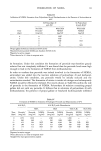
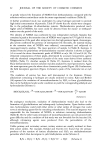
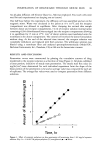
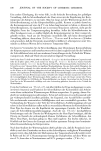
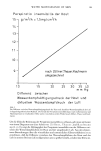
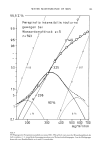
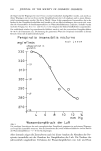
SKIN FRICTION 63 subsequent steady increase in friction coefficient reflects the slow hydrating effects of a product which acts mainly by occlusion. Thus, we found that, following the application of an emollient formulation, frequent measurements of the skin friction coefficient for a protracted period of time can provide an insight into the mechanism and duration of the formulation's moisturizing action. CORRELATION BETWEEN SENSORY EVALUATION AND SKIN FRICTION Lubricant raw materials such as petrolatum, heavy mineral oil, and glycerin, which were perceived as greasy in sensory evaluation, induced a substantial initial decrease in friction coefficient, thus supporting the correlation between skin friction and subjec- tive afterfeel of greasiness. On the three sensory attributes evaluated on the various commercial moisturizers and lOO .A CORRELATION BETWEEN CHANGES IN FRICTION COEFFICIENT AND SEN- SORY PERCEPTION OF GREASINESS ,C r 2= -0.995 E D, -2O -40 0 1 2 3 4 5 (not greasy) Mean score of greasiness (very greasy) Figure 5. Correlation between changes in friction coefficient and sensory perception of greasiness. A, B, C, D, E, and F are the same commercial products used in Fig. 4. The % change in skin friction coefficient is that observed immediately after application, while greasiness scores are taken from Table 3. r 2 is the correlation coefficient obtained by regression analysis and the line is the best fit.

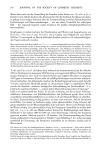
64 JOURNAL OF THE SOCIETY OF COSMETIC CHEMISTS surface lubricant cosmetic ingredients, only "greasiness" was found to correlate well with the immediate changes measured in skin friction coefficient, with a correlation coefficient of -0.995 (Figure 5). It is clear that the initial increase in skin friction coefficient is inversely proportional to the sensory perception of greasiness i.e., the higher the skin friction measured, the lower the greasiness rating obtained by tactile perception. Although the other sensory attributes evaluated (tackiness/stickiness and rate of product disappearance) did not correlate well with skin friction measurements, the sensory attributes measured do appear to interact with each other. For example, in general, the quicker that a product disappears, the less tacky and the less greasy it is perceived as being. But foremost, an overall preference is observed for those products which are perceived as less greasy. SUMMARY Changes in skin surface friction observed immediately after the use of different products, are inversely related to their perceived greasiness. Further, friction measure- ments made over an extended period of time (up to 6 hours) permit the assessment of the duration of hydration effects. Thus, measurement of friction coefficient can facilitate the screening of a large number of prototype formulations for the afterfeel attribute of greasiness, and for their moisturizing properties. Such measurement further permits the classification of emollient moisturizers into different categories according to their sensory and functional attributes. Some moisturizing products are perceived as non-greasy and, like water, increase friction coefficient immediately after application, but their hydration effects persist for a longer period of time. Other moisturizers are perceived as slightly or moderately greasy they induce a small or moderate increase in friction coefficient immediately after application, and this increase continues for a period of time thereafter because of their sustained hydrating effects. Finally, viscous lubricating emollients like petrolatum, heavy mineral oil, and glycerin can have a composite effect: they reduce the skin friction coefficient when applied, while eventually resulting in a delayed increase in friction due to the slow hydration induced by their potentially occlusive properties. ACKNOWLEDGEMENT We are grateful to Mr. B.C. Tillery, Manager, Vick R&D Publications, for editorial assistance in the preparation of this paper and to Ms. j. LaMattina and Ms. Nancy Penkin for their technical assistance. REFERENCES (1) S. Comaish and E. Bottoms, The skin and friction: deviations from Amonton's Laws, and the effects of hydration and lubrication, Br.J. Dermatol., 84, 37-43, 1971. (2) J. S. Comaish, P. R. H. Harborow and D. A. Hofman, A hand-held friction meter, Br.J. Dermatol., 89, 33-35, 1973. (3) J. K. Appeldoorn and Gabriel Barnett, Frictional aspects of emollience, Proc. Sci. Sect. Toilet Goods /lssoc., 40, 28-35, 1963.
Purchased for the exclusive use of nofirst nolast (unknown)
From: SCC Media Library & Resource Center (library.scconline.org)