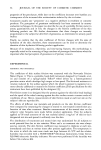
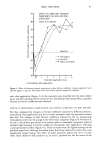
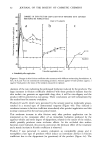
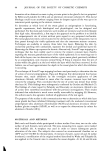
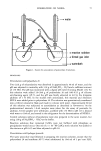
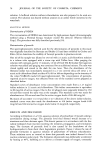
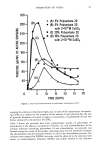
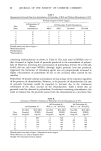
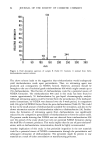
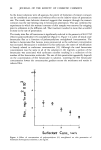
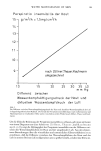
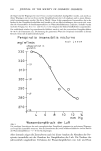
90 JOURNAL OF THE SOCIETY OF COSMETIC CHEMISTS As the donor solutions were all aqueous, the extent of hydration of stratum corneum can be considered as constant and without effect on the relative values of penetration rate. The steady state behavior observed suggests that transport through the stratum corneum was the rate limiting step in benzocaine penetration. This was confirmed by experiments in which the stratum corneum of skin samples was removed by stripping prior to utilization in the diffusion cell. That treatment resulted in more than a tenfold increase in the rate of penetration. The steady state flux of benzocaine is significantly reduced in the presence of 0.0227 M (2%w/v) polyoxyethylene (15) nonylphenol (Figure 1). Figure 2 is a plot of steady state benzocaine flux as a function of polyoxyethylene nonylphenol concentration. The decline in benzocaine flux became more pronounced as the surfactant concentration was increased. Benzocaine is solubilized by this surfactant the extent of solubilization is linearly related to surfactant concentration (15). Although the total benzocaine concentration was the same in all of the solutions (1.262 mg/ml), a portion of the benzocaine was associated with surfactant micelies resulting in a reduction of the number of free benzocaine molecules. The rate of skin penetration apparently depends on the concentration of free benzocaine in solution. Lowering the free benzocaine concentration lowers the concentration gradient across the membrane and results in reduced flux. I I I I J Surfactant Conc., %w/v Figure 2. Effect of concentration of polyoxyethylene (15) nonylphenol on skin penetration of benzocaine from aqueous solutions, 1.262 mg/ml.

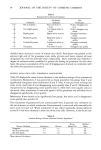
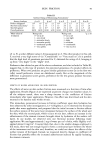
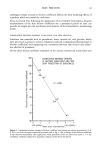
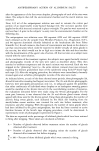
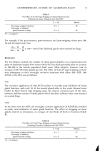
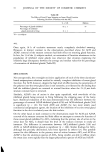
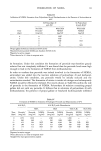
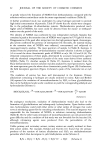
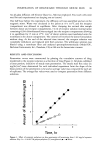
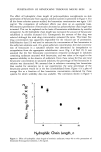
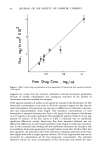
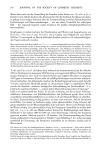
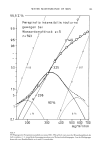
PENETRATION OF BENZOCAINE THROUGH MOUSE SKIN 91 The effect of hydrophilic chain length of polyoxyethylene nonylphenols on skin penetration of benzocaine from aqueous solution systems is presented in Figure 3. For all the donor solution systems studied, the benzocaine concentration was again 1.262 mg/ml. The comparison of surfactant effects was done on an equimolar basis. Percutaneous penetration of benzocaine decreased as polyoxethylene chain length was increased. This can be explained on the basis of benzocaine solubilization by miceliar entrapment. As the hydrophilic chain length was increased, the amount of benzocaine solubilized in micelies increased (15). Consequently the amount of free drug was reduced although the total drug concentration remained the same. This lower free drug concentration was apparently responsible for the reduced rate of penetration. Solubilization data (15) was used to estimate the concentration of free benzocaine in the surfactant solutions used. At a given surfactant concentration, the total concentra- tion of benzocaine in a saturated solution was determined by interpolation or extrapolation from the appropriate solubilization curve. (Fig. 4 of Ref. 15). It was assumed that the free benzocaine concentration remained unchanged in solutions containing surfactant saturated with benzocaine, and was taken to be equal to the aqueous solubility in the absence of surfactant. From these values for free and total benzocaine concentration in saturated solutions, the percentage of free benzocaine in solution was determined. We assumed that in solutions containing less benzocaine than needed for saturation (as in our experiments), the same percentage of the benzocaine present would be in the free (unsolubilized) form. Figure 4 is a plot of average flux as a function of free benzocaine concentration calculated for those systems for which solubility data was available. The correlation shown in Figure 4 E I I I I0 30 50 Hydrophilic Chain Length, n Figure 3. Effect of hydrophilic chain length of nonionic surfactant, 0.0227 M on skin penetration of benzocaine from aqueous solutions, 1.262 mg/ml.
Purchased for the exclusive use of nofirst nolast (unknown)
From: SCC Media Library & Resource Center (library.scconline.org)