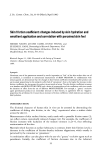
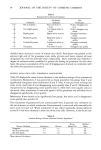
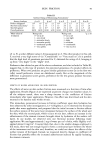
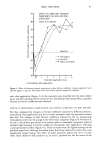
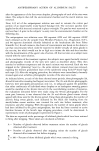
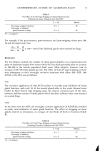
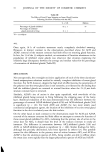
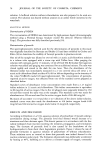
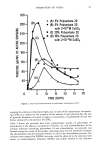
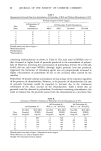
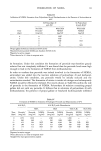
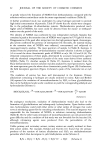
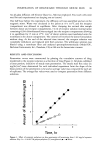
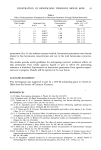
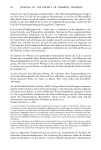
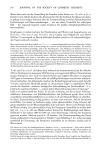
FORMATION OF NDE1A 83 100 42 901 A) Polysorbate 20 and Diethan 8O 7o• •6 n 6O 85 91 5O 103 4O II il 116127 o ....... ,, .,..&,,.,I. II, 3 ! ,,, ,,hl, I,,,,,.,• •,,. ,.•..,,,,•.,,I,,.:.:.:........,.,.......... 20 40 60 80 100 120 140 160 m/e lOO 90 8o 70 60 50 40 30 20 lO o 42 20 40 B) H202 and Diethanolamine 91 _ 103 ,8.,5,. J 116 127135 149 ,,, i' ', ,', i' i, , ,,, ', , , ......... [ .... ' ..... , 80 100 120 140 160 m/e Figure 3. Mass spectra of samples obtained by H.P.L.C. area collection of material eluting at the retention time of NDEIA. Table V High-resolution Mass Spectrometry of Sample A Error Mass Found Composition (mass unit) 91.0511 C2H7N202 +0.0003 103.0504 C•HTN202 - 0.0004 104.0708 C4H•oNO2 -- 0.0004

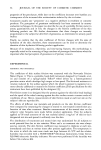
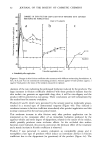
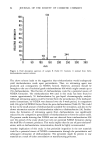
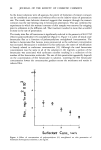
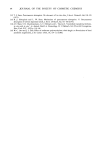
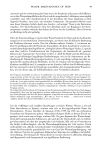
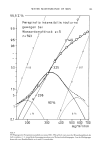
84 JOURNAL OF THE SOCIETY OF COSMETIC CHEMISTS 100: 90 80 7O 60 50 4O 3O 20. 10- 0 134 113 ......... , ......... ,.11.1..I 0 50 100 244 150 200 250 300 350 m/e Figure 4. Field desorption spectrum of sample B (Table IV, footnote 3) isolated from H202- diethanolamine reaction solution. The above scheme leads to the suggestion that triethanolamine would analogously yield triethanolamine oxide upon peroxidation. Thus, no nitrosating agent was produced and consequently no NDE1A formed. However, attention should be brought to the use of technical grade triethanolamine 85% which might contain up to 15% diethanolamine. This fraction of diethanolamine could be a potential source of NDEIA formation. The triethanolamine 85% used in this study has been found to contain approximately 7% diethanolamine by gas-liquid chromatography analysis. Although nitrosating agents could be formed from the peroxidation of the diethanoi- amine contaminant, no NDE1A was detected over the 4-week period, in comparison with 224 ng/ml of NDE1A formed from the pure diethanolamine (Table II). This could be due to the small amount of diethanolamine available for nitrosation, and also to the slower nitrosation reaction of triethanolamine relative to diethanolamine (10). Further- more, the formation of nitrosating agents from diethanolamine was significantly reduced by the competitive peroxidation of triethanolamine to form the amine oxide. The present results showing that NDEIA was not detected from triethanolamine 85% over the period of the study should not rule out potential NDEIA formation during the shelf-life of cosmetic products. This study implies that the use of pure triethanol- amine, with no diethanolamine contamination, should be highly recommended. Another implication of this study is that perioxide impurities in the raw materials could be a potential source of NDE1A contamination through the peroxidation and subsequent nitrosation of diethanolamine. The peroxides might be present in raw materials as a result of either autoxidation or manufacturing processes.
Purchased for the exclusive use of nofirst nolast (unknown)
From: SCC Media Library & Resource Center (library.scconline.org)