j. Soc. Cosmet. Chem., 33, 51-74 (March/April 1982) Analysis of paint-on artificial nails MARTIN FULLER, Lee Pharmaceuticals, P.O. Box 3836, South E1 Monte, California 9I 733. Received July I, 1981. Synopsis A scheme for the analysis of self-curing nail extenders (also called paint-on artificial fingernails) is described. The scheme takes advantage of instrumental methods to provide rapid qualitative and quantitative results. Analyses of nail extender products on the market since about 1975 indicate that methacrylate resins and polymers dominate the field, with cure initiated by a benzoyl peroxide-tertiary aromatic amine system. The methods, and the scheme incorporating them, provide rapid and reliable determination of the compositions of self-curing artificial nail products currently on the market. The scheme provides improvements over previously recommended procedures. INTRODUCTION Many paint-on artificial fingernails have been introduced to the market over the past ten or more years. The earliest products were based on formulations similar to those supplied to the dental trade for use in acrylic dentures. These materials commonly consisted of methyl methacrylate liquid monomer and poly(methyl methacrylate) powder. The powder contained an organic peroxide polymerization initiator, and the liquid contained a tertiary aromatic amine promoter or accelerator. In use, the liquid and powder were mixed to form a semi-fluid blend. This blend was then painted or formed over the natural nail and onto a shield placed to allow extension of the artificial nail to the desired length. Some of these early formulations could be fashioned into satisfactory artificial nails, but there was considerable room for improvement. Also, the methyl methacrylate monomer posed problems. It has a strong odor is an irritant and can act as a sensitizer (1). Paint-on artificial nails manufactured after 1974 would not be expected to contain methyl methacrylate (2). Nonetheless these formulations are based largely on acrylic systems. Some are as simple in concept as the earlier products, but substitute methacrylate esters of slightly higher molecular weight, such as ethyl, for the methyl methacrylate. Other formulations are more complex. A variety of ingredients, including several different monomers, have been used. Among these formulations there are considerable differences. Thus it is of interest to both the consumer and the cosmetic industry to know the composition of any given artificial nail product. The information which law requires be printed on the package is helpful but insufficient for exact 51

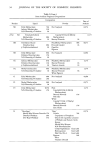
52 JOURNAL OF THE SOCIETY OF COSMETIC CHEMISTS identification or quantitative estimation. Also, it is of course important to be able to check the actual against the stated composition. The general methods of analysis of paint-on artificial fingernails (also called nail extenders) are described by Black (3). These methods are useful, but are oriented toward products with a limited range of compositions. In addition, they fail to include one of the most powerful techniques for obtaining rather quickly both qualitative and quantitative information about the composition of nail extenders, namely proton nuclear magnetic resonance (NMR). With the addition of NMR, and some refinement of the other methods, even fairly sophisticated formulations may easily be analyzed at least semi-quantitatively. Obtaining precise quantitative data, as always, requires more painstaking work. The work reported here had several objectives: 1. To check the general usefulness and reliability of the methods recommended by Black. 2. To refine, improve, and extend these methods where feasible. 3. To add NMR to the methods. 4. To determine the compositions of as many paint-on artificial nail formulations as were readily obtain- able. EXPERIMENTAL MATERIALS The artificial nail products were all purchased as kits from retail outlets such as drug and variety stores, or suppliers to the salon trade. The kits were obtained not more than a few weeks prior to the dates of analysis shown in Table I. With but one exception these kits consisted of two main components, a powder and a liquid. Except as otherwise noted, solvents and chemicals used were either Fisher Scientific HPLC or Certified Grade, orJ. T. Baker Reagent Grade, and were used without further purification. Table I Some Artificial Fingernail Compositions Composition Date of Product Liquid Powder Analysis A Methyl Methacrylate 99% Poly(Methyl Methacrylate) 06/75 N,N-Dimethyl-p-Toluidine 1% Methyl Phthalyl Ethyl Glycolate Benzoyl Peroxide B Ethyl Methacrylate 97% Copoly(50 Ethyl:50 Methyl 10/78 Methyl Methacrylate 1.5% Methacrylates) N,N-Dimethyl-p-Toluidine 1.5% Benzoyl Peroxide 3% Isobutyl Methacrylate 87% Poly(Ethyl Methacrylate) 98% 05/79 Ethylene Dimethacrylate 11% Benzoyl Peroxide 2% 02/80 N,N-Dimethyl-p-Toluidine 1-2% Titanium Dioxide Trace Isobutyl Methacrylate 76.5% n-Butyl Methacrylate 1.3% Ethylene Dimethacrylate 16.2% N,N-Dimethyl-p-Toluidine 6.0% Butylated Hydroxytoluene 500 ppm Poly(Ethyl Methacrylate) 97.5% Benzoyl Peroxide 2.23% Titanium Dioxide 0.23% 06/81
Purchased for the exclusive use of nofirst nolast (unknown)
From: SCC Media Library & Resource Center (library.scconline.org)