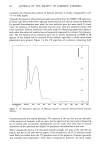
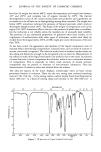
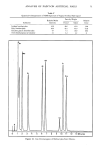
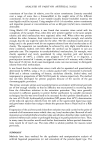
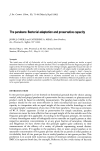
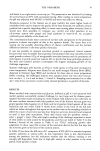
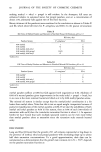
ANALYSIS OF PAINT-ON ARTIFICIAL NAILS 55 Table I (Cont.) Some Artificial Fingernail Compositions Product Composition Date of Liquid Powder Analysis S2 Ethyl Methacrylate 44% Poly(Ethyl Methacrylate) 03/78 Isobutyl Methacrylate 44% Benzoyl Peroxide 02/80 Ethylene Dimethacrylate 10% Pigment N,N-Dimethyl-p-Toluidine 2% S3 Methyl Methacrylate 98% Copoly(80 Methyl: 20 Ethyl 12/78 N,N-Dimethyl-p-Toluidine 2% Methacrylates) Benzoyl Peroxide Opaquer U1 Methyl Methacrylate 95% Copoly(65 Mehyl: 35 Ethyl 07/79 Acetone 2% Methacrylates) 90% Diethyl Phthalate 2% Diethyl Phthalate 8% N,N-Dimethyl-p-Toluidine 1% Benzoyl Peroxide 3% Pigment or Dye U2 Methyl Methacrylate %)% Not Analyzed 02/80 N,N-Dimethyl-p-Toluidine 1% V n-Butyl Methacrylate 91% Not Analyzed 02/75 Ethylene Dimethacrylate 7% N,N-Dimethyl-p-Toluidine 2% INSTRUMENTS The infra-red spectrophotometer was a Perkin-Elmer Model 283B double-beam optical null instrument, equipped with the Perkin-Elmer Model 3500 Infra-Red Data Station. The UV-visible spectrophotometer was a Perkin-Elmer Model 554. The gas chromato- graph was a Hewlett-Packard Model 5752 equipped with thermal conductivity detector and Shimadzu Chromatopac C-R1A computing integrator. The NMR spectrometer was a Perkin-Elmer Model R12B equipped with double resonance accessory. The energy-dispersive x-ray spectrometer was an EDAX Model 707B equipped with ECON detector and Model 183A preamplifier, fitted to a JEOL JSM-U2 scanning electron microscope. The thermogravimetric analyzer was a du Pont 951 module coupled to a du Pont 990 programmer-recorder. METHODS AND SCHEME OF ANALYSIS 1. Powder. (a) Appearance. The color, odor, fineness, and feel of the powder were noted. (b) Infra-red spectrum. Infra-red spectra were determined from thin films cast onto polished KC1 discs from dilute solutions of the powders in acetone or methylene chloride. The films were dried at 105-115øC for several minutes, and were either clear or very slightly hazy. A blank KC1 disc was used as reference. (c) NMR spectrum. Dilute solutions of the powders in deuterochloroform (Aldrich Gold Label, 99.8 atom-% D) were filtered through a plug of surgical cotton directly into

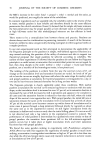
56 JOURNAL OF THE SOCIETY OF COSMETIC CHEMISTS NMR sample tubes. Tetramethylsilane was used as internal reference, usually with field/frequency lock. Electronic integration allowed quantitative estimation of the relative amounts of the major constituents (4). Copolymer compositions may also be estimated in this way (5). (d) Solvent extraction. About 1 g of the powder was placed in a 50 ml conical flask, about 25 ml of methanol (or in some cases ethyl ether) added, and the contents of the' covered flask were stirred for 30-60 minutes. The mixture was then filtered. A portion of the flitrate was diluted as required with the pure solvent, and a UV spectrum obtained from this diluted solution, using pure solvent as a reference. The bulk of the flitrate was evaporated in a stream of dry nitrogen until no more solvent could be removed. An NMR spectrum was determined from a filtered deuterochloroform solution of any residue. Where indicated, adsorption column chromatography on silica gel, with solvents chosen on the basis of thin-layer chromatographic experiments, was used to separate the extracted material into its components. (e) Methylene chloride insolubles. About 0.5 g of the powder was mixed with about 40 ml of methylene chloride, and the mixture agitated until all soluble material dissolved. It was then centrifuged for one-half hour at approximately 1800 x G relative centrifugal force. The supernatant solution was decanted from any residue. Residues, if present, were then combined and washed twice with fresh solvent by centrifugation and decantation. The final residue was dried for one hour at 80øC, and mounted (using double-sided sticky tape on a graphite stud) for examination in the scanning electron microscope. X-ray emission spectra were obtained using a TV raster scan, usually at an electron beam accelerating voltage of 25 kV. (f) Peroxide content. Benzoyl peroxide at levels greater than about 1% by weight was determined by NMR. When a more precise analysis was desired, ! g samples of powder were weighed into 125 ml conical flasks and dissolved in 40 ml acetone. The solution was purged for three minutes with carbon dioxide (about 15 ml/min). One milliliter of freshly-prepared 30% aqueous iodate-free potassium iodide was then added, thoroughly mixed with the acetone solution, and the mixture was allowed to stand under a blanket of carbon dioxide for fifteen minutes. Ten milliliters of carbon dioxide-saturated water was then added, and the liberated iodine titrated with 0.01 N sodium thiosulfate to the disappearance of the yellow color. Five minutes was taken as the measure of end point permanence (6). (g) Thermogravimetric analysis. Non-pyrolyzable matter was determined thermograv- imetrically, using approximately 25 mg samples, a heating rate of 10 deg/min, and a final temperature of 700øC. Any residue was mounted with double-sided sticky tape on a graphite stud, and its x-ray emission spectrum determined. 2. Liquid. (a) Appearance. The color, odor, and relative viscosity were noted. (b) Density. Black (3) recommends determination of the density when analyzing nail extender liquids. The data in Table II indicate densities to be of marginal usefulness in such analyses. Thus they were generally not determined in this work. Where significant, they are best determined using calibrated ! or 2 ml pycnometers. Use of a volumetric pipet, as recommended by Black, is less tedious but can give unreliable results. Such
Purchased for the exclusive use of nofirst nolast (unknown)
From: SCC Media Library & Resource Center (library.scconline.org)