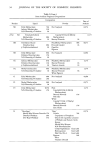
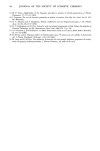
THE PARABENS 79 sub-batch in an eight-ounce screw-cap jar. The preservative was dissolved by heating for several hours at 60øC with occasional mixing. After cooling to room temperature, the pH was adjusted with 4N HC1 or NaOH and water was added to 100.0 g. Emulsions prepared in this fashion are of poor stability but when higher levels of emulsifiers were used to improve the quality of the base formulas, the addition of each paraben had a specific degrading effect, in some cases causing phase inversion. Since it would have been pointless to compare, say, methyl and ethyl parabens in an oil-in-water system with propyl and butyl parabens in water-in-oil, we accepted uniformly poor stability as the lesser evil. The concentration (basis water content) of nutrient salts and glucose in the prototype products is about one-eighth of that in the aqueous 'broths. The intent here is to swamp out the possibly distorting effects of chance nutrification and the nutrient differences inherent in the three product formulas. It was not possible to measure inoculum growth in unpreserved control systems because these were invariably found grossly contaminated with stray microbes but the rapid growth to about 107/g of recognizable inoculum bacteria and the persistence of mold spores in poorly preserved systems left no doubt that these prototype products, like their real cosmetic product counterparts will support damaging growth of the challenge organisms. Systems challenged with bacteria at 105/g or mold spores at 103/g were incubated at room temperature. Aliquots were diluted in one tenth strength Nutrient Broth (BBL), dispersed in Nutrient Agar (BBL) and incubated for three days at room temperature before counting. All challenged systems were sampled about one hour after inocula- tion, on day 1, 2, 3 or 4 and on days, 7, 14 and 21. Sampling was terminated on or after day 7 only if two successive counts clearly showed persistence or growth of bacteria. RESULTS Water nutrifled with mineral salts and glucose, buffered at pH 6.7 and saturated with methyl paraben successfully resisted challenge by two fungi and by thirteen gram- negative bacterial strains including the most resistant wild isolates in our collection. In the same medium saturated with ethyl paraben, five of the thirteen bacteria grew out propyl paraben failed against ten of them and butyl paraben failed against all but one bacterium and one mold. Table V shows these results in the form of the kill time which we define throughout this report as the earliest time in the sampling schedule at which the count of survivors was less than 10/g (no survivors detected) and remained so until 21 days after inoculation. These data clearly rank the parabens: methyl ethyl propyl butyl. (They also imply a ranking of the challenge organisms in terms of their ability to resist attack by the parabens, and they are listed in Table V in this fashion.) Several of the entries in Table V are "G(A)" indicating growth after adaptation. In these cases 95% or more of the inoculum died in the first few days but the survivors grew to the limit of the nutrient system. In Table VI we show the kill time of P. aeruginosa ATCC//9721 in saturated aqueous paraben solutions at various pH's. In this experiment there is less discrimination among the parabens, but the indication remains that the efficacy ranking is not strongly pH dependent from low to high pH, methyl or ethyl paraben is the most potent, butyl paraben is least.

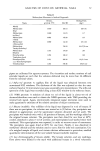
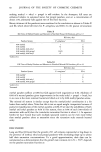
80 JOURNAL OF THE SOCIETY OF COSMETIC CHEMISTS Table V Kill Time of Parabens at Saturation in Nutrient-Buffer Solution pH 6.7 Kill time, days* Methyl Ethyl Propyl Butyl Microbe Origin Code Paraben Paraben Paraben Paraben Serratia marcescens Wild ED-2 7 G G Pseudomonas aeruginosa Wild MEM 1 G G Pseudomonas aeruginosa Wild BB-1A 1 G(A) G Enterobacter hafnia Wild LSC 1 G(A) G Serratia liquifaciens Wild T-1 1 G(A) G Pseudomonas cepacia Wild RS 7 7 G Pseudomonas aeruginosa Wild SM-5 4 14 G Pseudomonas aeruginosa ATCC ff9721 4 14 G Serratia rubidaea Wild CW-! 4 4 G Pseudomonas putida Wild SM-6 1 ! G Enterobacter cloacae Wild PLS-2 ! 1 1 Escherichia coli ATCC //25922 Enterobacter hafnia Wild SG 4 14 14 Aspergillus niger ATCC //16404 4 4 4 Penicillium species Wild 7 ! 7 G G G G G(A) G G G G G G(A) G(A) 14 21 1 *G indicates heavy growth G(A) indicates growth preceded by 95% or greater kill. Table VI Kill Time of Parabens at Saturation in Nutrient-Buffer Solution at Various pH's Challenged with Pseudomonas aeruginosa ATCC 319721 Kill time, days Methyl Ethyl Propyl Butyl pH Buffer x Paraben Paraben Paraben Paraben 5.4 Malic acid 1 1 1 G(A) 6.7 Phosphate 1 G(A) G(A) G(A) 7.7 Tris-Phosphate 1 1 G(A) G(A) 8.6 Tris-Glycine 2 1 1 1 1 XApart from the buffer changes and substitution of glycine for NH4 +, the nutrients are as given in Table 1. 2In this solution, glycine is also the source of nitrogen. Table VII shows the kill time of ED-2, a very resistant isolate identified as Serratia marcescens, in neutral mineral oil and peanut oil emulsions and in the shampoo, with and without nutrients with 0.8% nominal paraben level in all cases. In the mineral oil emulsion the methyl, ethyl and propyl parabens readily dissolve to this extent at 60øC but crystallize out in part on standing at room temperature these systems are at saturation at about 0.6%. Re-precipitation does not occur with butyl paraben in the mineral oil emulsion nor with any of the parabens in the peanut oil emulsion or the shampoo these systems are at or below saturation. In the nutrifled systems, only methyl paraben kills this organism in the emulsions in the shampoo even methyl paraben fails to check its growth. In the absence of nutrient the preservatives do better in general methyl and ethyl parabens are effective in the emulsions but propyl and butyl parabens still fail, and in the shampoo all four parabens fail.
Purchased for the exclusive use of nofirst nolast (unknown)
From: SCC Media Library & Resource Center (library.scconline.org)