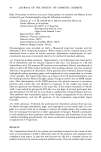
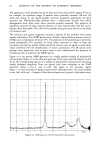
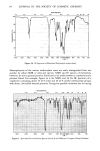
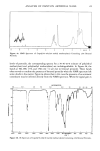
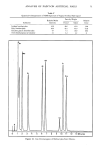
ANALYSIS OF PAINT-ON ARTIFICIAL NAILS 73 constituent of less than 1% relative, even for minor constituents.' Linearity extended over a range of more than a thousandfold in the weight ratios of the different constituents. In the absence of non-volatile (usually hexane-insoluble) material, the neat liquids could be injected. Using samples of 0.5-2.0 microliter, minor constituents and impurities present at concentrations as low as 400 ppm (wt/wt) were consistently detectable. Using Black's GC conditions, it was found that retention times varied with the complexity of the sample. Thus, when they were present together in the same sample, toluene and ethyl methacrylate were separated rather well. When either was present without the other, however, their retention times were similar enough, and variable enough, that the one might be taken for the other. The GC conditions stated above as being used in the present work do not separate toluene from ethyl methacrylate at all cleanly. The separation can nonetheless be achieved by only slight modifications in these conditions. Indeed, with little effort the method can be adapted to suit any particular case. The impurities in tetrahydrofurfuryl methacrylate, for example, were cleanly separated and nicely quantitated by using injection port and detector temperatures of 150øC, a column oven program of 75-225øC at 15 deg/min, a post-injection interval of I minute, an upper limit interval of 4 minutes, with a helium flow rate of 25 ml/min. In all cases investigated, some care was necessary to distinguish toluene from ethyl methacrylate. It was found that the methacrylate esters could also be separated and quantitatively determined by HPLC, using a 25 cm column packed with 5 micrometer Lichrosorb SI-60 and a solvent consisting of hexane, methylene chloride, diethyl ether, and isopropanol in proportions of 500:250:250:4 parts by volume respectively. The method was not fully developed for present purposes because of the success of the gas chromatographic procedure. The tertiary aromatic amines used as polymerization accelerators with benzoyl peroxide are of low enough volatility so that no difficulty was encountered in recovering them from the chloroform solutions in the extraction procedure. They were generally recovered in sufficient quantity to permit further purification by suitable microscale techniques, but this was never found to be necessary for their positive identification. In the case of N,N-di(2-hydroxyethyl)-p-toluidine (MP greater than 48øC), determination of the infra-red spectrum directly from the melt or the supercooled liquid was easier and gave better results than trying to obtain the spectrum from a Nujol mull or a KBr pellet. Evaporation of the acid-extracted chloroform solution was easily carried to the point of removal of all monomers more volatile than, say, hexyl methacrylate. Removal of such monomers as tetrahydrofurfural methacrylate and ethylene dimethacrylate could not be achieved without such undue or prolonged heating as to partly polymerize them. Thus, in many cases, the residue would need further fractionation before spectral determina- tions would be of much use. The extra effort is seldom justified, for reasons noted previously. SUMMARY Methods have been outlined for the qualitative and semiquantitative analysis of artificial fingernail preparations (or nail extenders) of the powder-liquid type. The

74 JOURNAL OF THE SOCIETY OF COSMETIC CHEMISTS methods have been used to determine the approximate compositions of a number of nail extender products. The compositions found for many of these products represent not much change from the early methyl methacrylate-based systems. Analysis of products, and mixtures, of known composition indicates the methods to be reliable and capable of moderate quantitative precision. It may be noted in passing that, with appropriate modification, the methods and the scheme incorporating them can be adapted to the analysis of other materials, such as dental composites, certain adhesives, etc. ACKNOWLEDGEMENTS The author would like to thank Craig Colby, Wendell Miyaji, and Barbara Belmont for their help with some of the experimental work and Lee Pharmaceuticals for the encouragement and support. REFERENCES (1) A. A. Fisher, Contact Dermatatis, (Lee & Febiger, Philadelphia, 1968) pp 62, 170-171. (2) Food and Drug Administration, Seizure Actions, FDA Consumer, 8 No. 7, p 37 No. 9, p 37 No. 10, p 36 (1974). (3) Roderick E. Black, Analysis of Nail Extenders, in Newburger's Manual of Cosmetic Analysis, 2nd ed., A.J. Senzel, Ed., (Association of Official Analytical Chemists, Inc., Washington, DC, 1977), Ch. 8, pp 70-71. (4) See, for example, F. Kalser, Quantitative Analysis by NMR Spectroscopy, (Academic Press, London, 1973) or D. E. Leyden & R. H. Cox, Analytical Applications OfNMR, (Wiley-Interscience, New York, 1977). (5) J. Haslam, H. A. Willis, and D.C. M. Squirrell, Identificaton and Analysis of Plastics, 2nd ed., (Butterworth, London, 1972), p 278 if. (6) Lee Pharmaceuticals Standard Test Method 2-22, Peroxide content of polymer powders. Experiments have shown that the acetone does not interfere under these conditions. The method is not adequate for peroxides which react with iodide much less rapidly than benzoyl. (7) See for example J. Chiu, Applications of thermogravimetry to the study of high polymers, Proceedings of the Applied Polymer Symposia, No. 2, pp 25-43 (1966). (8) G. F. L. Ehlers and E.J. Soloski, Thermogravimetric analysis of polymers in air, Report 1978, AFML-TR-78-64 (Air Force Materials Lab., Wright-Patterson AFB, OH, USA) No. AD-A070669, from NTIS. (9) Frank A. Bovey, Nuclear Magnetic Resonance Spectroscopy, (Academic Press, New York, 1969), pp 143-144. (10) Food and Drug Administration, private communication dated March 8, 1977 received Jan. 24, 1980.
Purchased for the exclusive use of nofirst nolast (unknown)
From: SCC Media Library & Resource Center (library.scconline.org)