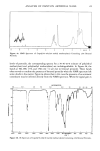
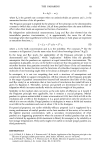
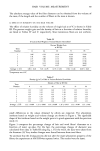
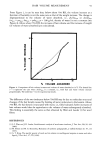
HAIR VOLUME MEASUREMENT 91 From Figure 2, it can be seen that, below about 75% RH, the volume increase as a function of humidity is not the same rate as that of the weight increase. The change is disproportional to the volume of water absorbed, i.e., dv/dwn2o or dv/dvn2o (Wn,o = PVH2O, dwn,o = pdvH,o, P = 1.00 g/ml, density of water) is not a constant (see Figure 4). Above about 75% RH, the increase of hair volume and the increase of weight (or volume of water absorbed) are coincidental. 2O IO 20 % VOLUME ABSORBED Figure 4. Comparison of hair volume increase and volume of water absorbed at 21øC. The dotted line ( ..... ) represents the case when dv/dVl•,O is a constant, i.e., both hair and water volume increase proportionally. The solid line (--) is the experimental results. The difference of the two isotherms below 75% RH may be due to molecular structural changes of the hair keratin caused by binding of water molecules to the keratin. Above 75% RH, the hair keratin is saturated with water, i.e., fully hydrated futher increases of hair volume would then be equivalent to the volume of water subsequently absorbed. This finding is essentially the same as that obtained by Watt and Leeder (1) for wool fibers. REFERENCES (1) I. C. Watt andJ. D. Leeder, Stoichiometric analysis of wool-water isotherm,J. Text. Inst., 59, 353-364 (1962). (2) M. Breuer and M. G. Kennerley, Hydration of synthetic polypeptides, J. Colloid Interface Sci. 37, 124 (1971). (3) A. T. King, The specific gravity of wool and its relation to swelling and sorption in water and other liquid,J. Text. Inst., 17, T53 (1926).

92 JOURNAL OF THE SOCIETY OF COSMETIC CHEMISTS (4) E. Buras,Jr., A. Fookson and M. Breuer, Precise measurements of humidity effects on human scalp hair diameter, Presented at the 1979 International Hair Research Conference, Hamburg, Germany. (5) L. B. Rockland, Saturated salt solutions for static control of relative humidity between 5 ø and 40øC, Anal. Chem., 32, 1375-1376 (1960). (6) P Alexander and F. R. Hudson, IVool--Its Chemistry and Physics, 2nd Ed. (Franklin Publishing Co., New Jersey, 1963) p. 87.
Purchased for the exclusive use of nofirst nolast (unknown)
From: SCC Media Library & Resource Center (library.scconline.org)