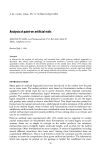
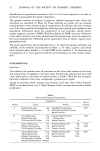
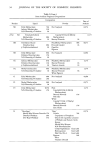
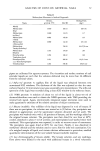
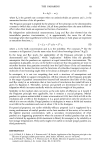
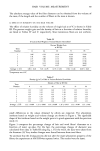
THE PARABENS 81 Table VII Kill Time of 0.8% Paraben in Prototype Products at pH 6.5 Challenged with ED-2 • Medium Paraben Kill time, days No Nutrient 2 Nutrifled Mineral Oil Emulsion Methyl 3 Ethyl 3 Propyl 3 Butyl 1 1 G(A) G(A) 2 G(A) G G Peanut Oil Emulsion Methyl Ethyl Propyl Butyl Shampoo Methyl Ethyl Propyl Butyl •Serratia marcescens, wild isolate. 2Orthophosphate buffer. 3Saturated. In the mineral oil emulsion at saturation the performance of the parabens is not very different from that in water. In Tables VIII and IX we show kill time data on the first three parabens at saturation in the peanut oil emulsion and in the shampoo. Performance is marginally better in the peanut oil emulsion than in water, but the Table VIII Kill Time of Parabens at Saturation in Nutrifled Peanut Oil Emulsion, pH = 6.5 Microbe • Kill time, days 2 Methyl Ethyl Propyl Paraben Paraben Paraben 1.0-1.2% 0.8-1.0% 1.2-1.6% A. niger, ATCC 16404 2 2 7 P. aeruginosa, ATCC 9721 1 1 1 EB-1 1 2 1 ED-2 1 G G •EB-1 and ED-2 are wild strains of Serratia marcescens. •Percentages are approximate concentrations. Table IX Kill Time of Parabens at Saturation in Nutrifled Shampoo, pH 6.5 (ca. 2.5% in all cases) Kill time 2 Methyl Ethyl Propyl Microbe • Paraben Paraben Paraben A. niger, ATCC 16404 ld P. aeruginosa, ATCC 9721 lh EB-1 lh ED-2 lh •EB-1 and ED-2 are wild strains of Serratia marcescens. 2Days or hours as indicated. ld lh lh lh ld lh G(A) G(A)

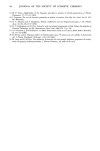
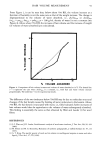
82 JOURNAL OF THE SOCIETY OF COSMETIC CHEMISTS ranking methyl ethyl propyl is still evident. In the shampoo, kill rates are enhanced relative to saturated water, but propyl paraben, even at a concentration of about 2.5%, ultimately fails against two of the three bacteria. Binary mixtures of the parabens were examined in the emulsions as shown in Tables X and XI, which show kill times for P. aeruginosa and ED-2. In the peanut oil emulsion Table X Kill Time of Methyl Paraben and Mixtures in Nutrifled Peanut Oil Emulsion, pH ca. 6.7 Kill time, days Paraben System P. aeruginosa • ED-2 0.8% methyl 1 2 0.4% methyl G G 0.4% methyl, 0.4% ethyl 1 G 0.4% methyl, 0.4% propyl G(A) G 0.4% methyl, 0.4% butyl G G 1ATCC 9721 Table XI Kill Time of Methyl Paraben and Mixtures in Nutrifled Mineral Oil Emulsion, pH ca. 6.5 Kill .time, days Paraben System P. aeruginosa • ED-2 0.8% methyl 2 1 2 0.4% methyl 1 G 0.4% methyl, 0.4% ethyl 1 1 0.4% methyl, 0.4% propyl 1 G 1ATCC 9721 2Saturated. methyl paraben suffices at 0.8% but fails against both organisms at 0.4%. Addition of 0.4% of a second paraben gives improvement in the order ethyl propyl butyl, but in no case is the more resistant bacterium killed as it is by 0.8% methyl paraben alone. The mineral oil system is similar except that the methyl/ethyl combination is a bit better than methyl alone. Note that this is not an equal weight comparison because of partial recrystallization of the methyl paraben at 0.8%. If we take the solubilities of both methyl and ethyl paraben as 0.6% in this system, then at 0.4% of each (two-thirds of saturation with each) then the cumulative saturation fraction is about 1.3. In aqueous broths we have found that such multiply saturated systems can be even more lethal than methyl paraben alone at saturation since the saturation scale extends beyond unity. DISCUSSION Lang and Rye (9) found that the growth of E. coli remains exponential or log-linear in the presence of methyl, ethyl and propyl parabens with decreasing slope up to about half their saturation concentrations. To a good approximation, their data can be summarized as a demonstration that the growth rate constant, k, in N = Nøe kt, depends on the paraben saturation fraction as
Purchased for the exclusive use of nofirst nolast (unknown)
From: SCC Media Library & Resource Center (library.scconline.org)