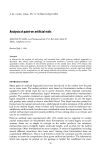
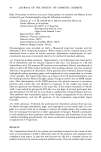
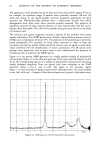
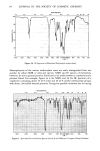
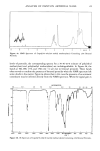
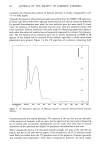
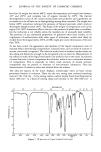
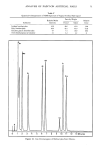
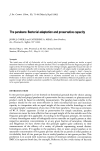
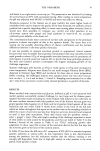
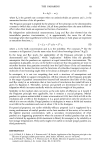
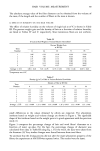
ANALYSIS OF PAINT-ON ARTIFICIAL NAILS 69 region associated with C-H stretching a pair of strong and sharp bands, often with the appearance of a nearly symmetrical doublet, in the region 1295-1330 cm(-1) the very strong carbon-oxygen stretching bands in the 1150-1200 cm(--1) region, separated by nearly 40 cm(-1) in methyl methacrylate but coalescing with increasing mass of the alcohol residue so that in hexyl methacrylate only a single nearly symmetrical band remains and a sharp band of varying intensity in the 800-820 cm(-1) region. The spectra are most readily distinguished from one another by the pattern of C-H bending and single bond stretching bands in the 600-1100 cm(-1) region, the numbers and shapes of the bands in the 1250-1500 cm(--1) region, and the C-H stretching bands in the 2800-3100 cm(-1) region. Thus the spectra of the pure esters can easily be recognized if comparison spectra are available. Identification of the components of mixtures of the esters directly from infra-red spectra is much more difficult. Figure 7 is the infra red spectrum of a mixture typical of those encountered in this work. Careful comparison of this spectrum with those of the individual esters allows a reasonable guess as to the main components of the mixture, but positive identification is not possible. The presence of a component other than methacrylate esters is indicated by the band at about 1520 cm(-1). The position of this band suggests an aromatic constituent, but its identity cannot be established from the infra-red spectrum alone. Nuclear magnetic resonance provided by far the quickest and easiest estimate of both qualitative and quantitative compositions of the liquids. The NMR spectrum of methyl methacrylate has been analyzed in detail (9). The methacrylate portion of the spectrum remains almost identical throughout the series of methacrylate esters encountered in this work. In deuterochloroform at about 20% V/V it consists of a closely-spaced quartet at about 1.93 delta, a quintuplet at about 5.56 delta, and a sextuplet at about 6.12 delta (all relative to internal tetramethylsilane at 0). In mixtures of methacrylate esters, multiplets from corresponding methacrylate protons of different esters may almost never be resolved from one another. By contrast, the portions of the ester molecules derived from alcohols give quite distinctive patterns, usually recognizable even in complex mixtures. Figure 8 is the NMR spectrum of the same mixture as was used to obtain the IR spectrum of Figure 7. The qualitative interpretation of the spectrum is 8 I p.p.m. 0 7 6 5 4 3 2 Figure 8. NMR Spectrum of Typical Artificial Nail Liquid.

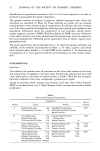
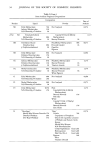
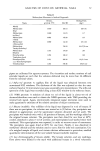
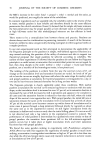
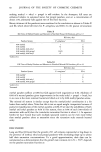
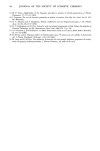
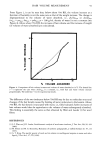
70 JOURNAL OF THE SOCIETY OF COSMETIC CHEMISTS Table IV NMR Spectrum of Typical Artifical Nail Liquid Peak or Description Multiplet or Type Origin A AA'BB' Multiplet B ABX(3), Sextuplet C ABX(3), Quintuplet D Singlet E A(2)X(3) Quartet F A(2)X Doublet G Singlet H Singlet I AB(3)B'(3)C(2) complex multiplet J A(3)XY Quartet K A(3)X(2) Triplet L Essentially an A(3)M doublet Aromatic protons of N,N-dimethyl-p-toluidine Vinyl proton of methacrylate moiety trans to methyl group Vinyl proton of methacrylate moiety cis to methyl group Aliphatic protons of ethylene glycol dimethacrylate Methylene protons of ethyl group of ethyl methacrylate Methylene protons of isobutyl group of isobutyl methacry- late N-methyl protons of N,N-dimethyl-p-toluidine C-methyl protons of N,N-dimethyl-p-toluidine Methyne proton of isobutyl group of isobutyl methacry- late Methyl protons of methacrylate moiety Methyl protons of ethyl group of ethyl methacrylate Methyl protons of isobutyl group of isobutyl methacrylate given in Table IV. The methacrylate esters in the mixture are readily identified from this spectrum, and even the amine constituent can be identified with near certainty. Figure 9 shows the same spectrum with its integral (taken five times to narrow the confididence interval). The integrals of peaks A and G were combined and the result used to calculate a relative molar intensity for the amine. The integrals of the remaining peaks were grouped as follows: B q- C + D + E q- F H + I +J and K + L. 'These values were then used to create a system of simultaneous linear equations in the relative molar intensities of the various substances. Solution of this set of equations led to relative molar amounts of the substances, from which the composition of the mixture by weight was calculated. The results are summarized in Table V. The accuracy is typical. 8 7 8 5 4 3 2 1 p.p.m. 0 Figure 9. NMR Spectrum of Typical Artificial Nail Liquid, with Integral Trace.
Purchased for the exclusive use of nofirst nolast (unknown)
From: SCC Media Library & Resource Center (library.scconline.org)