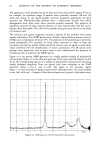
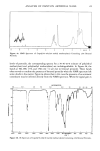
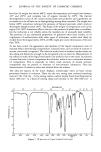
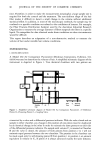
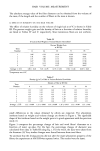
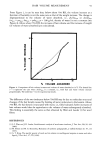
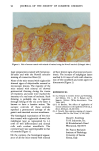
ANALYSIS OF PAINT-ON ARTIFICIAL NAILS 67 1 p.p.m. 0 Figure 6. NMR Spectrum of Benzoyl Peroxide-Diethyl Phthalate Mixture. identified, and often quantified, directly from the NMR spectrum. Figure 6, for example, is the NMR spectrum of a mixture of benzoyl peroxide and diethyl phthalate. The presence of a benzoyl group is clearly indicated by the characteristic pattern in the 8.0-8.4 delta region. The quartet and triplet point unambiguously to an ethyl ester. The pattern in the 7.3-8.0 delta region, and the intensity ratios for the various peaks, point to the given mixture. In this case a single integration gave a calculated composition by weight equal within a relative error of less than 1% to that taken (BPO taken, 48.0% found, 48.3%). Material insoluble in methylene chloride was seldom present in more than trace amounts. Electron-excited x-ray emission spectra nevertheless allowed identification of the presence in the residues of any elements with atomic numbers of 11 (sodium) or greater. With the use of suitable standards, this method can yield approximate quantitative data, though it is usually necessary to make some assumptions as to the particular compounds present. For example, zinc o•ide cannot be distinguished from zinc carbonate by this method alone. It is possible that some inorganic pigments, such as iron oxides, and aluminum hydroxide lakes, could be identified by the described techniques. Iodimetric determination of benzoyl peroxide in the powders gave results at least an order of magnitude more precise than direct estimation from integrated signal intensities in the NMR spectrum. Agreement between the two methods was nonethe- less reasonable. Measurements on known samples indicated that in the range 1-4% peroxide, NMR gave values with relative uncertainties as great as 50%. If a precise value is required, or the peroxide level is below about 1%, NMR is inadequate. The relative error in the iodimetric determinations was less than 0.5%. It was found that acetone does not interfere under the stated conditions. Thermogravimetric analysis of the powders revealed the presence of any inorganic matter such as titanium dioxide, down to percentages as low as 0.1 or lower. It also provided some indication of the kind of polymer present (7, 8). Thus the thermal decomposition curves were typical of methacrylate ester polymers. There was generally

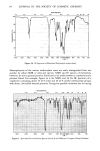
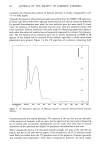
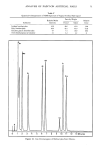
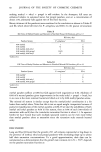
68 JOURNAL OF THE SOCIETY OF COSMETIC CHEMISTS less than 5% weight loss below 200øC, major decomposition and weight loss between 225 ¸ and 350øC, and complete loss of organic material by 450øC. The thermal decomposition curves of the various methacrylate ester polymers and copolymers are so similar as to be of little use in distinguishing among these materials. The weight loss below 200øC sometimes indicated the presence of benzoyl peroxide, which tends to decompose sharply around 120øC. The shape of the weight vs. temperature curve in the region 150-250øC sometimes offers a clue as to the presence of plasticizers or modifiers, but the indication is not reliable unless the materials are of unusually high volatility. The presence of any substantial proportion of polymers other than acrylics, or of copolymers of methacrylates with other types of monomers, would most likely be evident from thermogravimetry. DTA or DSC might give more information of this sort than TGA. As has been noted, the appearance and densities of the liquid components were of minimal help in determining compositions. Unusual odors, such as those of acetone or styrene, were easily recognized. The odors of methyl and of isobutyl methacrylates are also sharp and distinctive enough to be recognized, even in mixtures. Measurement of the refractive index of the liquid was found to be useful in one or two cases. In mixtures of more than two or three components the refractive index is not a convenient measure of composition. This is especially so where small amounts of several aromatic compounds may be present in mixtures of non-aromatic substances. Thus the determination of refractive index was omitted from the scheme. The infra-red spectra of the lower aliphatic methacrylate esters all have certain prominent features in common. These are: the very strong ester carbonyl stretching band at 1720-1730 cm(-1) the strong carbon-carbon double bond stretching band at about 1640 cm(-1) a band of varying shape and intensity in the 1430-1460 cm(-1) lOO v 60 Z -- z 40 2.5 3.0 4.0 5.0 o I I 4000 3500 3000 MICROMETERS 6.0 8.0 ! _ i_ _ 10 16 20 25 , '' i i , . , , , i i __ _ , I I I ' I- I 1 .... I - 1 ..... r'- ,--1 ' 2500 2000 1600 1600 1400' 1200 WAVELENGTH 600 400 (CM 1) Figure 7. IR Spectrum of Typical Artificial Nail Liquid. 200
Purchased for the exclusive use of nofirst nolast (unknown)
From: SCC Media Library & Resource Center (library.scconline.org)