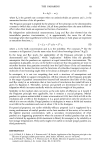
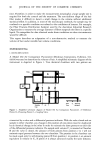
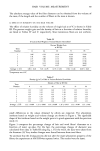
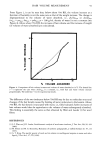
HAIR VOLUME MEASUREMENT 87 the distance that piston B differs from position 1, when the pressure in both chambers is equal, will always be proportional to the volume of the sample, Vx. II. MEASUREMENTS The measurements, except for those taken at 65% RH, were carried out in an enclosed humidity chamber which was in a controlled environmental room to maintain a constant temperature of 21øC. Saturated salt solutions were used to maintain the various humidities of interest in the chamber. LiCl, K2CO3, NaC1, KCI were used for 12, 44, 75 and 85% RH, respectively (5). The 65% RH experiment was carried out in a controlled environmental room. Six caucasian virgin brown hair (purchased from DeMeo Brothers, Inc., N.Y.) tresses, 4 inches in length and weighing 6-11 grams, were put in separate weighing bottles and dried in a 105øC oven until they reached a constant weight (approx. three hours). Then the weighing bottles were covered, cooled in a desiccator and the weights were determined. The dried tresses in the covered weighing bottles were put in the humidity chamber along with the Air Comparison Pycnometer, an analytical balance and a hygrometer. When the humidity in the chamber reached equilibrium with the salt solution, the weighing bottles were uncovered and the tresses exposed to an atmosphere of constant humidity. The weights of the tresses were checked frequently until no change occurred. The tresses were in equilibrium with the atmospheric water vapor pressure. Then each tress was transferred to the sample container of the Air Comparison Pycnometer and the volume was determined. The measurement was repeated at least four times for each tress. For zero humidity, dry nitrogen was used to purge the instrument. The same six tresses were used in all the experiments. A measurement procedure was selected to have the initial and final pressures inside the chambers equal to the atmospheric pressure. The weight of each tress was determined before and after each measurement. This was done to ascertain that no desorption or further absorption of moisture, which may have been caused by a continuous change of pressure inside the chambers, had taken place. No difference was found. RESULTS AND DISCUSSION I. THE METttOD The reliability of using the Air Comparison Pycnometer to measure the volume of hair depends upon the reproducibility of the measurement and the sensitivity of the instrument. A typical set of data of the tress volume obtained with the Air Comparison Pycnometer is shown in Table I. The standard deviation in tress volume obtained with repeated measurements is less than + 0.02 mi. Table II shows the reproducibility of the measured volume change obtained with different tresses as the humidity was increased from 0 to 65% RH. It is better than 95%. The sensitivity of the instrument is less than 0.05 ml (see Table I) that is, if the volume of the tress used is 5 ml or larger, then the instrument can accurately detect less than 1% change in its volume. The dimensional change of a keratinous fiber is highly anisotropic. The increase in diameter of a wool fiber saturated with water is about 18%, whereas the change in

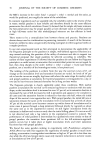
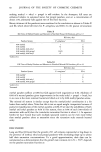
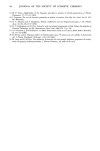
88 JOURNAL OF THE SOCIETY OF COSMETIC CHEMISTS Table I Tress Hair Volume at 65% RH Measured by Air Comparison Pycnometry Volume (ml) Measurement Number Tress Number 1 2 3 4 Average Volume + S.D. (ml) 1 7.24 7.29 7.28 7.29 2 4.91 4.92 4.91 4.97 3 8.45 8.44 8.44 8.45 4 5.94 5.94 5.94 5.98 5 4.81 4.79 4.80 4.80 6 6.19 6.21 6.17 6.19 7.28 __+ 0.01 4.93 + 0.03 8.44 __+ 0.005 5.95 -+ 0.02 4.80 __+ 0.01 6.19 -+ 0.016 Table II Effect of Humidity on Hair Volume Volume (ml) Tress Number 0% RH 65% RH % Volume Increase ! 6.64 7.28 9.63 2 4.54 4.93 8.59 3 7.73 8.44 9.18 4 5.45 5.95 9.18 5 4.42 4.80 8.60 6 5.69 6.19 8.79 Average _+ S.D. 9.00 _+ 0.41 length is only 1.2 to 1.8% (6). This increase in length contributes less than 1.5% to the total volume gained. Therefore, it is a good approximation that the percent change in diameter of a hair fiber may be obtained from % Change of Diameter -- • x 100%, (1) where V• and V2 are the volume of the tress at 0% RH and at the relative humidity of interest, respectively. Table III Percent Increase in Hair Volume at Various Relative Humidities a Percent Volume Increase at RH (%) Tress Number 12 44 65 75 85 1 2.41 4.67 9.16 16.89 18.07 2 2.64 5.29 8.59 15.86 17.61 3 2.33 4.27 9.18 14.36 17.08 4 2.93 6.24 9.18 15.78 17.98 5 3.39 6.56 8.60 15.84 18.10 6 3.16 5.80 8.79 16.34 18.98 Average + S.D. 2.80 _+ 0.42 5.47 _+ 0.89 9.00 _+ 0.41 15.85 + 0.84 17.96 + 0.62 •Temperature was 21øC
Purchased for the exclusive use of nofirst nolast (unknown)
From: SCC Media Library & Resource Center (library.scconline.org)