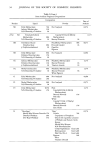
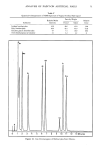
ANALYSIS OF PAINT-ON ARTIFICIAL NAILS 61 is of course the method of choice for determining volatile minor or trace constituents. Such determinations are complicated by the number and variety of impurities commonly found in methacrylate esters. Minor constituents, including accelerators and plasticizers, encountered in the liquids are shown in Table III. They are listed in order of increasing boiling point, and therefore of increasing elution time for the gas chromatographic conditions used in this work. Possible impurities in the acrylic monomers include various solvents, and starting materials and by-products from the reactions used to make the monomers. The only such impurities detected with certainty were innocuous, and never present at levels in excess of 1%. The presence of pigments and dyes was evident in many cases, but no attempt was made to identify specific colorants. The presence of UV absorbers could in no case be established with certainty. Current laws generally lead to the identification of dyes, some pigments, and additives such as UV absorbers on the package label. If the identity of these ingredients is thus known, methods can be chosen for their quantitative estimation. DISCUSSION MATERIALS Most of the products were built around low molecular weight aliphatic monometha- crylates. Only SI was not based on an acrylic system. Even in that case there was dependence on a vinyl-type polymerization initiated by a peroxide-amine reaction, but with a formulation reminiscent of the glass fiber-reinforced plastics (fiber glass) technology. One formulation of Product I contained no monomers, but depended upon a polymer-solvent combination to build an artificial nail. Eleven of the products contained polyfunctional acrylic monomers. These monomers provide cross-linking in the cured material. Such cross-linking, if of appropriate distribution and extent, will improve the properties of the finished nail. Too large a fraction of polyfunctional methacrylates can, however, be detrimental. The preferred amounts of those cross-linking agents employed seem to be in the range from 4 to 15%. Methacrylate polymers can be made more pliable, and even tougher, by plasticizers such as phthalate esters. Nonetheless only a few of the formulations in Table I include plasticizers. The variations in the types of polymers used in the powders probably represent attempts to achieve the most desirable handling characteristics. Even though use of copolymers of ethyl and methyl methacrylates reduces brittleness, and makes it easier to mix the powder with the liquid, not all the products take advantage of it. Two characteristics of the polymers not determined in this study are the average molecular weight and the molecular weight distribution. It would be interesting to know the effects of variations in these two parameters. Pigments, dyes, and opacifiers are of course used to give the nail a more natural appearance. METHODS Reference to the detailed results given previously for Product C will help clarify portions of the following discussion.

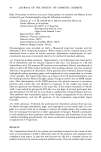
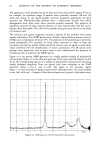
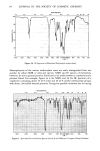
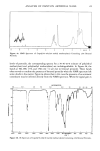
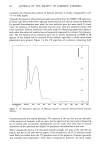
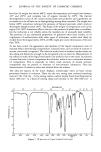
62 JOURNAL OF THE SOCIETY OF COSMETIC CHEMISTS The appearance of the powders has to do with more than their esthetic appeal. There is, for example, an optimum range of particle sizes--probably between 100 and 270 mesh--for giving to the liquid-powder mixtures properties appropriate for their intended use. Polymethacrylate powders have a distinctively smooth feel, which distinguishes them from most other common powder materials. The presence of significant amounts of silica, titanium dioxide, or other mineral alters that feel, and is thereby often detectable. The color of the powder may give some clue as to the kinds of colorants used. The infra-red and proton magnetic resonance spectra of the powders were about equally informative. The NMR spectra were ordinary high-resolution spectra, taken at 60 Mhz, and a temperature of about 37øC. The polymers in the powders gave somewhat broad absorptions. The necessity of using dilute solutions in order to keep the viscosities, and the line widths, within reason led in some cases to signal-to-noise ratios which interfered with the identification of minor constituents. The IR spectra were perhaps more impressive, and in some cases in fact substantiated the presence of constituents left in doubt by the NMR spectra. Figure la is the proton NMR spectrum of a highly purified sample of poly(methyl methacrylate). Figure lb is the infra-red spectrum of the same material. Figures 2a and 2b are the corresponding spectra of a sample of poly(methyl methacrylate) containing diethyl phthalate plasticizer. Note the typical ethyl ester multipiers in the NMR spectrum (delta = 1.25-1.5, and 4.2-4.6). The peaks in the aromatic region (delta = 7.5-8.0) resemble the pattern expected for a phthalate ester. The weak doublet in the 1560-1610 cm(-1) region of the infra-red spectrum is typical of phthalate esters, 6 5 4 • 2 1 P.P.M. 0 Figure la. NMR Spectrum of Pure Poly(methyl methacrylate).
Purchased for the exclusive use of nofirst nolast (unknown)
From: SCC Media Library & Resource Center (library.scconline.org)