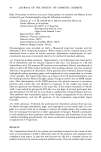
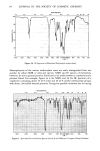
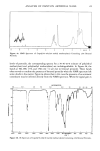
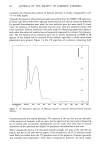
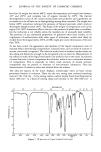
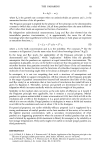
ANALYSIS OF PAINT-ON ARTIFICIAL NAILS 65 , r i Figure 4a. NMR Spectrum of Copoly(70 ethyl:30 methyl methacrylates) Containing 2.6% Benzoyl Peroxide. levels of peroxide, the corresponding spectra for a 70-30 wt-% mixture of poly(ethyl methacrylate) and poly(methyl methacrylate) are indistinguishable. In Figure 4b, the bands at 700, 990, 1770, and 1790 cm(-1) are due to benzoyl peroxide. These bands often served to confirm the presence of benzoyl peroxide when the NMR spectrum left some doubt in the matter. Figure 4a shows that in this case the presence of an aromatic constituent may be inferred directly from the NMR spectrum. When the signal gain is • 40 I'- MICROMETERS 2.5 6.0 100 ' 20 3.0 4.0 5.0 1, 6.0 1600 10 16 20 25 50 4000 3500 3000 2500 2000 1600 1400 WAVENUMBER 800 600 400 (OM-*) 2OO Figure 4b. IR Spectrum of Copoly(70 ethyl:30 methyl methacrylates) Containing 2.6% Benzoyl Peroxide.

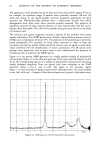
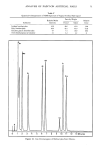
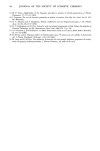
66 JOURNAL OF THE SOCIETY OF COSMETIC CHEMISTS increased, the characteristic pattern of benzoyl peroxide is clearly recognizable in the 7.5-8.5 delta region. Typically the presence of benzoyl peroxide was evident from the NMR or IR spectrum. In some cases where both direct spectral determination and solvent extraction followed by spectral determination were used, the two methods gave the same result. In some cases the presence of benzoyl peroxide was not clear until the methanol extract had been examined. Solvent extraction was most useful in identifying plasticizers, particu- larly when the extracted material was subsequently separated by column chromatogra- phy. The UV spectra of the solutions were not as readily interpreted as NMR or IR spectra of the residue left by removal of the solvent, especially in those cases where plasticizers were present. Figure 5 is the UV spectrum of a solution containing both 1.0 WAVELENGTH (nm) 190 200 220 0.6 0.4 • 0.2 I , I • I , I , I • I , I , I , [ [• 240 260 280 300 320 340 360 380 400 420 Figure 5. UV Absorbance Spectrum of Methanol 'Sc lution of Benzoyl Peroxide-Diethyl Phthalate Mixture. benzoyl peroxide and diethyl phthalate. The maxima at 201 and 231 nm are indicative of the presence of aromatic acids or esters, but the spectra of so many such compounds are so similar that no positive identification can be made. Not even first or second derivatives of the spectrum are helpful for qualitative identification in this case. Most compounds used as UV absorbers absorb strongly not only in the 190-260 nm region, but also in the 260-360 nm region. Thus the presence of a UV absorber would most likely be evident from the UV spectrum even in the presence of benzoyl peroxide and aromatic ester plasticizers. These latter components, however, are more readily
Purchased for the exclusive use of nofirst nolast (unknown)
From: SCC Media Library & Resource Center (library.scconline.org)