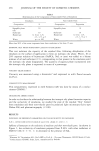
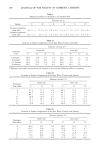
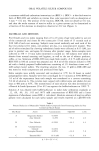
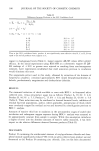
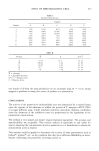
EVALUATION OF SHAMPOO DETERGENCY 275 In the early phases of this project, residual sebum was determined by gas chromatog- raphy using a packed-glass column which contained a high temperature liquid phase (3% Dexsil 300 on Suplecoport). This column provided for the resolution of most of the major sebum components with the exception of spermaceti and cholesterol and some of the minor paraffinic compounds. The column produced some tailing of the acidic sebum components. In order to improve the resolution of the chromatographic system the use of capillary columns (Supelco SPB-1) was investigated. This resulted in the baseline separation of the squalene/cholesterol peaks and the minor paraffinic compounds. The overall reac- tivity of the chromatographic system was also improved so that the acidic components no longer produced tailing peaks. Analyses were conducted on a Hewlett Packard model 5840 equipped with a dual FID and setup for on-column injection. The chromatographic conditions for packed and capillary techniques are listed in Table I. In the normal course of sample analysis 20 characteristic peaks were identified and tracked as a function of sample treatment. Identification was done through the matching of retention times between sample peaks and corresponding peaks in individual sebum fraction standards. This matching technique allowed for the tracking of the various sub-components present in the various sebum formula constituents. This resulted in the collection of more than 15,000 data points in the course of our evaluation. The volume of data which had to be reduced required the use of a micro-computer using Visi-Calc and Lotus 1-2-3 for weight correction and normalization with control samples. Lotus 1-2-3 also provided the ability to prepare visual representations of the data. SINGLE SURFACTANT SYSTEMS The investigation was conducted with three surfactants which represent some of the major actives used in commercial shampoos. The surfactants used were ammonium lauryl sulfate (ALS), sodium alpha olefin C14-C16 sulphonate (AOS), and sodium laureth 2-sulphate (alkyl ethoxy sulfate or AES containing 2 moles ethylene oxide). Each surfactant was evaluated at a use level of 10%. Table I Gas Chromatographic Operating Conditions for Sebum Analysis on Both Packed and Capillary Columns Packed Capillary Liquid phase 3% Dexsil 300 Supelco SPB1 Column length (meters) 2 60 Helium flow rate (ml/min) 30 12 Makeup gas flow (ml/min) not required 40 Injection temperature 320 deg. C 280 deg. C FID Detector temperature 320 deg. C 320 deg. C Initial oven temperature 100 deg. C 180 deg. C Initial temperature hold 4 minutes 8 minutes Oven temperature rate 5 deg./min. 4 deg./min. Final oven temperature 320 deg. C 320 deg. C Attenuation 2/N8 2/•3 On-column injection Volume (microliters) 4 4

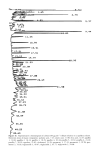
276 JOURNAL OF THE SOCIETY OF COSMETIC CHEMISTS STSRT 8.51 - • 18.91 - 14.49 17.65 28.48 2•- 11 - 28.77 6.•238.45 .•5.5-3 48.45 • 49.8• 0.58 Figure la. Representative chromatogram of a dilute (85 •g ml- l) sebum solution on a packed column. Retention times of major components: palmitic acid, 7.14 stearic acid, 8.51 oleic acid, 10.91 paraffin 1, 14.49 paraffin 2, 17.65 paraffin 3, 20.48 paraffin 4, 23.11 paraffin 5, 25.37 paraffin 6, 27.62 paraffin 7, 29.73 squalene, 34.16 cholesterol, 41.57 not resolved from spermaceti: spermaceti 1, lost in baseline spermaceti 2, 41.57 not resolved from cholesterol: spermaceti 3, 44.00 triglyceride 1, 47.82 triglyceride 2, 49.82 triglyceride 3, 51.73.
Purchased for the exclusive use of nofirst nolast (unknown)
From: SCC Media Library & Resource Center (library.scconline.org)