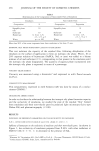
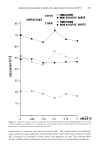
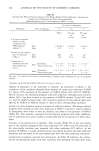
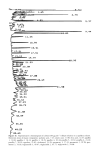
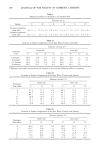
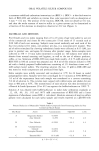
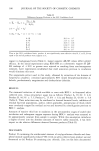
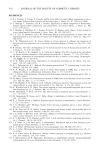
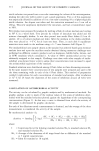
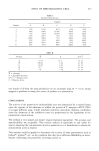
294 JOURNAL OF THE SOCIETY OF COSMETIC CHEMISTS Table VI Variation in Outer Surface Composition of the Skin When Treated with Sodium Lauryl Sulfate (SLS) Elements (Atomic %) Treatment Time (Min.) C O N Si S 0 82.5 12.8 0.8 3.7 0.2 2 78.1 15.4 3.8 1.9 0.9 5 74.8 17.2 5.6 0.4 2.0 10 74.0 16.8 7.6 0.2 1.5 20 73.0 17.9 7.8 0.2 1.2 minute washes with acetone or ethanol). Sulfur at the surface is mainly in the form of S TM (sulfonate or sulfate), and after washing with ethanol or acetone for 17 minutes or more, sulfur exists in two distinct chemical forms the lower binding energy corresponds to disulfide sulfur, referred to as S-II, and the higher binding energy corresponds to sulfonate or sulfate and is referred to as S-VI. This is demonstrated in Figure 4 for the skin washed in ethanol for 37 minutes. The relative changes in the chemical form of sulfur with depth can be explained on the basis of the following: With extraction of lipid, particularly cholesterol sulfate (17), the S TM contribution to the sulfur peak de- creases. This removal of cholesterol sulfate increases the protein at the surface, and the contribution of S n increases. Secondly, the upper layers of the skin may contain S v• due to oxidation of the disulfide bond of the protein and, therefore, the ratio of SII/SVI increases with depth. Phosphorus exists in the form of phosphate and its percentage increases with wash time and reaches a maximum for the inner side (0.6 atomic %) after 17 minutes in ethanol. With further washing ( 17 minutes with ethanol), phosphorus content decreases. The same trend is observed with acetone washing, although the time frame is different. With acetone or ethanol washing, the outer side of the skin does not show a change in phosphorus content. It seems from the present study that solvent has to penetrate the skin surface to extract structural lipid. Penetration of the skin by solvent depends on the polarity of the solvent and the surface charge of the skin. Solubility parameters (which depend on the polarity of the solvent) of ether, acetone, and ethanol are 7.4, 10.0, and 12.7 respec- tively (18). A comparison of the skin lipid removal (Figures 2 & 3) with the solubility Table VII Variation in Outer Surface Composition of the Skin When Treated with Ethoxylated Alcohol Sulfate (AEOS-6.5 EO) Elements (Atomic %) Treatment Time (Min.) C O N Si S 0 81.0 14.3 0.7 3.9 0.2 2 77.5 16.9 3.8 1.1 0.6 5 77.1 17.7 3.9 0.6 0.7 10 75.2 19.1 4.1 0.7 0.9 20 72.5 21.9 4.1 0.5 1.2 30 70.4 22.0 6.0 0.4 1.1

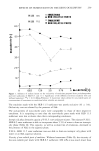
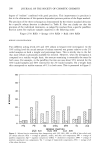
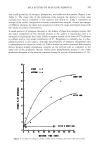
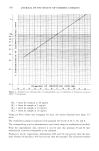
ESCA STUDIES OF SKIN LIPID REMOVAL 295 10 8 -- SLS AEOS o 0 5 IO 15 20 25 50 55 WASHING TIME (MIN.} Figure 5. Increase in nitrogen content of skin versus washing time with SLS and AEOS. parameters seems to indicate that skin lipid removal depends on the polarity of the solvent. TREATMENT WITH SODIUM LAURYL SULFATE (SLS) AND SODIUM LAURETH--6.5 SULFATE (AEOS-6.5EO) Skin samples were washed for different amounts of time with 2% wt. concentration solution of SLS and AEOS (6.5EO). After each treatment, samples were rinsed for ten minutes in distilled water. The surface composition of the skin after each treatment with SLS and AEOS is tabulated in Tables VI and VII. Skin samples rinsed only with water were also studied as controls. No changes in the surface composition of the skin were observed with the water-treated samples, thus ruling out the possibility of major water-soluble material present at the skin surface. It should be noted from Tables VI and VII that only the outer side of the epidermis was studied although occasional checks on the inner side showed that more skin lipid is removed from the inner side than the outer side. Tables VI, VII and Figure 5 show that skin lipid removal is greater
Purchased for the exclusive use of nofirst nolast (unknown)
From: SCC Media Library & Resource Center (library.scconline.org)