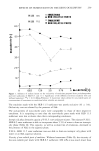
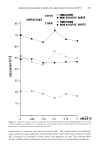
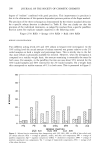
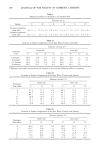
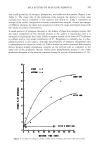
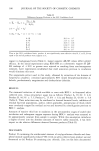
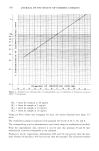
292 JOURNAL OF THE SOCIETY OF COSMETIC CHEMISTS TREATMENT WITH SOLVENTS Untreated samples of epidermis were washed with ether, acetone, or ethanol for different periods of time and after treatment rinsed with distilled water for 10 minutes. After every wash and rinse cycle, skin samples were analyzed by ESCA for surface composition (see Tables II to IV). With ether washing, there is no increase in nitrogen content (Table II and Figure 2), which means ether treatment does not extract lipid from the surface of the skin. These results are different from the studies of Kirk (15), where ethyl ether was used to collect residual skin lipids from the surface of the whole hand. However, our present results are consistent with the findings of Buettner (16). Buettner observed that the application of ether to the arms of four volunteers for four hours did not decrease the barrier properties of the skin. It seems that Kirk's studies deal mainly with surface lipids and sebum, while the results of Buettner depend mainly on the removal of structural lipids from the membrane. 16 14 o I•ER SlOE 12 OUTER SIDE o o 5 IO I$ 20 25 10 $$ 40 45 54) WASHING TIME (MIN.) Figure 3. Increase in nitrogen content of skin versus washing time with ethanol.

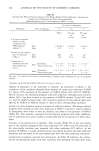
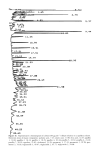
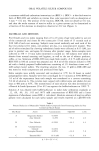
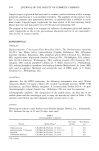
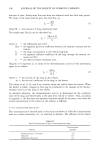
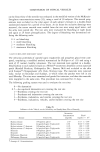
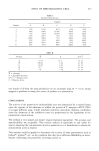
ESCA STUDIES OF SKIN LIPID REMOVAL 293 Table V Surface Composition (wt. %) of the Skin after Treatment with Acetone or Ethanol for 47 and 37 Minutes Respectively Compared with That of Protein Element Average Protein Composition* Skin Composition (inner side) Washed with Acetone for 47 Min. Washed with Ethanol for 37 Min. C 59.9 63.8 62.2 O 23.0 21.6 22.7 N 17.1 14.6 15.0 * Taken from: General Biochemistry by Joseph S. Fruton and Sofia Simmonds (John Wiley & Sons, Inc., New York, 1959), p 27. With acetone or ethanol treatment, extraction of lipids from the skin increases with wash time as shown in Figures 2 and 3 and Tables III and IV. There is a difference in skin lipid removal from the two sides of the skin (Figures 2 and 3). Skin lipid removal is larger from the inner side as compared to the outer. After a 47-minute wash with acetone or a 37-minute wash with ethanol, the surface composition of the inner side approaches very close to an average protein composition as shown in Table V. Small amounts (• 1%) of sulfur, phosphorus, silicon and calcium were also observed at the surface of most of these skin samples. Silicon is maximal at the surface (--1-2 atomic %) and gradually decreases with depth. Sulfur is at a minimum at the surface (--0.2 atomic %) and increases with depth to a level of 0.5 atomic percent (after 27- ?$ $0 $VI $11 o -iTI / I I I I I I I I / / / - UNTREATED SKIN \ FOR 3'i' MIN. IN ETHANOL - I'J'S -174 -172 -I70 -161 -lit -1•4 -162 -144) BINDING ENERGY, (eV) Figure 4. Sulfur 2P spectra on untreated and ethanol-treated samples of skin.
Purchased for the exclusive use of nofirst nolast (unknown)
From: SCC Media Library & Resource Center (library.scconline.org)