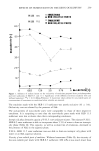
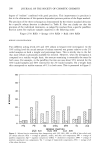
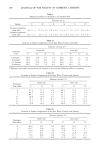
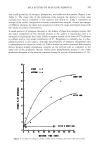
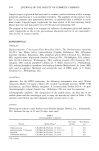
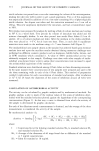
284 JOURNAL OF THE SOCIETY OF COSMETIC CHEMISTS 6O 5O 4O • 3o 2o 10 o FFA PW SQ CHOL SPW TG AVG RESIDUE FRACTION • 1 CYCLE • 10 CYCLES • 20 CYCLES Figure 8. Effects of multiple soiling/shampooing treatments on average (by chemical fraction) sebum residues on hair. Hair soiled with 2% sebum solution and shampooed with 10% AOS. Soiling/shampooing carried through one, ten, and twenty cycles. FFA = average ofpalmitic, stearic, and oleic acid components PW = average of paraffin components SQ = squalene component CHOL = cholesterol component SPW = average of synthetic spermaceti wax components TG = average of triglyceride components AVG = average of all of the above fractions. The question we decided to address was: Is there a difference in the amount of total sebum or sebum fraction left on the hair between the 1st and the nth soil/shampoo cycle? In an attempt to analyze sebum removal as well as to determine if there may be a change or a build-up of one sebum fraction in comparison to another, we repeatedly soiled and washed hair tresses. Single-surfactant systems only were tested. This was done in an effort to isolate the effects of the actual active ingredient and to prevent coformulated ingredients from masking the desired observations. Data was collected for 1, 10, and 20 soiling and washing cycles for the 2% soiling samples and 1 and 10 cycles for the 10% soiled samples. This could represent a period of one or two months of regular shampooing for an individual, depending upon washing intervals. Figures 5-8 represent the data obtained in this portion of the study. It is striking to note that there appears to be data supporting the notion that "shampoo fatigue" takes place in as few as 10 cycles. Of particular interest is the accumulation of the paraffinic compounds on the hair substrate. In almost every case the paraffinic and squalene residues were higher after 20 washing cycles than those observed after a single cycle. There did not appear to be an accumulation of the triglyceride, cholesterol, or fatty acid fractions after 20 cycles.

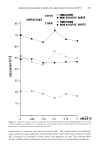
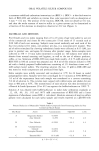
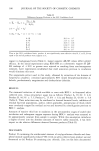
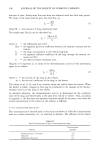
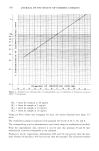
EVALUATION OF SHAMPOO DETERGENCY 285 14 12 11 10 9 8 ? 6 5 4 2 1 0 BRAND X ACTIVE BRAND Y GENTLE FINISHED & PROTOTYPE PRODUCTS Figure 9. Average (across all components) sebum residues remaining after shampooing with commercial or prototype "active" and "gentle" shampoos of hair soiled with 2% sebum solutions. As previously stated, AES appears to exhibit the greatest detergency when the single- cycle data is examined. This did not prove to be the case when multiple soiling and cleaning cycles were performed. The data indicate that AES demonstrated the highest degree of sebum buildup with repeated application when compared to the other two surfactants. The data from the 5 sample replicates were examined in an effort to determine if this was an anomaly or a valid effect. The precision of the data appears to be consistent with respect to all of the other sample sets. A more extensive study will have to be conducted to develop a possible mechanism to explain this effect. AOS is similar in that it tended to leave higher residues regardless of cycle. ALS appears to exhibit the least amount of residue buildup of the three surfactants tested. The data indicate that the surfactant type determines the detergency of the formulation. To further test this premise, several prototype shampoo formulations were prepared using these surfactant types and evaluated using this technique. Shampoo formulations prepared to reflect what would normally be perceived as "gentle" were found to leave higher sebum residues than those formulated as "active"-type shampoos. These pro- totype formulations were contrasted to existing finished product formulations which are generally recognized as active (Brand X) and gentle (Brand Y). This data is rep- resented in Figure 9. The data from this portion of the experiment may indicate an apparent concentration effect. "Built" finished product formulations exhibit slightly different detergency than would be predicted strictly from the single-surfactant models. This could either be a concentration effect or some sort of enhancement between blended surfactants. This question will require additional work to fully develop a working predictive model for finished products.
Purchased for the exclusive use of nofirst nolast (unknown)
From: SCC Media Library & Resource Center (library.scconline.org)