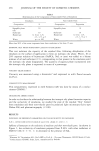
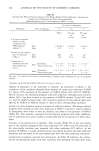
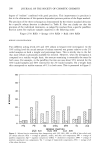
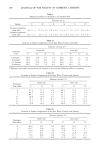
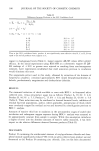
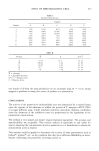
300 JOURNAL OF THE SOCIETY OF COSMETIC CHEMISTS Table II Differences between Products at the 99% Confidence Level __ __ /NA + NB l) X A - X•---ts ¾ •-N• 2) S = •SA 2 "• SB 2 3)(NA + NB -- 2) = 12---• t = 3.06 A-B A-D A-C B-D B-C D-C 20.9 ñ 9.7 21.5 ñ 11.5 49.8 ñ 11.8 0.60 + 11.9 28.9 + 12.2 28.3 ñ 13.7 Thus at the 99% confidence limit, product A was significantly more effective than B, C or D B was equal to D and all products were superior to C. respect to background levels (Table I). Larger negative AR-SH values reflect greater efficacy. In the initial experiments using BDC-OH as a colormetric reagent all AR- SH readings of + 10% or greater were rejected as resulting from non-homogenous mixtures. Later experiments established that mild sonication previous to incubation would eliminate this error. The sanguinaria extract used in this study, obtained by extraction of the rhizome of Sang•inaria canadensis, contained approximately 80% mixed benzophenanthridine al- kaloids, predominantly sanguinarine and chelerythrine chlorides. RESULTS The measured reduction of thiols available to react with BDC + in fermented saliva collected post- versus pre-product usage was as follows: Product A, 65.4% ___ 4.0 Product B, 44.5% + 5.5 Product C, 15.6% + 6.0 and Product D, 43.9% + 5.8 (Table I). These reductions may be attributed to lowered bacterial levels, inhibition of residual bacterial populations, and/or, where applicable, precipitation of thiols which were covalently trapped by residual actives and removed by centrifugation previous to BDC + analysis. Amounts of reactive thiol lost to oxidation in the pre-anaerobic stages of sealed tube incubation and subsequent oxygen exposure during BDC q- analysis were assumed to be approximately constant from sample to sample. While this assumption introduces a degree of error into the absolute amounts of reactive sulfur measured, it has little impact on the relative differences observed between products (Table II). DISCUSSION Product D containing the antibacterial mixture of cetylpyridinium chloride and dom- iphen bromide significantly reduced VSC levels in saliva collected post-product use and fermented as did Product B containing zinc chloride. Zinc ion has been documented

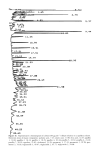
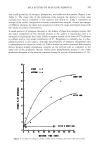
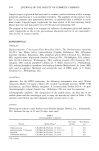
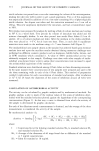
ORAL VOLATILE SULFUR COMPOUNDS 301 Ill R = H, Alkyl, Enzyme Figure 2. Reaction of sanguinarine with volatile sulfur compounds to affect neutralization. as an effective VSC control agent which appears to diminish VSC levels via the formation of insoluble zinc sulfides (2). Thus rinses capable of lowering populations of anaerobic VSC-producing bacteria or those capable of covalently trapping their metabolic by-product, VSC, were consistently effective. The most effective rinse in this screen, that which contained sanguinaria extract with zinc ion, combined the potential to act in a two-fold manner, both via antimicrobial activity and covalent thiol trapping (5,11 Figure 2). Sanguinaria extract has been demonstrated as having significant bacteriastatic potential and, like zinc ion, its alkaloidal constituents have been shown to be retained in the oral cavity for periods of several hours after product usage, most notably in dental plaque, salivary sediment, and on the surface of the tongue (7,11). In the iminium ion form, benzophenanthridine alkaloids of the sanguinarine type have been determined as covalently binding with reactive sulfhydryls (5). We postulate that residual zinc ion complemented by residual benzophenanthridine alkaloids could trap VSCs as they are generated or, more poignantly, tie up sulfur substrates rendering them metabolically unavailable for VSC production. The product containing "essential oils" with moderate bacteriastatic properties exhib- ited marginal effectiveness in this screen. REFERENCES (1) A. A. Rizzo, The possible role of hydrogen sulfide in human periodontal disease. Hydrogen sulfide production in periodontal products, Periodontics, 5(5), 223-236 (Sept/Oct 1967). (2) J. Tonzetich, Oral malodor: An indicator of health status and oral cleanliness, Int. Dent. J., 28, 308-319 (1978). (3) J. Tonzetich: Reaction of H2S and CH$SH with oral mucosa, J. Dent. Res., (Abstract #HS), 63, 163 (1984). (4) J. Tonzetich and P. W. Johnson: Irreversibility of CH3SH-induced inhibition of protein synthesis in fibroplasr cultures, J. Dent. Res., (Abstract #166), 63, 189 (1984). (5) D. Walterova, J. Ulrichova, V. Preininger, V. Simanek, J. Lenfeld, and J. Lasovsky: Inhibition of liver alanine aminotransferase activity by some benzophenanthridine alkaloids, J. Med, Chem. 24, 1100-1103 (1981).
Purchased for the exclusive use of nofirst nolast (unknown)
From: SCC Media Library & Resource Center (library.scconline.org)