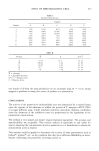
J. Soc. Cosmet. Chem., 36, 313-318 (July/August 1985) Method for determination of the microbiological assay of imidazolidinyl urea A. POLTRONIERI, Lab. Analytical Research, STAR S.p.A.. Agrate B.za, Milan, Italy, S. PRIVITERA, Urelain S.r.l.. via Gatdone 7, Milan, Italy, and A. SALVI, Biolab S.r.l., Segrate, Milan, Italy. Received August 28, 1984. Synopsis The preservative imidazolidinyl urea is available from several manufacturers. Work with imidazolidinyl urea suggested its antimicrobial activity was variable. Therefore an assay based on zone of inhibition measurements using agar plates seeded with PJe//domonaJ aer/•ginosa was done to assess imidazolidinyl urea activity. Forty samples obtained from five vendors were assayed. in some cases substantial variability in antimicrobial activity was found. Results obtained by this assay method may, however, be used to adjust the preservative concentration in cosmetic products compensating for its variable activity. INTRODUCTION In recent years there has been a notable increase in the number of companies which offer under their own brandnames the antibacterial defined by the Cosmetic, Toiletry and Fragrance Association as imidazolidinyl urea. This study arose from our goal to determine via microbiological testing whether the antibacterial capacity of the preservative varies depending on its source, since traditional chemical analysis, viz. formaldehyde titration (1) or nitrogen assay (by Kjeldahl method) (2) apparently cannot be relied upon to indicate the antibaterial capacity of the preser- vative. METHODS OF EVALUATING THE ANTIBACTERIAL ACTIVITY OF PRESERVATIVES Standard methods of evaluating preservative activity are generally very simple, although they do require good laboratory technique and rigorous standardization. The methods are scalar (broth) dilution and agar diffusion (3). We chose agar diffusion for our study. The preservative activity was judged by inhibition of the growth of Pse•domonas aer•- ginosa strain ATCC 15442. It was stored for no longer than 14 days. It was transplanted by means of a streak onto the slanted solid medium (4 cc per 16 X 150 mm test tube, screw-capped). Incubation was for 48 hours at 30-32 ø C. The culture medium was Plate Count Agar (Difco) poured into test tubes 16 x 150 mm (4 cc per tube) and into bottles. It was sterilized at 121 ø C for 20 minutes. Seven cc of physiologically 313

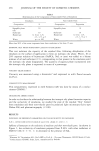
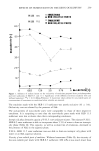
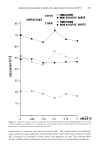
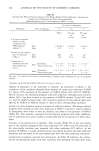
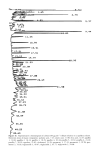
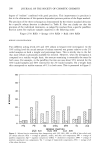
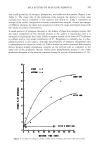
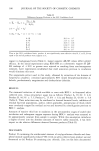
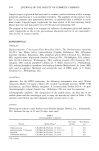
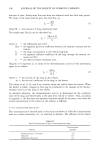
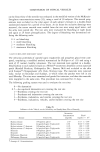
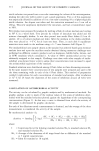
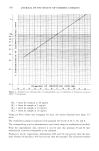
314 JOURNAL OF THE SOCIETY OF COSMETIC CHEMISTS sterile solution was poured into a test tube containing the culture of the microorganism, shaking the tube very well in order to get a good suspension. Two cc of this suspension was aseptically diluted by addition of it to a test tube containing 18 cc of physiologically sterile solution. An aliquot was taken and the extinction measured in a 1-cm cell at 460 •. This new suspension represented the inoculum, and had a transmittance equal to 50%. Petri dishes were prepared for analysis by melting a flask of culture medium and cooling to 50 ø C in a water bath. Two percent by volume of inoculum was added and the mixture thoroughly shaken. It was then poured into sterile Petri dishes (12-cm di- ameter, 40 cc of culture medium per dish). After the medium in the dishes solidified, they were placed at +4 ø C for at least one hour. Then, in each dish 6 equidistant reservoirs were made in the medium using a 6-7-mm diameter drill (Figure 1). The imidazolidinyl urea sample chosen as the standard was selected based upon chemical analysis data and upon the excellent results obtained during numerous challenge tests performed on different cosmetic products such as shampoos, bubble baths, lotions, and an O/W emulsion which contained it. A value of 100% antimicrobial activity was arbitrarily assigned to this sample. Challenge tests done with other samples of imida- zolidinyl urea showed lower activity unless their concentrations were increased to equal the antimicrobial equivalent of the standard. Standard solutions were distributed among 6 Petri dishes in three alternating reservoirs. In the same manner three concentrations of test samples were prepared and used to fill the three remaining wells in each of the 6 Petri dishes. This method of preparation yielded 6 replications for each concentration of standard and sample. After incubation at 32 ø C for 24 hours the diameters of the zones of inhibition around all wells were measured. CALCULATION OF ANTIMICROBIAL ACTIVITY The activity can be calculated by graphic analysis and by mathematical methods. For graphic analysis a plot is made of the median values of the zones of inhibition deter- mined with the standard solutions plotted against the logarithms of the corresponding concentrations (Figure 2). In this way a curve is obtained from which the activity of the sample is determined by graphic calculation. For each of the dilutions tested a measurement is obtained, and the average of the three measurements is considered the activity of the sample. By mathematical analysis (4), Activity = Antilog I- •- where: I (SC• + SC2 + SC4) - (SS• + SSi + SS4) 1 log I (SS4 + SC4) - (SS• + SC•) ' = Conversion factor for diluting standard solution SS4 to standard solution SS2 and standard solution SS•. SS• = Average of the diameters of all rings found due ro diffusion of the standard at 5 mg/ml concentration. SS2 = Idem for standard at 10 mg/ml.
Purchased for the exclusive use of nofirst nolast (unknown)
From: SCC Media Library & Resource Center (library.scconline.org)