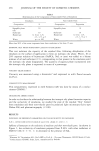
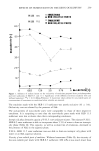
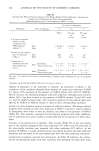
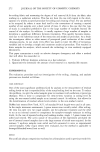
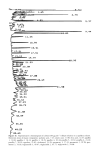
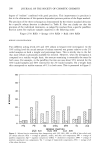
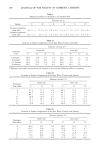
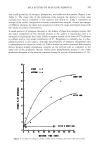
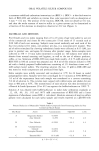
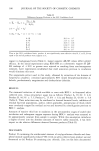
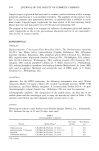
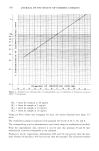
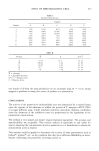
280 JOURNAL OF THE SOCIETY OF COSMETIC CHEMISTS degree of "realism" combined with good precision. This improvement in precision is due to the elimination of the operator-dependent pressure portion of the finger method. The precision of the three techniques as demonstrated by the relative standard deviation for a specific sebum fraction is tabulated in Table II. One can clearly see that the precision of the individual treatments, as judged by residues from a specific paraffinic fraction across five replicate samples improves in the following order: Finger (27% RSD) Sponge (15% RSD) Bulk (10% RSD) SOILING CONCENTRATION Two different soiling levels (2% and 10% sebum in hexane) were investigated. At the 10% soiling level the actual amount of sebum removed was greater relative to the 2% soiled samples on both a weight and percentage basis. This is strictly due to the fact that more sebum is physically available for removal. However, when the detergency is compared on a residue weight basis, the amount remaining is essentially the same for both cases. For example, in the paraffinic fraction one sees about 95% removal for the 10% loaded samples and 60% removal for the 2% loaded samples. On a weight basis this corresponds to residue amount of 0.5 in both cases. This is presented in Figure 2. 6O 50- 40- 50- 20- 10- FFA I I I I I SQ CHOL SPW TG AVG RESIDUE FRACTION • ALS • AES •'.• AOS Figure 3. Sebum fraction remaining after shampooing with 10% ALS, AES, or AOS of hair soiled with 2% sebum solution. FFA = average of palmitic, stearic, and oleic acid components PW = average of paraffin components SQ = squalene component CHOL = cholesterol component SPW = average of synthetic spermaceti wax components TG = average of triglyceride components AVG = average of all of the above fractions.

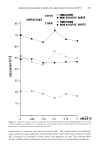
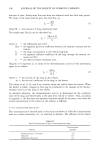
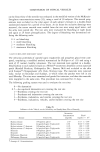
EVALUATION OF SHAMPOO DETERGENCY 281 la.I o PALMITIC STEARIC OLEIC FATTY ACID • ALS • AE$ • AO$ Figure 4. Fatty acids remaining after shampooing with 10% ALS, AES, or AOS of hair soiled with 2% sebum solution. 52 50 28 26 24 22 20 18 16 14 12 10 8 6 4 2 0 o 20 NUMBER OF SOILING/WASHING CYCLES • AL$ • AE$ • AOS Figure 5. Effects of multiple soiling/shampooing treatments on average (across all components) sebum residues on hair. Hair soiled with 2% sebum solution and shampooed with 10% ALS, AES, or AOS. Soiling/shampooing carried through one, ten, and twenty cycles.
Purchased for the exclusive use of nofirst nolast (unknown)
From: SCC Media Library & Resource Center (library.scconline.org)