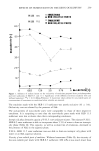
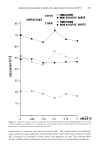
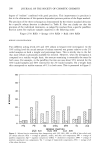
EVALUATION OF SHAMPOO DETERGENCY 285 14 12 11 10 9 8 ? 6 5 4 2 1 0 BRAND X ACTIVE BRAND Y GENTLE FINISHED & PROTOTYPE PRODUCTS Figure 9. Average (across all components) sebum residues remaining after shampooing with commercial or prototype "active" and "gentle" shampoos of hair soiled with 2% sebum solutions. As previously stated, AES appears to exhibit the greatest detergency when the single- cycle data is examined. This did not prove to be the case when multiple soiling and cleaning cycles were performed. The data indicate that AES demonstrated the highest degree of sebum buildup with repeated application when compared to the other two surfactants. The data from the 5 sample replicates were examined in an effort to determine if this was an anomaly or a valid effect. The precision of the data appears to be consistent with respect to all of the other sample sets. A more extensive study will have to be conducted to develop a possible mechanism to explain this effect. AOS is similar in that it tended to leave higher residues regardless of cycle. ALS appears to exhibit the least amount of residue buildup of the three surfactants tested. The data indicate that the surfactant type determines the detergency of the formulation. To further test this premise, several prototype shampoo formulations were prepared using these surfactant types and evaluated using this technique. Shampoo formulations prepared to reflect what would normally be perceived as "gentle" were found to leave higher sebum residues than those formulated as "active"-type shampoos. These pro- totype formulations were contrasted to existing finished product formulations which are generally recognized as active (Brand X) and gentle (Brand Y). This data is rep- resented in Figure 9. The data from this portion of the experiment may indicate an apparent concentration effect. "Built" finished product formulations exhibit slightly different detergency than would be predicted strictly from the single-surfactant models. This could either be a concentration effect or some sort of enhancement between blended surfactants. This question will require additional work to fully develop a working predictive model for finished products.

286 JOURNAL OF THE SOCIETY OF COSMETIC CHEMISTS CONCLUSIONS This paper has described an approach to evaluating shampoo efficacy on a hair substrate. The technique is reproducible and practical. It can be ultimately extended to the evaluation of prototype formulations and to the evaluation of commercial products. It can be used to provide information about product effectiveness prior to conducting extensive and expensive i, vivo use testing. The techniques described not only allow for the determination of sebum residue but can be used to profile residual sebum components as a function of treatment. The experimental data collected indi6ate that shampoo effectiveness can be moderated or determined by the surfactant. The inclusion of certain surfactants will reduce the residue of the non-polar sebum fractions which seem to be more tenaciously bound to the substrate surface. The implication of this result should not be interpreted as some surfactants being "bad" or ineffective. On the contrary, these may be the surfactants of choice when a mild detergency is required, such as the case with "dry" hair. The study also describes our findings which indicate that repeated soil/wash cycles can affect the perceived cleaning ability. Repeated soiling and washing cycles accentuate the accumulation of sebum residue remaining on the hair surface. It seems quite feasible that product effectiveness could be perceived as diminishing with use. Additional work will be required to determine how this situation may be remedied or controlled. REFERENCES (1) A.M. Schwartz and J. W. Perry, Surface Active Agents, (Wiley-Interscience, 1949). (2) E. W. Washburn, Phys. Rev. Set., 2, 17, 273 (1921). (3) J. W. McBain, Trans. Farady Soc., 9, 99 (1913). (4) S. K. Durham, Surface Activity and Detergency, (Macmillian, New York, 1961). (5) A.M. Schwartz, Recent advances in detergency theory, J. Amer. Oil Chem. Sot., 48, 566-569, (1971). (6) N. K. Adam, J. Soc. Dyes Colour, 53, 121, (1937). (7) H. L. Rosario and M. Weil, Am. DyestuffRep., 2, 53-56, (1953). (8) A.S.T.M., Annual Book of ASTM Standards, ASTM, 15, 15,04, D3050 (1983). (9) J. C. Harris, Detergency Evaluation and Testing, (Wiley-Interscience, 1954). (10) Spangler, Cross, and Schoafsma, A laboratory method for testing laundry products for detergency, J. Amer. Oil Chem. Soc., 42, 723-727 (1965). (11) M. M. Breuer, Cleaning ofhair, J. Soc. Cosmet. Chem., 32, 437-458 (1981). (12) M. Gloor, Determination and Analysis of Sebum on Skin and Hair, Cosmetic Science Volume 1, (Academic Press, London, 1978). (13) L. S. Ettre, Introduction to Open Tubular Columns (Perkin-Elmer Corporation, Norwalk, Conn. 1976). (14) J. Koch, K. Aitzetmuller, G. Bittorf, and J. Waibel, Hair lipids and their contribution to the perception of hair oiliness: Parts I & II, J. Soc. Cosmet. Chem., 33, 317-343 (1982). (15) H. J. O'Neill and L. L. Gershbein, Analysis of fatty acid and alcholic compounds of sebaceous lipid type, J. Chrom. Sci., 14, 28-36 (1976).
Purchased for the exclusive use of nofirst nolast (unknown)
From: SCC Media Library & Resource Center (library.scconline.org)