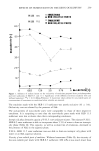
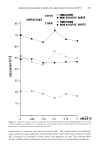
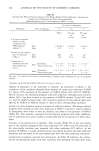
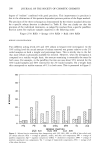
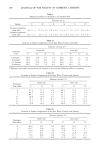
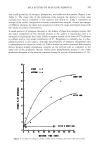
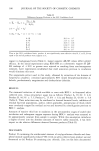
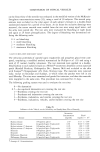
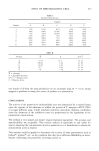
COMPARISON OF TOPICAL VEHICLES 309 Table VII Twenty-One Day Cumulative Irritancy Grade* Test Material Total Mean + S.D. p Value Caprylic/Capric Triglyceride 4.0 0.16 + 0.47 Propylene Glycol 72.0 2.88 + 7.31 0.0077 * 25 Subjects. no statistically significant differences between the effects of different vehicles on the bioactivity of the steroids at either the eight-hour or the 24-hour evaluations. Caprylic/capric triglyceride demonstrated a minimal potential compared to propylene glycol for causing irritation. When applied under occlusion for 21 days in 25 volunteers, caprylic/capric triglyceride elicited a total cumulative irritation score of 4, whereas propylene glycol had a total cumulative score of 72 (Table VII). This difference was statistically significant (p 0.01). Bioactivity of a topical dosage form can be optimized by using the minimum amount of solvent necessary to completely dissolve the drug. For several hydrophobic steroids, this requires high concentrations of propylene glycol. However, propylene glycol has been reported to be an irritant and/or sensitizer at high concentrations (10% or more). The in vitro and in vivo data show that caprylic/capric triglyceride is an acceptable vehicle for topical formulations, exhibiting an efficacy equal to that achieved with propylene glycol. Further, since caprylic/capric triglyceride is not an irritant and/or sensitizer, it can be safely used in place of propylene glycol in optimized formulations requiring high solvent concentration. CONCLUSIONS 1. The in vitro steady-state penetration flux of difiorasone diacetate from the caprylic/ capric triglyceride vehicle was higher than that from the propylene glycol vehicle. For the other steroids used in this study, no differences were observed in the in vitro penetration from the two vehicles. 2. There are no statistically significant differences between the vehicles in the in vivo vasoconstriction assay of selected corticosteroids. 3. Caprylic/capric triglyceride has significantly less potential for causing irritation (p 0.01) than propylene glycol. 4. Caprylic/capric triglyceride is a suitable vehicle for topical formulations and, due to lack of irritancy, is preferred over propylene glycol in optimized formulations requiring high solvent concentrations. ACKNOWLEDGEMENT The 21-Day Cumulative Irritancy Assay was performed by Derma Test Labs, Inc., Long Island, New York.

310 JOURNAL OF THE SOCIETY OF COSMETIC CHEMISTS REFERENCES (1) B. J. Poulsen, E. Young, V. Coquilla, and M. Katz, Effect of topical vehicle composition on the in vitro release of fluocinolone acetonide and its acetate ester, fl. Pharm. Sci., 57, 928-933 (1968). (2) J. Ostrenga, C. Steinmetz, and B. J. Poulsen, Significance of vehicle composition I: Relationship between topical vehicle composition, skin penetrability, and clinical efficacy, J. Pharm. Sci., 60, 1175-1179 (1971). (3) J. Ostrenga, J. Haleblian, B. J. Poulsen, B. Ferrell, N. Mueller, and S. Shastri, Vehicle design for a new topical steroid, fluocinonide, J. Invest. Derre., 56, 392-399 (1971). (4) J. S. Turi, D. Danielson, and J. W. Woltersom, Effects of polyoxypropylene 15 stearyl ether and propylene glycol on percutaneous penetration rate of diflorasone diacetate, fl. Pharm. Sci., 68, 275- 280 (1979). (5) C. W. Whitworth and L. D. Yantis, Ability of certain additives to influence the absorption of salicylic acid from solutions in an in vitro study: Preliminary Report, fl. Pharm. Sci., 56, 1161-1163 (1967). (6) B. Pormoy, The effect of formulation on the clinical response to topical fluocinolone acetonide, Br. J. Dermatol., 77, 579-581 (1965). (7) C. W. Barrett, J. W. Hadgraft, G. A. Caron and I. Sarknay, The effect of particle size and vehicle on the percutaneous absorption of fluocinolone acetonide, Br. J. Dermatol., 77, 576-578 (1965). (8) M. Ponec, Penetration of corticosteroids through the skin in relation to the vehicle, Dermatologica, 152 (Suppl. 1), 37-46 (1976). (9) M. K. Polano and M. Ponec, Dependence of corticosteroid penetration on the vehicle, Arch. Der- matol., 112, 675-680 (1976). (10) R. J. Feldmann and H. I. Maibach, Percutaneous penetration of •4C hydrocortisone in man, Arch. Dermatol., 94, 649-651 (1966). (11) R. N. Brogden, T. M. Speight, and G. S. Avery, Fluocinonide in FAPG base: A review of its therapeutic efficacy in inflammatory dermatoses, Drugs, 7, 337-343 (1974). (12) I. I. Lubowe, Scalp dermatoses: Treatment with fluocinolone acetonide in propylene glycol, Skin, 3, 267-269 (1964). (13) M. Henry, Clinical trial of fluocinolone acetonide in FAPG base in the treatment of varicose eczema, Curr. Ned. Res. Opin., 2, 27-31 (1974). (14) S. M. Bluefarb, F. M. Howard, and E. Leibsohn, Diflorasone diacetate: Vasoconstrictor activity and clinical efficacy of a new topical corticosteroid, J. Int. Ned. Res., 4, 454-461 (1976). (15) R. Woodford and B. W. Barry, The placebo response to white soft-paraffin/propylene glycol in the skin blanching test, Br. J. Dermatol., 89, 53-59 (1973). (16) M. Hannuksela, V. Pirila, and O. P. Salo, Skin reactions to propylene glycol, Contact Dermatitis, 1, 112-116 (1975). (17) M. Hannuksela, M. Kousa, and V. Pirila, Allergy to ingredients of vehicles, Contact Dermatitis, 2, 105-110 (1976). (18) R. J. Trarrick and H. I. Maibach, Propylene glycol: Irritation or sensitization?, Contact Dermatitis, 1, 112-116 (1975). (19) T. G. Warshaw and F. Hermann, Studies of skin reactions to propylene glycol, J. Invest. Dermatol., 19, 423-430 (1952). (20) R. H. Shore and W. B. Shelley, Contact dermatitis from stearyl alcohol and propylene glycol in fluocinonide cream, Arch. Dermatol., 109, 397-402 (1974). (21) J. A. Oleffe, A. Blondeel, and A. deCorinck, Allergy to chlorocresol and propylene glycol in asteroid cream, Contact Dermatitis, 5, 53-54 (1979). (22) R. S. Medansky, R. M. Handler, and W. Cook, A trial with fluocinonide in recalcitrant dermatoses, Int. J. Dermatol., 18, 83-88 (1979). (23) J.P. Nater, A. J. M. Baar, and P. J. Hoedemaeker, Histological aspects of skin reactions to pro- pylene glycol, Contact Dermatitis, 3, 181-185 (1977). (24) A. A. Fisher, Dermatologic hazards of electrocardiography, Cutis, 20, 686-695 (1977). (25) A. A. Fisher, Dermatitis associated with transcutaneous electrical nerve stimulations, Cutis, 21, 24- 33 (1978). (26) A. A. Fisher and R. R. Brancaccio, Allergic contact sensitivity to propylene glycol in a lubricant jelly, Arch. Dermatol., 115, 1451 (1979). (27) S. Agren-Jonsson and B. Magnussun, Sensitization to propanthiline bromide, trichlorocarbanilide and propylene glycol in an anti-perspirant, Contact Dermatitis, 2, 79-80 (1976).
Purchased for the exclusive use of nofirst nolast (unknown)
From: SCC Media Library & Resource Center (library.scconline.org)