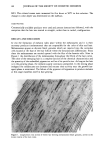
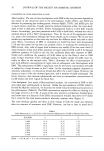
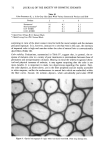
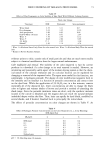
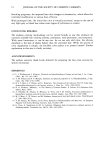
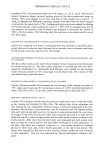
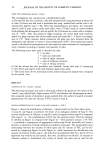
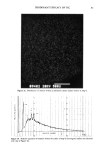
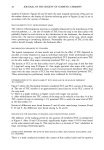
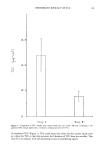
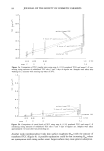
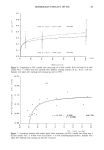
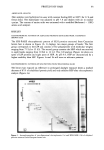
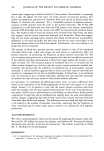
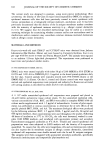
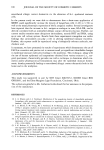
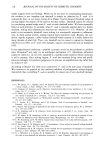
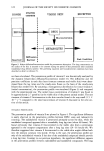
68 JOURNAL OF THE SOCIETY OF COSMETIC CHEMISTS HCI. The colored tresses were immersed for five hours at 50øC in this solution. The change in color depth was determined on the LabScan. HAIR WAVING Commercially available products were used and process instructions followed, with the exception that the hair was treated in straight, rather than in curled, configuration. RESULTS AND DISCUSSION In vivo the formation of melanin takes place within the melanocytes and it is their secretory products (melanosomes) that are responsible for the color of skin and hair. Melanosomes appear as discrete black granules which are injected into the corticular cells located at the base of the hair follicle where the keratinocytes differentiate. From there the melanosomes are carried upward with the flux of the keratin cells. Note in Figure 1 the distribution of the melanosomes throughout the fibrils of the hair cortex. The color of the emerging hair is a complex function of the chemical characteristics and the quantity of the embedded pigment as well as of its particle size. As long as the hair is in the growing phase, the melanin supply continues unimpeded. In the resting phase (telogen) the melanocytes are dormant and resume their activity once the growth (an- agen) phase is reinitiated. The failure of the pigment cell apparatus to produce melanin at this stage manifests itself in hair greying. Figure 1. Longitudinal cross section of brown hair showing melanosomes (black granules, arrow) in the keratin matrix of the hair cortex.

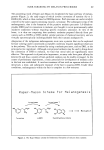
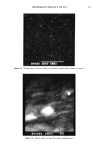
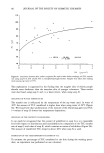
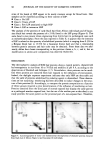
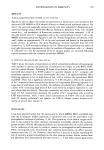
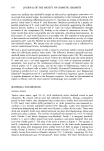
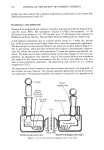
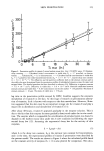
HAIR COLORING BY MELANIN PRECURSORS 69 The pioneering work of Raper and Mason (4) deciphered the basic pathway of melano- genesis (Figure 2), the early stages of which involve conversion of tyrosine (A) to L- DOPA (B), which is then oxidized to DOPAquinone. Both processes are under catalytic control by the same copper-containing enzyme, tyrosinase. The subsequent steps of the melanogenesis, that is the formation of the putative melanin precursor 5,6-dihydrox- yindole (DHI) and its conversion to melanin, are thought to occur spontaneously under oxidative conditions without requiring specific enzymatic assistance. In view of the latter, it is thus not surprising that synthetic melanins prepared directly from pre- cursors such as DOPA or DHI exhibit similar patterns of chemical reactivity and are virtually spectroscopically indistinguishable from their natural analogues (5). Adaptation of the indigenous melanogenesis route into a process that can be exploited for hair coloring under cosmetically acceptable conditions requires significant shortcuts in the pathway. This can be attained by using a melanin precursor, such as DHI, as the principal active ingredient. Although conventional oxidants may be used to bring about the conversion of DHI to melanin, we find that metal salts are significantly more effective. This approach is of particular importance, as many salts have great affinity for keratin (6) and thus a system of hair-anchored catalysis can be readily envisaged. In the course of preliminary experiments, a basic procedure for development of melanin color in the hair was established. It involves treatment of hair with an aqueous solution of a metal salt, a rinse, and subsequent exposure of the hair to aqueous DHI. Under these conditions, melanogenesis within the hair is complete in a few minutes. Raper-Mason Scheme ?or Melanosenesis tyr•oslnase ty•oslnase ? " laX•[•...•c%" • NH• HO/•,,,• NH• Tyrosine L-DOPfl 5•6-Dihydroxyindole Melanin Figure 2. The Raper-Mason scheme for biochemical formation of melanin from tyrosine.
Purchased for the exclusive use of nofirst nolast (unknown)
From: SCC Media Library & Resource Center (library.scconline.org)