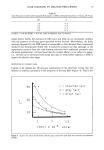
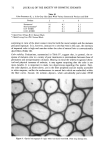
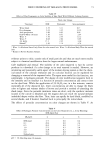
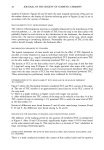
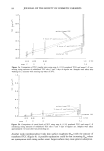
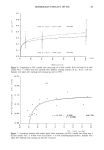
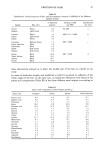
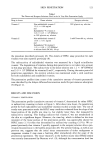
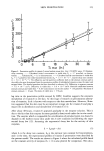
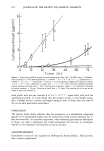
SKIN PENETRATION 123 200 o o 6 12 18 24 30 36 Time (h) Figure 3. Penetration profile of vitamin C across hairless mouse skin. Key: ([•) HPLC assay. (O) Radioac- tivity counting. - .... Calculated (initial concentration in viable skin C o = 2.7 •mol/ml, no biocon- verson) ....... Calculated (C o = 0, no bioconversion). -- Calculated (initial concentration in viable skin C o = 2.7 •xmol/ml, first order bioconversion kinetics k o = 1.5 x 10⁻⁵ s-•, enzyme decay rate constant A = 5.6 x 10 -6 s-•). The diffusivity and the partition coefficient both in the stratum corneum and in the viable skin were determined from the penetration profiles of radiolabeled vitamins across the intact and stripped skins. The detailed procedure has been described in reference (10). Diffusivity in stratum corneum = 7.6 X 10 -• cm2/s. Diffusivity in viable skin = 5.8 x 10 -8 cm2/s. Partition coefficient between stratum corneum and viable skin = 0.28. Concentration on the skin surface = 136 •xmol/ml. Thickness of stratum corneum = 10 •m. Thickness of viable skin = 370 •tm. lag time in the penetration profile assayed by HPLC therefore suggests the extensive metabolism of vitamin E in the skin. At this stage of research on percutaneous absorp- tion of vitamins, little is known with respect to the skin metabolism. However, Shira- tori suggested that the skin may be an important storage site for vitamin E and play a major role in distribution and metabolism of vitamin E (11). After about 48 hours, vitamin E appeared gradually in the receptor solution. This is due to the fact that skin enzyme becomes gradually deactivated under the in vitro condi- tion. The enzyme which is responsible for esterification of estradiol esters was found to degrade in the hairless mouse skin under the in vitro condition by following the expo- nential decay law (12). Assuming the exponential decay law for the activity of skin enzymes, k = koexp( - At) (1) where A is the decay rate constant, k o is the intrinsic rate constant for bioconversion, and t is the time, the experimental profiles of vitamin E penetration were described by the present model. The results are shown in Figure 4 where the calculated profile based on the constant activity of enzymes (A = 0) is also plotted for comparison. The calcu-

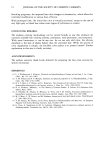
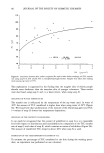
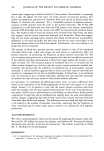
124 JOURNAL OF THE SOCIETY OF COSMETIC CHEMISTS 6 2 o - // - _ ///(3 0 12 24 36 48 60 72 Time (h) Figure 4. Penetration profile of vitamin E across hairless mouse skin. Key: (VI) HPLC assay. (O) Radioac- tivity counting ( X 1/10). m Calculated (k o = 0.0038 s- •, A = 5.6 X 10 -6 S- •). __ Calculated (k o = 0.0038 s- •, A = 0). - .... Calculated (X 1/10) (k 0 = 0, no metabolism). Diffusivity in stratum corneum = 8.4 X 10 -• cm2/s. Diffusivity in viable skin = 7.1 x 10 -8 cm2/s. Partition coefficient between stratum corneum and viable skin = 18.9. Concentration of the skin surface = 22.3 p•mol/ml. Thickness of stratum corneum = 10 p•m. Thickness of viable skin = 370 p•m. The numbers on the curves are the values of decay rate constant A. lated profile with the rate constant A of 5.6 x 10 -6 s-1 agrees fairly well with the experimental profile. It is also found that the enzyme activity in the hairless mouse skin, if freshly excised, remains unchanged during at least 24 hours after the onset of the in vitro skin penetration experiment. CONCLUSION The present study clearly indicates that the permeation of a radiolabeled compound appears to be significantly higher than the penetration of the actual compound due to skin bioconversion. It is therefore important, when evaluating percutaneous absorption of drugs, not only to determine the overall permeation rate but also to investigate whether or not enzymatic bioconversion occurs in the skin. ACKNOWLEDGMENT Radiolabeled vitamin E was supplied by Hoffmann-La Roche (Nutley, NJ) and their help is greatly appreciated.
Purchased for the exclusive use of nofirst nolast (unknown)
From: SCC Media Library & Resource Center (library.scconline.org)