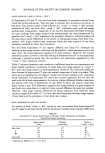
350 JOURNAL OF THE SOCIETY OF COSMETIC CHEMISTS washes (ANOVA: 90% confidence level, p = 0.068). Combining the results, it is concluded that these two shampoos alter hair body differently (98% probability, p = 0.018) and that Shampoo B-washed tresses have more hair body than tresses washed with Shampoo A. The tresses were also evaluated by an expert panel. They judged the hair treated with Shampoo B to be cleaner, fuller, and "drier" and to have more body than the A-treated hair. The latter tresses were assessed to be more conditioned, softer, and slightly limp. Friedman analysis of the data showed the two treatments significantly different at 99% confidence level. This experiment demonstrates the utility of the image analysis technique for instru- mentally evaluating, and differentiating between, hair body effects of shampoos, that is, after treatments that alter hair fiber surfaces in a relatively small manner. These two shampoos differ basically in the use of paraffin wax (B) and silicone (A) as the active conditioning materials. This image analysis hair body technique essentially assesses the different surface effects of these two compounds delivered from a shampoo. Hence this experiment provides further evidence of the utility of this technique for the cosmetic chemist. CONCLUSIONS A method has been developed to quantify hair body in terms of volume changes in tresses measured either via planimetry or by image analysis. For large volume differences (eight- and fourfold respectively), hair body can be evaluated as hair volume irrespective of textural changes. We have shown, too, that the image analysis technique can dis- tinguish between formulations within a product type (shampoos) and that the data agree with expert panel (subjective) evaluations. We have also presented panelist data that indicate a textural component is sometimes a part of self-assessment of hair body. As hair increases in curvature, hair body and hair volume generally increase. However, there are individual preferences and limitations to curvature changes as the kinky region of curvature is approached. One limitation in the correlation of the image analysis technique with panelists' evaluation of hair body occurs if the hair is extremely curly (black Afro-American hair). Hair texture may also play a role in body evaluations, particularly when the relative volume differences between treatments is small (approx- imately 1.6-fcld or less). We conclude that image analysis is a valid technique to assess hair body of hair samples that encompass a wide range of volume and textural differ- ences. REFERENCES (1) M. L. Garcia and Jose Diaz, Combability measurements on human hair, J. Sac. Cosmet. Chem., 27, 379-398 (1976). (2) C. R. Robbins and C. Reich, Prediction of hair assembly characteristics from single-fiber properties. Part II. The relationship of fiber curvature, friction, stiffness, and diameter to combing behavior, J. Sac. Cosmet. Chem., 37, 141-158 (1986). (3) P. Hough, J. E. Hey, and W. S. Tolgyesi, Hair body, J. Sac. Cosmet. Chem. 27, 571-578 (1976). (4) C. R. Robbins and G. V. Scott, Prediction of hair assembly characteristics from single fiber prop- erties,J. Sac. Cosmet. Chem., 29, 783-792 (1978). (5) D. L. Wedderburn and J. K. Prall, Hair product evaluation: From laboratory bench to consumer and back again, J. Sac. Cosmet. Chem., 24, 561-576 (1973).

j. Soc. Cosmet. Chem., 42, 351-359 (November/December 1991) Cationic-anionic surfactant interactions on wool: Implications for the conditioning of human hair LEO A. HOLT, The Textile and Fibre Research Institute, 23 Cumberland Rd., Pascoe Vale 3044, Australia. Received April 16, 1991. Presented at the 24th Annual ConJ•rence of the Australian Society of Cosmetic Chemists, South Australia, 1989. Synopsis Pretreatments of wool with an anionic surfactant influenced the uptake of cationic surfactants. When the amount of anionic surfactant on the wool was greater than the amount of cationic surfactant applied subsequently at pH 7, the initial sorption was followed by desorption of both anionic and cationic surfactants. Desorption of cationic surfactants was not observed when a large excess was applied. When wool was treated first with a cationic surfactant and then with an anionic surfactant at pH 3.5, similar sorption/ desorption effects were observed. The formation of an anionic-cationic complex that slowly desorbs from the fiber may be important in the mechanism of conditioning of hair with cationic surfactants. Procedures such as washing hair with non-ionic surfactants or cold acetone/salt water mixtures are shown to be ineffective for removing ionic surfactants from hair. Previous experiments investigating the conditioning of hair may, therefore, have been misin- terpreted. INTRODUCTION The mechanism of the conditioning of hair is not well understood (1). The action of cationic surfactants as conditioning agents for hair has been attributed to their greater binding by comparison with anionic surfactants and to their durability to rinsing treatments (2). However, structural rearrangement of the sorbed cationic at the fiber surface has been proposed (3) as being essential for conditioning, so as to explain the effects that can be obtained on hair by dodecyltrimethylammonium chloride treatment only when the hair is subsequently warmed. Robbins et al. (4) found that the uptake of cationic surfactants by hair was faster if the hair had been pretreated with an anionic surfactant, and that equilibrium sorption occurred at a lower level than with untreated hair. The uptake of surfactants by wool has been well documented for both anionics and cationics. Length of surfactant side-chain, and time, temperature, and pH of applica- tion, all affect the amount of surfactant bound to wool (5-8). The extraction of anionic surfactants from wool has also been extensively studied (9). 351
Purchased for the exclusive use of nofirst nolast (unknown)
From: SCC Media Library & Resource Center (library.scconline.org)