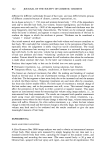
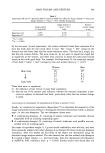
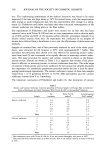
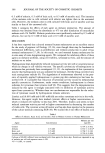
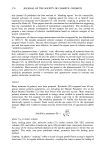
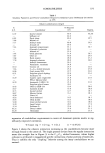
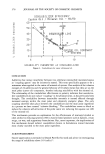
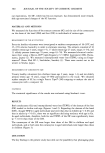
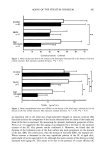
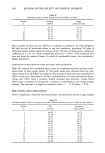
348 JOURNAL OF THE SOCIETY OF COSMETIC CHEMISTS IMAGE ANALYSIS VS BODY ("VISUAL + FEEL") In Experiments III and IV the final hair body assessment by panelists included both visual and tactile evaluations. This was done to examine the contribution of texture to hair body. The question arises of how different is a "visual" vs "visual + feel" panelist evaluation of body and how does "visual + feel" evaluation agree with the image analysis body measurement. Inspection of the data for Experiment III (Table II) shows the same rankings from image analysis body measurements and visual assessments (by panelists) and "visual + feel" assessments (by panelists). However, statistical analysis of the data shows subtle differences in the ability to distinguish among these three eval- uations, with image analysis body assessment being the most sensitive of the three evaluation methods for these four treatments. The data from Experiment IV are slightly different (see Table IV). Although the rankings of the image analysis evaluation and the panelists' visual assessments are in the same order, the visual assessment appears to be more sensitive. However, the textural assessment causes a reversal in the body ranking of treatments B and F in this experiment (although it should be noted that this reversal is not statistically significant by the "visual + feel" evaluation of body). Table V compares Spearman rank correlation coefficients from the two experiments and shows highly significant correlations of visual body and image analysis or "visual + feel" body and image analysis in both experiments. However, the correlation coefficient does decrease for Experiment IV when the textural component of body is included. This result may be explained by the relative volume and textural changes of the treatments being considered. In Experiment III, where the textural component did not alter the rank order of the body measurements, the relative volume difference between treatments was almost twice that of Experiment IV (see Table V) when the texture component began to play a role. This observation suggests that image analysis is a good measure of hair body even when there is a relatively large textural difference between hair samples. However, when large textural differences are being examined with relatively small volume changes of the order of 1.6 or less, then the relationship between image analysis of hair body and the perception of hair body may weaken. BODY ASSESSMENT BY MEN AND WOMEN An analysis of body "visual + feel" ratings by men and women from Experiments III and IV suggests that hair treated with the particulate treatment B are assessed differently Table IV Experiment IV: Image Analysis Body vs Panelists' Visual Assessments and Panelists Visual-Plus-Textural Evaluation Image analysis Panelists Panelists body (visual body) ("visual + feel") Most body D* D* D* v B F ] F* B C* Least body C C * Significantly different at p = 0.05 level.

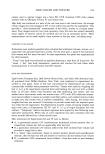
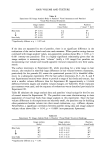
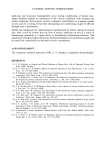
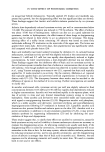
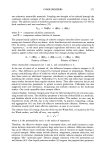
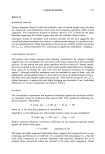
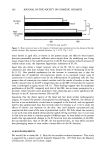
HAIR VOLUME AND TEXTURE 349 Table V Experiments III and IV: Spearman Rank Correlation Coefficients (Rho) for Image Analysis vs Visual and Image Analysis vs "Visual + Feel" Panelist Evaluations Image analysis vs Relative Image analysis "visual + feel" volume change vs visual body body in test Experiment III 0.85 * 0.84' 3.0 Experiment IV 0.94** 0.71' 1.6 * p 0.001. ** p = 0.0001. by the two sexes. In each experiment, the women evaluated tresses from treatment B to have less body than the men rated them to have. The "visual q- feel" rating (of the women) was also lower than that for visual evaluation alone. This hair has a rough, dry feel that the women dislike. The men, however, do not seem to regard the rough feel as negatively as the women, and these men continue to assess the particulate-treated tresses as hair with good body. For example, for Experiment IV the statistical analysis of hair body ("visual + feel") ratings by men and women shows (p = 0.05): Women Men Most body D[ D* E E •/ F* B c I Least body B C* These data serve to emphasize: (i) the influence of hair texture on hair body assessment (ii) that the sex of the assessor may influence whether the textural component is per- ceived to enhance or diminish hair body, particularly when the hair volume change is small. EVALUATION OF TECHNIQUE TO DISCRIMINATE WITHIN A PRODUCT TYPE Finally, we conducted an experiment (Experiment V) to determine the sensitivity of the image analysis/hair body method to distinguish between formulations within a product type--in this case shampoos. The two shampoos chosen were: ß A conditioning shampoo, A, consisting of anionic surfactant and insoluble silicone suspended with an acylating suspending agent ß A conditioning shampoo, B, consisting of anionic surfactant with paraffin wax sus- pended with an acylating agent Six tresses of equivalent weight (3.5 g) and initial combability were selected, and were then repeatedly washed with either shampoo A or shampoo B (three tresses per shampoo treatment). After five washes the hair body of the tresses was determined using the described image analysis method. The data showed that the hair washed with Shampoo B occupied a larger volume, i.e., had more body, than that shampooed with Shampoo A (ANOVA: 90% confidence level, p = 0.056). Similar results were found after ten
Purchased for the exclusive use of nofirst nolast (unknown)
From: SCC Media Library & Resource Center (library.scconline.org)