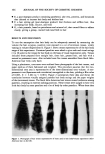
342 JOURNAL OF THE SOCIETY OF COSMETIC CHEMISTS different for different individuals because of hair type, and may differ between persons of different countries because of climate, customs, expectations, etc. An in-house survey (n = 150 men and women) showed only --15% of the respondents used stiff to describe hair body, but volume, bounce (springiness), and thickness de- scriptors were each used by -90% of the respondents. Volume and thickness were the most frequently cited hair body characteristics. The former can be evaluated visually, while the latter is inferred, and appears to require a textural examination of the hair to confirm the degree to which the attribute is present. Thickness can be considered a "volume q- texture" attribute. Our initial research with panelists suggests that both volume and texture contribute to hair body. We concluded that volume contributes most to the perception of hair body, especially when the judgement is solely visual (no tactile contribution). The visual impact of voluminous hair moving in a controlled manner is a universal description of hair with body. In the past year, volume has in many cases superseded body as a claim of hair care products and many "volumizing" products are now available in the US market. Texture should be more important for self evaluation than when the evaluation is made about someone else's hair. In the latter case evaluation is usually only visual. Products that impart body to hair can be divided into two main groups: ß Permanent treatments e.g., permanent waving solutions, hair bleaches ß Temporary effects e.g., shampoo, conditioner, or fixative type treatments The former are chemical treatments that affect the making and breaking of covalent bonds in the hair and, in the case of permanent waving, the amount or degree of curl of the hair. The hair appears to have more body due to the increased curl and the manner in which the fibers interact. Temporary treatments are used more often by consumers, but these also deliver smaller effects. For both types of treatments a textural change of the hair surface may, and in the permanent case will, occur. This textural change can affect the perception of hair body in either a positive or negative manner. This paper reports an instrumental means for measuring hair volume using image analysis, i.e., an instrumental hair body assessment. The results are compared with panelist assessments made using visual and visual-plus-tactile evaluations. For certain treatments, e.g., permanent waves where the hair volume change is relatively large, volume measurement alone will suffice. However, for a few surface treatments, e.g., where the hair volume change is relatively small and the texture change is relatively large, hair texture and hair volume may both need to be evaluated and the results combined to give the most meaningful measure of hair body. EXPERIMENTAL IMAGE ANALYZER EVALUATIONS A Zeiss Kontron Ibas 2000 image analyzer was used to obtain an instrumental measure of hair body. Hair tresses were measured by simply hanging the test tress next to a standard (control) body (hair tress), capturing the images on the analyzer screen, and determining and recording the tress areas. (The same control body--a 30 g tress of Oriental hair, sprayed with hair spray until rigid--was used for all experiments). The

HAIR VOLUME AND TEXTURE 343 camera used to capture images was a Sony XC-77CE miniature CCD video camera module with an Olympus 50-mm F2 auto-macro lens. Hair body was evaluated as a ratio of the test tress area to the control area. An average of four images per tress (imaged at 90 ø to each other) was used for the assessment. This provides a "three-dimensional" measurement of hair body, similar to a human assess- ment. Four images (and not two) were necessary, since the tress was rotated manually (exact angles of rotation cannot be verified) and not by an automated device. These measurements can be made rapidly: three minutes or less per tress, including setup. PANELISTS' EVALUATIONS Evaluations were made by panelists who evaluated hair attributes (volume, texture, etc.) using their own personal experience criteria. For the most part, a panel of ten evaluators (five women and five men) was used. In some experiments this panel was supplemented by other assessors. "Visual" hair body was evaluated by panelists observing a tress from all directions. For "visual + feel" hair body assessments, panelists also touched the hair fibers while estimating body in the previously described manner. HAIR AND TREATMENTS Light brown European hair, dark brown Oriental hair, and black Afro-American hair, all purchased from DeMeo Brothers, New York, were employed in experiments de- scribed in this paper. Some of this hair was permed for experimental use utilizing commercially available home permanent wave kits. Tresses were made by weighing the hair (1 to 6 g for experiments reported here) and binding the root end with a rubber band. In all cases, before final treatment and after fashioning into tresses, hair was washed twice (one-minute wash one-minute rinse, 43øC) with 20% surfactant (ammo- nium lauryl sulfate) to ensure an initially clean fiber surface, and combed twenty strokes to make sure that tresses were of uniform combability. After drying, the tresses were weighed and hair was removed (if necessary) to provide tresses with the required quan- tity of hair for the experiment. For Experiments I and II, tresses of varying weights (and type) were used in Experiments III, IV, and V, 3.5 g of virgin European hair was utilized. "Temporary" surface treatment regimens were applied to hair following man- ufacturers' instructions. When only an active ingredient was used, treatment time was thirty seconds followed by a thirty-second rinse. Hair treatments for Experiments III and IV were as follows: ß A, a quaternized protein (2% laurdimonium hydrolyzed animal protein) that in- creased hair volume but did not appreciably alter hair feel ß B, a particulate treatment (2% barium sulfate) that both increased hair volume and provided a rough feel to hair ß C, a "heavy" hair conditioner, based on cetearyl alcohol, keratin and stearalkonium chloride, that left hair very soft and smooth to touch but did not enhance hair volume ß D, a surfactant (20% ammonium lauryl sulfate)•-clean hair with no post-shampoo treatment
Purchased for the exclusive use of nofirst nolast (unknown)
From: SCC Media Library & Resource Center (library.scconline.org)