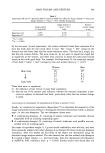
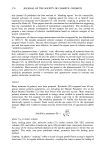
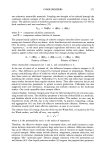
COSOLUBILIZERS 371 two otherwise immiscible materials. Coupling was thought to be induced through the combined cohesive energies of the solvent and cosolvent (cosolubilizer) acting on the solute. The additive nature of solubility parameters has been the explanation (32-34) for both cosolvency and non-cosolvency (35). 8123 where 8 = component solubility parameters, and cI) = component volume fraction of mixture The proportionally additive mixing of cohesive energies described above assumes "ori- enting and chemical effects are absent, while distributions and orientations are random (36). In reality, competition among cohesive energies results in non-polar separation by "squeeze-out," as the more polar (stronger) ingredients self-attract and coalesce. Par- tially miscible mixtures exhibit energetic competition within each phase. Additive polarity applies within each individual phase but changes during equilibrium. 8• = (ti)81) + (tI)82) + (tI)Sc)• 82 = (ti)82) + (tI)Sc) Polarity of Phase 1 Polarity of Phase 2 where immiscible components are 1 and 2, and cosolubilizer is C. In the case of castor oil vs mineral oil, the difference between cohesive energies is 30 cal/cc. That difference can be reduced by increased pressure or temperature. However, strong cosolubilizing effects of additives which maintain the polarity dif•rence indicate that there exists an additional important contributor to phase separation mechanics modifying the cohesive energy. Yalkowsky (37), Acree (38), and others have recognized many similar deviations from regular solution theory. They offer correction factors and empirical interaction parameters to permit accurate predictions. Yalkowsky has also suggested some new mechanics, recognizing non-uniform cohesion on the molecular surface. Our study quantifies these entropic effects. Cohesive blocking. Cohesive energies arise from the field produced by the electrons spin- ning around each atom. The solubility parameter is the sum of these fields in a molecule, and therefore related to the size of the molecular surface. This surface, in turn, may be described as sticky (39,40), due to the cohesive fields. In practice, branching, coiling, and aggregation (41) can limit the effective intermolecular cohesion. However, these deviations usually yield lower effective polarities, as seen in our results. The cohesive force (U), being a function of the van der Waals field, is situated at the Van der Waals surface, and falls off very, very rapidly. 2 --6 U=ar where a is the polarizability and r is the radius of separation. Therefore, the effective cohesive range is extremely short, and small increases in sepa- ration between molecules will produce large reductions in cohesion. Molecular distanc- ing can be effected most commonly through heat. Loss of viscosity on slight heating is a typical example. Other means include dilution, magnetism, pressure reduction, and solvation. In solvation, dissimilar molecules with similar cohesive energies will attract, wedging "like" molecules apart. Density changes consistent with this mechanism are well known (42). Gas-liquid partition studies (43) support the proposal that geometric

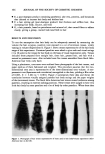
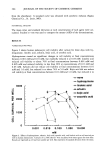
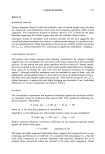
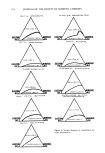
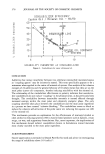
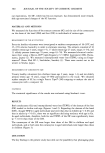
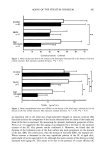
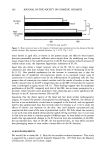
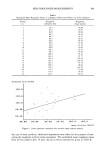
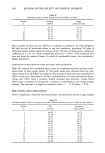
372 JOURNAL OF THE SOCIETY OF COSMETIC CHEMISTS dissimilarity relates to reduced interaction. Mechanistically viewed, as less contact is possible, entropy rises and is evidenced in reduced cohesion. This is what we believe is happening in the cosolubilizer systems we studied and possibly in all systems that use true molecular cosolubilizers and not microemulsifiers. EXPERIMENTAL For a model system we chose mineral oil/castor oil. This system is immiscible, with components separated and differing by about 30 cal/cc (two solubility parameter units). Mineral oil/castor oil is a good model system for lipstick development, and was origi- nally investigated by Chadwick and Pears (4). The mineral oil/castor oil system exhibits two-phase immiscibility throughout the temperature range shown in Figure 1. The limited solubility of mineral oil makes this system sensitive to effects of additives. The steric dissimilarity between mineral oil and castor oil exaggerate this effect. Turbidity titration (44) was performed in a carefully temperature controlled (+/- 0. IøC) insulated beaker. Various cosolubilizers were added to magnetically stirred mixtures of castor oil and mineral oil by weight. Clarity was determined by the visibility of lines in a standard ruled strip of notebook paper placed under the beaker. T P . o 70 •o 4o 3o 20 -to CASTOR OIL MINERAL OIL Figure 1. The mineral oil/castor oil system exhibits two-phase immiscibility throughout the temperature range.
Purchased for the exclusive use of nofirst nolast (unknown)
From: SCC Media Library & Resource Center (library.scconline.org)