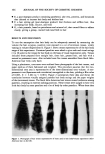
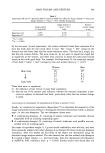
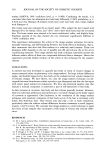
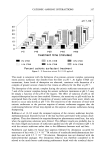
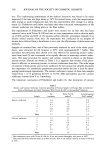
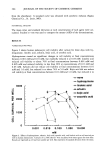
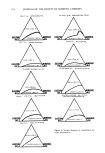
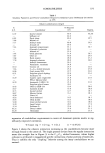
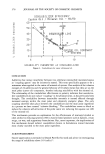
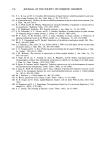
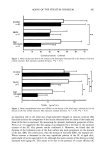
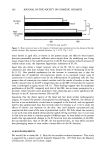
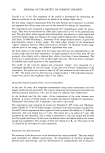
COSOLUBILIZERS 373 RESULTS MONOPHASE DOMAINS Ternary diagrams (Figure 2) show the solubility state of various weight ratios of castor oil, mineral oil, and cosolubilizer. Each corner of the diagrams represents 100% of each ingredient. The combination required to produce clarity at 25øC is shown by the phase boundary separating the soluble (upper) area and the insoluble (lower) region. Systematic studies of emulsifiers with cosolvent alcohols (45,46) have suggested that nonuniform phase boundaries are related to conformational changes in interfacial struc- ture and amphiphilicity. Phase boundaries in this study are uniform with few exceptions (see C12-C15 alcohol benzoates) (47), indicating no significant amphiphilic "bridging." COSOLUBILIZING EFFICIENCY The pattern that clearly emerges from ordering cosolubilizers by cohesive energies suggests that the cosolubilizer acts selectively on the polar component of the immiscible mixture. In this system the most polar ingredient would be castor oil. Several emulsi- fiers were included in the study to see if they would exhibit added efficacy by "bridging" from castor oil to mineral oil, since such were the historical mechanics of "coupling agents." Although solubility parameters were not available for some of them, only the amphiphiles and emulsifiers closest to the polarity of castor oil exhibited high solvency, and these were only slightly higher than projected. Thus with the exception of C12-C15 alcohol benzoates, it appears that only slight bridging was detectable, if any. Individual efficiencies of 34 test cosolubilizers are listed in Table I. STATISTICS The cosolubilizer requirement was regressed nonlinearly against the solubilizer solubil- ity parameter using the method of least squares (48). This yielded the following em- pirical quadratic relationship: % Cosol. req. = 4.455 Spc 2 - 81 Spc + 387 where Spc is the solubility parameter of cosolubilizer. Simplified, to the following root relationship between castor oil and cosolubilizer: % Cosol. req. = 9(0.5 Spc 2 - 9 Spc + 43) Product moments (Pearson's correlation coefficient) for the nonlinear regressed results against the actual values gave: r = 0.9289 (goodness of fit) The easily factorable regressed relationship above suggests that separate factors or par- ticipating contributors are at work here. It is consistent with our proposal (i.e., that the most polar component of a mixture dominates that mixture's dynamics) for us to examine those interactions where one material is the most polar component. Linear

374 JOURNAL OF THE SOCIETY OF COSMETIC CHEMISTS BUTYL STEARATE OCTYL DODE•NOL CASTO ERAL OIL! • • '•ø• •'•' • •- •01L I SOSTEAF•ETH--2 CAS INERAL OiL/ •,•o?•-• 'SOIL •0• CETYL A •--ETATE Oll CAS ERAL OIL/ / ,, \OIL C12--15 BENZOATES CAS ERAL OIL! • * •'% ...... XOiL OLEYL ALCOHOL CAS INERAL OIL / /•,.,•o•u•,-,• -'%OIL ISOPROPYL PALMI TATE CAS ERAL OIL/ ,/ • NSI•OLUE:•LI'- XOIL PROPYLENE •LY•--OL D I PELAR•ONATE CAS INERAL OIL/ / ..... ...... \OIL Figure 2. Ternary diagrams of cosolubilizers for castor oil/mineral oil.
Purchased for the exclusive use of nofirst nolast (unknown)
From: SCC Media Library & Resource Center (library.scconline.org)