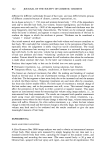
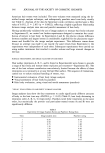
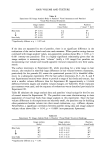
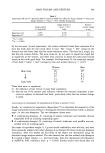
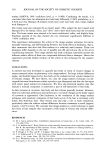
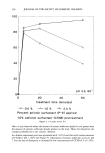
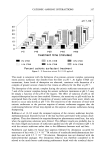
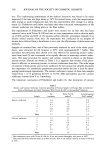
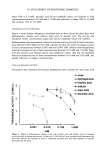
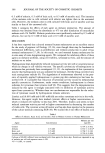
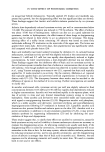
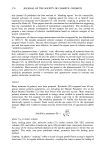
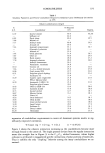
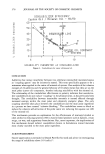
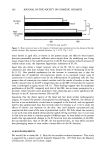
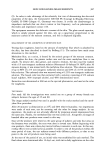
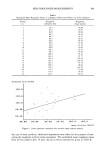
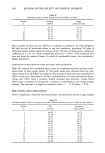
COSOLUBILIZERS 3 7 5 Table I Solubility Parameters and Percent Cosolubilizer Required to Solubilize Castor Oil/Mineral Oil (50/50) at 25øC Relative solubilization strength 8 % Required S.P. Cosolubilizer (25) Regress. 6.19 Isocetyl stearate 50.9 56.2 % -- Safflower oil 44.0 -- 6.92 Decyl oleate 40.6 39.5 7.09 Mineral oil -- 7.17 Isodecyl oleate 40.8 34.9 -- Avocado oil 39.0 7.43 Isostearyl neopentanoate 35.1 30.7 -- Glycereth-3 palmitate 34.0 -- Almond oil 32.4 7.44 Octyl palmitate 31.0 30.5 7.87 Olive oil 30.0 24.9 7.68 Butyl stearate 28.0 27.2 7.78 Isopropyl palmitate 28.0 26.0 -- Isodecyl isononanoate 26.5 Pentaerythr. tetraoleate 24.8 8.10 Coconut oil 23.4 22.6 7.63 C x2-C •5 alcohol benzoates 23.0 27.8 8.06 Cetyl acetate 90% 22.5 23.0 8.21 Propylene glycol dipelarg. 22.0 21.6 Eucalyptus oil 22.0 -- 8.29 Caprylic capric triglyceride 21.0 21.0 PPG-2 Myristyl ether 21.0 -- 8.29 Isosteareth-2 (HLB 2.0) 21.0 21.0 Propylene glycol laurate 20.5 -- 8.43 Oleth-2 (HLB 4.9) 19.9 20.0 8.67 Isostearyl alcohol 15.0 18.8 8.71 Isocetyl alcohol 12.7 18.7 8.87 Myristyl lactate 13.1 18.2 8.90 Castor oil -- -- 8.92 Octyl dodecanol 14.5 18.1 8.95 Oleyl alcohol 15.3 18.0 9.00 Linear alcohol lactates 19.2 18.0 9.20 Lauryl lactate 20.5 17.9 9.34 Padimate O 23.6 18.1 10.21 Dioctyl malate 21.6 23.1 10.29 Homosalate 27.2 23.9 regression of cosolubilizer requirements in castor oil dominant systems results in sig- nificantly improved correlation. % Cosol. req = 14.5 spc + 141.2 (r = 0.9725) Figure 3 shows the cohesive interaction increasing as the cosolubilizers become more strongly bound to the castor oil. The single greatest deviant from the regular interaction mean (the straight line in Figure 3) is the C•2-C•5 alcohol benzoates, whose higher cohesion is attributed to exaggerated specific interactions of polar portions of molecules. Thus it exhibits the only "coupling" behavior among the many cosolubilizers we ex- amined.

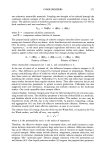
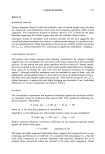
376 JOURNAL OF THE SOCIETY OF COSMETIC CHEMISTS C:OSO LLIB, I L I Z ERE F F I C I EHCV C.•stor Oil / Idiner.•l Oil - 50/513 61-] , • C,4 s TOIl \ [3..•,.... I•Ib/EI?AL OIL ..,& OIL' "' '•,,t.. E] REGRE::" S•,OIi LIHE i ' I " ..... ---' I ""J-•S[]:EM"S ' - I I I I o 'iEI SO LI_IB, I L IT'.? PARAhlET ER cd:' -"- ½'- -• ' I_:J._,l_l LLIB. I L I ..-ER Figure 3. Cosol•biIizcrs oeor c•stor oil/•incr•l oil. HAHT CONCLUSION Additives that induce miscibility between two otherwise immiscibile materials known as "coupling agents" may be incorrectly named. This term specifically appears to be a misnomer when applied to the castor oil/mineral oil system. Our analysis of the cohesive energies of 24 additives and the general behavior of 10 others shows that they act on the most polar (castor oil) component, thereby inducing miscibility with the mineral oil. The relationship of the cosolubilizer effectiveness to polarity indicates that nonelectro- lyte cosolubilizers do not induce "coupling" in the physical sense, as has previously been thought. The cosolubility between immiscible materials is instead effected through increased entropy within the most polar and cohesively energetic phase. The only coupling observed takes place between the cosolubilizer and the most polar ingredient in a process we have termed "cohesive blocking." The cosolubilizer serves to block or reduce the cohesive self-attraction of the polar castor oil, reducing the squeeze out (49) of the mineral oil. This mechanism provides an explanation for the effectiveness of isostearyl alcohol or oleyl alcohol in reducing syneresis (50) in wax/oil based products such as lipstick, cream rouge, car wax, and suppository formulations. But, more important, the implications of this mechanism should redirect cosolubilizer choices in formulation toward materials most closely matched to the most polar ingredient. ACKNOWLEDGMENT Sincere appreciation is extended to Dinesh Patel for his work and advice in investigating the range of solubilities above 9.0 (cal/cc) v2.
Purchased for the exclusive use of nofirst nolast (unknown)
From: SCC Media Library & Resource Center (library.scconline.org)