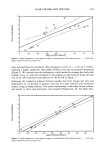
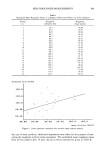
SKIN ROUGHNESS MEASUREMENTS 391 measurement. The correlation with skin moisture again confirms the assumption of Potts (9) and other authors that the water content of the stratum corneum is a significant criterion in influencing skin roughness. The methylene blue method provides a satisfactory correlation with the image analysis method (Figure 1). It confirms that this simple procedure gives usable data on the influence of cosmetics on skin roughness. The results of the correlations between the roughness investigation with the stylus equipment and image analysis are only indicative, because in this case the individual values of the test subjects were correlated. The wide individual variation helps to explain the relatively small r value. Statistical analysis indicates that the methods agree very well for a comparison of products. In Table II, product 4 achieves a significant smoothing effect according to both methods, with p = 0.05 in the t-test. This test determined whether the roughness value found differed from 100. In comparison, all other products did not provide significant results. These investigations support the conclusion that the described image analysis method provides similar results to the profilometry method and is a useful method to determine skin roughness. As image analysis is less time-consuming than the use of stylus instru- ments and the evaluation programs can be acquired on usual image analyzers without programming knowledge, this method is a useful alternative to profilometry. ACKNOWLEDGMENTS We are grateful to the Warentest Foundation, Berlin, for permission to publish data that was prepared by the two authors within the framework of a study of skin care ranges in 1987. REFERENCES (1) P. Corcuffetal., Skin relief and aging, J. Sac. Cosmet. Chem., 34, 177-189 (1983). (2) P. Corcuff et al., A fully automated system to study skin surface patterns, Int. J. Cosmet. Sci., 6, 167-176 (1984). (3) P. Corcuff et al., Evaluation of anti-wrinkle effects on humans, Int. J. Cosmet. Sci., 7, 117-126 (1985). (4) P. Corcuff et al., The impact of aging on the microrelief of periorbital and leg skin, J. Sac. Cosmet. Chem., 38, 145-152 (1987). (5) U. Hoppe, Topology of skin, J. Sac. Cosmet. Chem., 30, 213-239 (1979). (6) T. H. Cook, Profilometry of skin--A useful tool for the substantiation of cosmetic efficacy, J. Sac. Cosmet. Chem., 31, 339-359 (1980). (7) S. Makki et al., Statistical analysis and three-dimensional representation of the human skin surface, J. Sac. Cosmet. Chem., 35, 311-325 (1984). (8) U. Hoppe, G. Sauermann, and R. Lunderstadt, Quantitative analysis of the skin's surface by means of digital signal processing,J. Sac. Cosmet. Chem., 36, 105-123 (1985). (9) R. O. Potts, Stratum corneum hydration: Experimental techniques and interpretation of results, J. Sac. Cosmet. Chem., 37, 9-33 (1986). (10) J. L. Leveque and J. De Rigal, Impedance methods for studying skin moisturization, J. Sac. Cosmet. Chem., 34, 419-428 (1983). (11) G. Padberg, Modifizierte Methylenblau-Methode zur Priifung des Rauhigkeitsgrades der Horn- schicht, J. Sac. Cosmet. Chem., 12, 719-728 (1969).

j. Soc. Cosmet. Chem., 42, 393-394 (November/December 1991) Letters to the Editor TO THE EDITOR: The conclusions drawn in the Korting et al. paper on skin pH (J. Soc. Cosmet. Chem., 42, 147, 1991) require critical teevaluation. In the authors' opinion, the results "support the hypothesis that acidity or alkalinity can influence both the surface pH and propionibacteria as one of the major components of the skin flora in the long term." The authors assert that "the only difference between the two [test] preparations consisted of the pH (5.5 with preparation A 8.5 with prepa- ration B)." The chemical and physical properties of several major components common to both A and B are altered by pH. As a result, the ingredients' interaction with skin and with microorganisms are also altered. The observed differences in the results be- tween A and B should not have been attributed exclusively to alteration in the activity of hydrogen ions. The authors also failed to provide data on the time elapsed between skin washing and their measurements, a critical issue according to Sauermann et al. (J. Soc. Cosmet. Chem., 37, 309, 1987). Specifically, sodium lactate, citric acid, the vitamins, amino acids, and disodium EDTA are not the same chemicals at pH 5.5 and pH 8.5. More importantly, the reactions between an alkylether sulfate and skin protein (sorption, denaturation, etc.) depend on pH. The substantivity of the betain in the product is dependent on pH. Finally, the preservative system (which reportedly included only benzyl alcohol and methylisothia- zoline but not methylchloroisothiazoline) exhibits its stability and its optimal efficacy (perhaps against skin bacteria) in a reasonably narrow pH range. It would be a formidable task to sort out all potential interactions that might contribute to the observed differences in the propionibacteria population. An acidic skin pH per se might indeed be a poor environment for the survival of certain bacteria and may benefit acne patients, but the evidence presented to date by Korting et al. suggests that the presumptive benefit should more likely be attributed to pH-controlled alterations of one or more of the product's components. M. M. Rieger Morris Plains, NJ 07950 TO THE EDITOR: I am grateful to Dr. Rieger for his letter, as it may encourage broader discussion on the role of the pH of skin cleansers or even cosmetics in general. In fact, this has been a 393
Purchased for the exclusive use of nofirst nolast (unknown)
From: SCC Media Library & Resource Center (library.scconline.org)