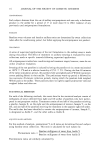
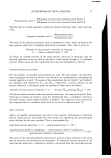
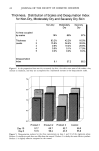
14 JOURNAL OF THE SOCIETY OF COSMETIC CHEMISTS CONDITIONING Each subject abstains from the use of axillary antiperspirants and uses only a deodorant product in the axillae for a period of 17 or more days (3) to effect washout of any previously used antiperspirant formulations. BASELINE Baseline sweat volumes and baseline axillary ratios are determined by sweat collections taken after the conditioning period, but before applying the antiperspirant test product. TREATMENT A series of supervised applications of the test formulation to the axillary areas is made during this period. The effect of treatment on axillary sweating is evaluated by sweat collections made at specific intervals following supervised applications. All antiperspirant studies have conditioning and treatment stages however, some do not utilize a baseline evaluation. Sweating of the test panelists is induced by having the panelists sit in a room maintained at 100øF --- 2øF and at a relative humidity of 35% --- 5%. During the first 40 minutes of the sweat stimulation period, the panelists hold unweighed pads of Webril (nonwoven cotton padding fabric) in their axillae. This preliminary warm-up period is followed by two successive 20-minute collection periods, during which the panelists hold weighed Webril pads in the axillae. These pads are placed in tightly capped polystyrene vials and weighed before and after use. STATISTICAL METHODS For each of the following methods, the source data for the statistical analysis consist of milligrams of sweat collected from right and left axillae of panelists who have partici- pated in antiperspirant studies. Treatments consist of one half of the panelists receiving a placebo, Sample X, on the right and the antiperspirant of interest, Sample Y, on the left, and one half of the panelists receiving the treatment in the opposite right-left order. The axilla that has been identified to receive the antiperspirant of interest, Sample Y, is designated as Axilla Y, and the other axilla as Axilla X. ADJUSTED RATIO METHOD For this method of analysis, pretreatment Y-to-X ratios are determined for each subject using baseline sweat collections. This ratio is calculated for each subject by Pretreatment ratio = Baseline milligrams of sweat from Axilla Y Baseline milligrams of sweat from Axilla X Posttreatment ratios are similarly calculated by

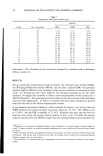
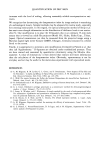
ANTIPERSPIRANT DATA ANALYSIS 15 Posttreatment ratio = Milligrams of sweat after treatment from Axilla Y Milligrams of sweat after treatment from Axilla X The data that is actually analyzed is called the adjusted treatment ratio, and is calculat- ed by Adjusted treatment ratio = Posttreatment ratio Pretreatment ratio The mean of the adjusted treatment ratios is employed to find a point estimate of the mean percent reduction in sweating achieved by consumers. This value is given by Estimate of mean percent reduction in sweating = (1 - mean of adjusted ratio) x 100. To obtain an interval estimate of the mean percent reduction in sweating, first the adjusted treatment ratios are used to calculate a small sample (Student's t) confidence interval. These values are then subtracted from one and multiplied by 100 (4). WOODING-FINKELSTEIN METHOD For this analysis, no baseline measurements are used. For each subject, the posttreat- ment milligrams of sweat for Axilla Y and Axilla X are transformed by calculating the natural logarithm of each. The means of the transformed data for Axilla Y and Axilla X are calculated and denoted by Ylog and X•og, respectively. A point estimate of the percent reduction is calculated using the antilogs of these values as follows' -- -- Estimate of mean percent reduction = [1 - Antilog (Y•og)/Antilog (X•og)] x 100. To find an interval estimate of the mean percent reduction, two steps are required. First, following an analysis of variance using the transformed data, a confidence interval is calculated using a small sample (Student's t) method. The endpoints of this interval are then exponentiated to transform them back to the percent reduction scale (5). DIRECT METHOD Again, no baseline measurements are used in this analysis. Posttreatment individual percent reductions are determined for each subject by employing the posttreatment ratios (defined for the ratio method). This is accomplished by Individual percent reductions = (1 - posttreatment ratio) x 100 = (posttreatment Axilla X milligrams) - (posttreatment Axilla Y milligrams) x 100. (posttreatment Axilla X milligrams) The mean of the individual percent reductions is used as a point estimate of the mean percent reduction in sweating for all consumers. To obtain an interval estimate of the mean percent reduction, a confidence interval is calculated from the individual percent
Purchased for the exclusive use of nofirst nolast (unknown)
From: SCC Media Library & Resource Center (library.scconline.org)