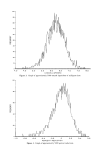
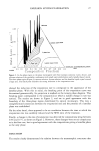
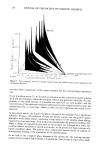
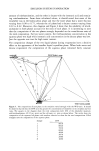
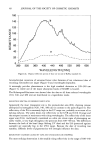
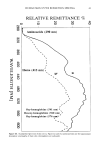
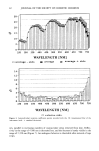
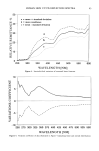
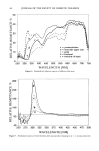
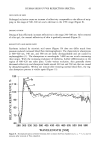
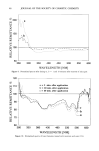
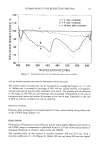
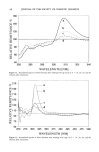
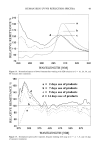
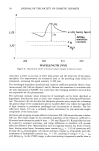
HUMAN SKIN UV/VIS REFLECTION SPECTRA 51 the drier state therefore scattering will be less, optical paths will be longer, and the chance of absorption will be larger. Such phenomena will repeat at each absorption peak but will be negligible above 340 nm on account of increasing penetration depth and the resultant falling influence of moisturization of the upper horny layer. Light-absorbing compounds very often show shifting absorption and fluorescence peaks, depending on the polarity of the solvent and the resulting stabilizing effects on ground and excited states (13). Adsorption of endogenous UV filters (such as aromtic amino acid or urocanic acid) to surfaces of corneocytes, modified by moisture content, might be another important factor influencing light-absorption characteristics of human skin (14,15). Erythema either induced by UVB, pressure (dermographism), or nicotinic acid ester shows the normal O2-hemoglobin absorption at 410 nm, 540, and 580 nm. The absorption at 460 nm is probably caused by bilirubin. Increased pressure during mea- surement decreases these absorptions. Skin with insufficient venous flow (the lower legs of elderly people) is characterized by intense absorptions at 440 and 560 nm, mainly the absorption of desoxyhemoglobin. Water extracts low-molecular-weight ingredients from the horny layer. The spectra of Figures 13 and 14 show an overlapping of the increased reflectivity caused by increased H20 content (300-340 nm) and caused by the increasing potential of soap and SDS to elute water-soluble substances absorbing in the spectral range of 250-300 nm. This is especially well recognized when the hydrated stratum corneum loses water (Figure 12) and the primarily lowered reflectivity is changing into increased reflectivity, caused by deficits of absorbing compounds (Figure 14). Reflection spectroscopy, especially in the UV range, opens many new possibilities to answer unsolved questions referring to skin moisturization and to the content of low- molecular-weight compounds in the horny layer and their light absorption, which differ in the horny layer of changing moisture content from the well known optical behavior in definite solvents. REFERENCES (1) R. Anderson and J. Parrish, The optics of human skin, J. Invest. Dermatol., 77, 13-19 (1981). (2) L. Grossweiner, "Photophysics" in The Science of Photobiology, K. C. Smith, Ed. (Plenum Press, New York, 1989). (3) H. Ippen, in Biological Effects of Ultraviolet Radiation, F. Urbach, Ed. (Pergamon Press), p. 683. (4) N. Kollias and A. H. Baqer, Quantitative assessment of UV-induced pigmentation and erythema, Photodermatol., 5, 53-60 (1988). (5) K. F. K•51mel, B. Sennhenn, K. Giese, Investigation of skin by ultraviolet remittance spectroscopy, Brit. J. Dermatol., 122, 209-216 (1990). (6) Cheryl F. Rosen and R. Gange, Immediate pigment darkening: Visual and reflectance spectropho- tometric analysis of action spectrum, Photochem. Photobid., 51, 583-588 (1990). (7) G. Sauermann and U. Hoppe, "Intrinsische Fluoreszenz yon Haut-Integrale und bildmiiBige Erfas- sung" in Empfindliche Haut (Diesbach Verlage, Berlin, 1992), pp. 95-1105. (8) I. H. Blank, Factors which influence the water content of the stratum corneum, J. Invest. Dermatol., 18, 433-440 (1952). (9) S. Dikstein, M. Katz, A. Zlotogorski, Y. Broun, D. Wilson, and H. Maibach, Comparison of different instruments for measuring stratum corneum moisture content, Int. J. Cosmet. Sci., 8, 289- 292 (1986).

52 JOURNAL OF THE SOCIETY OF COSMETIC CHEMISTS (10) G. Sauermann, unpublished results. (11) G. Sauermann, H.-J. Dfising, U. Hoppe, M. Klier, and H. W. Kreysel: Betrachtungen fiber qual- itative und quantitative Wirkungen einer W/O-Emulsion, J. Soc. Cosmet. Chem., 33, 263-280 (1982). (12) E. Hecht, Optik (Addison-Wesley, Bonn, 1991). (13) J. R. Lakowicz, Principles of Fluorescence Spectroscopy (Plenum Press, New York), Chapters I and 11. (14) W. A. G. Bruls, H. Slaper, J. C. van der Leun, and L. Berrens, Transmission of human epidermis and stratum corneum as a function of thickness in the ultraviolet and visible wavelengths, Photochem. Photobiol., 40, 485-494 (1984). (15) Publication in preparation.
Purchased for the exclusive use of nofirst nolast (unknown)
From: SCC Media Library & Resource Center (library.scconline.org)