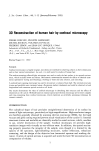
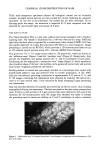
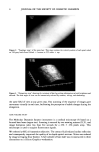
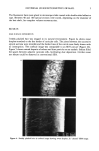
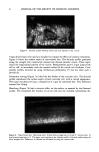
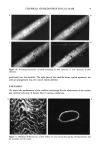
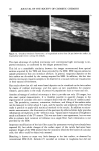
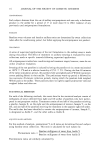
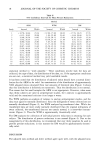
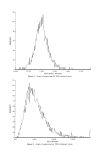
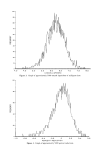
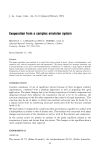
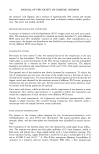
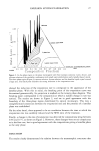
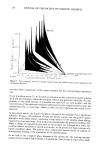
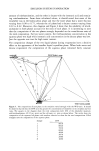
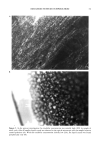
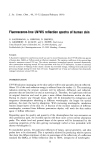
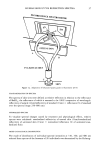
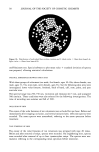
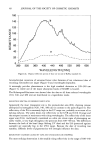
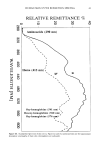
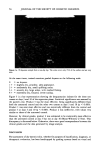
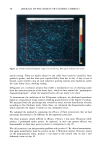
6 JOURNAL OF THE SOCIETY OF COSMETIC CHEMISTS Figure 5. Plucked eyelash showing sebum and dust deposits on the cuticle. Virgin brown hairs were used as a standard to evaluate the effects of cosmetic treatments. Figure 6 shows the surface aspect of non-treated hair. The altitude profile generated along the straight line constructed interactively showed periodic events. These repro- duced the longitudinal pattern of the cuticle. Measurements gave 0.3-1.tm jumps from cell to cell, in accordance with the reputed values (6) for cuticle cell thickness. Com- parable profiles recorded by using mechanical profilometry (7) did not draw such a periodicity. Permanent waving (Figure 7a) lifted the free border of the cuticular cells. The altitude profile reproduced the surface aspect of each cuticular cell, with a curved appearance. The jump was about 0.6 I•m, compared to 0.3 I•m for untreated hair. This difference assessed the lifting. Bleaching (Figure 7b) had a corrosive effect on the surface, as assessed by the flattened profile. The crenelated free borders of cuticle cells and the widened intercellular dis- Figure 6. Virgin brown hair. Horizontal scale: 10 •tm between large bars in X and Y. Vertical scale: 10 •tm between large bars in Z. The upper curve reproduces the altitude profile of the hair surface along the white straight line. Differences in altitude are calculated by using the vertical scale.

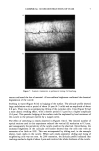
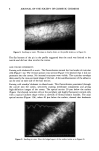
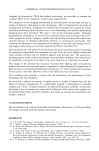
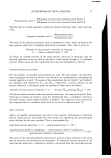
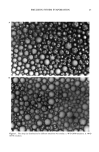
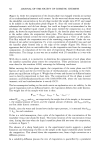
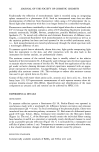
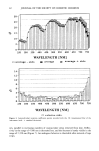
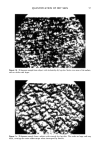
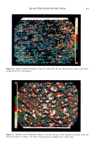
CONFOCAL 3D RECONSTRUCTION OF HAIR 7 Figure 7. Cosmetic treatments: a) permanent waving b) bleaching. tances confirmed the loss of material. A less-uniform brightness confirmed the chemical degradation of the cuticle. Swelling in water (Figure 8) led to bulging of the surface. The altitude profile showed large undulations with a period of about 34 I•m (4-5 cells) and an amplitude of about 0.8 I•m. There was no accompanying lifting of the cuticular cells. Urea (Figure 9) had a more drastic swelling effect, with a shorter period (15 I•m) but a higher amplitude (2.6 I•m). This periodic bulging of the surface could be explained by local resistance of the cuticle to the pressure exerted by a turgid cortex. The effect of stretching is clearly observed in Figures 10ad. The limited number of optical sections used in this experiment reduced the vertical (Z) resolution to 0.5 I•m, and consequently the periodicity of the cuticle could not be observed. Nevertheless, the increased brightness of the cuticular cell border showed that the cells rose with an extension of as little as 10%. This was accompanied by sliding and, in the example shown, local cracks in the cuticle. When such cracks appeared, sliding and rising of neighboring cells was not seen. At 20% extension, the altitude profile indicated that cracking reached a depth of about 4 I•m and involved the whole thickness of the cuticle.
Purchased for the exclusive use of nofirst nolast (unknown)
From: SCC Media Library & Resource Center (library.scconline.org)