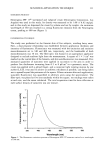
j. Soc. Cosmet. Chem., 47, 73-84 (March/April 1996) Dynamic hairspray analysis. I. Instrumentation and preliminary results j. JACHOWICZ and K. YAO, International Specialty Products, Wayne, NJ 07470. Received January 1996. Synopsis A new method, termed dynamic hairspray analysis, was developed to study the mechanical behavior of pre-set hair tresses, untreated and modified by hairspray resins, under a wide range of bending deforma- tions. The technique includes a vertically acting tensile meter designed to measure the force in both compression and extension modes. The instrument, including a sample holder and spraying devices, was housed in an environmental chamber equipped with a humidity controller. The drying of a hairspray was investigated by (a) applying low intermittent deformations to a preformed hair tress in order to determine the properties of untreated hair, (b) treating the fibers with a hairspray, and (c) measuring the changes both in adhesive properties of a hairspray solution on the surface and in mechanical stiffness of the fiber assembly as a function of drying time. This approach allows the simultaneous determination of parameters such as stiffness of untreated and resin-modified hair, duration of tack, maximum value of tack force, and time of drying. In addition to this, the data collected during the experiment provide information about changes in geometrical dimensions of hair after the application of hairspray and after subsequent drying. In order to test the resistance of fixative resins to high humidity, the kinetic measurements of stiffness and tackiness were also performed at 90% RH. INTRODUCTION The mechanical characteristics of hair, including bending and extension moduli, to- gether with surface parameters, determine their perceptible attributes such as body and feel. Hair fixatives can modify hair by imparting a permanent set and by increasing the stiffness of a fiber assembly. The key hair properties characterizing a hairspray formu- lation or a fixative resin include: ß Stiffness of a hair tress after the application of a hairspray and its complete drying. Twist retention analysis employing a torsional braid analyzer (1) and a bending test developed by BASF (2) have both been used to measure the mechanical properties of hair treated with fixative formulations. The bending test, which involved dipping a swatch of hair in a 3% ethanolic solution of a polymer, gave values ranging from 80 to 140 G as a measure of a stiffening effect (3). It was also found that an increase in stiffness is proportional to the viscosity (molecular weight) of polymer solutions as well as to the total amount of resin deposited on hair. In industrial practice, panel 73

74 JOURNAL OF THE SOCIETY OF COSMETIC CHEMISTS testing is widely employed to gauge this property qualitatively by evaluating curl stiffness and curl snap. ß Stiffness of a hair tress as a function of time following a treatment with a hairspray. Such data were not reported in the literature, and are the subject of the present study. This characteristic should be primarily determined by the rate of solvent evaporation from a hairspray composition and by its rheological properties at various stages of the drying process. The rate of evaporation is dependent upon the solvent composition, total amount of formulation deposited during spraying, and ambient conditions such as temperature and relative humidity. ß Initial curl droop (ICD). This property is a decrease in percent curl retention observed within a few minutes after spraying with a water-containing composition (4,5). This phenomenon was not observed for alcohol-based systems, probably because alcohol absorption does not result in hair swelling or a decrease in its mechanical strength, but conversely, produces a small increase in fiber stiffness (6). On the other hand, water diffusion from low VOC compositions can swell and soften the hair signifi- cantly, affecting both stiffness and geometrical dimensions of a hair set. For wet hair, the mechanical modulae (both stretching and bending) is reduced by a factor of approximately 2.7 compared to dry fibers, while water swelling causes 1.2% and 15% increases in fiber length and diameter, respectively (7). It was reported that even small percentages of water can significantly reduce curl retention with a magnitude of an initial curl droop, typically in the range from 10 to 25%, proportional to the content of water in the formulation (4). The extent of ICD can be reduced by increasing polymer concentration in the formulation and/or depositing lower absolute amounts of water on the fibers. In order to determine the extent of ICD, a condi- tioned tress is hung in an environmental chamber (usually at low humidity), sprayed with a formulation, and its percent curl retention followed until hair becomes dry, usually for several minutes. ß Curl retention at 65% and 90% relative humidity. This is a measure of a resin's ability to hold a set after absorption of water from the applied formula or from the surrounding atmosphere (8,9). This characteristic is tested by the use of the high humidity curl retention (HHCR) technique, which measures the percent curl reten- tion as a function of exposure time to a humid atmosphere. Long-term humidity resistance is evaluated by drying the treated tress on the rollers and then exposing it to a high-humidity atmosphere in an environmental chamber while monitoring curl retention over a 4-24 hour period of time. ß Wearability of a resin-treated hairset. This property is related to the ability of polymer links to resist yielding at various deformations. It may be dependent upon thermomechanical properties of a polymer, such as glass transition or tensile strength, or upon the characteristics of the polymer-hair interface (10-12). Optical microscopy has shown that the failure of hair-polymer-hair junctions is usually adhesive rather than cohesive (10). Another factor affecting the kinetics of changes in fiber stiffness is the viscosity of a formulation. Lower viscosity increases the ability of a spray droplet to spread or migrate on the surface of hair towards a fiber-fiber junction. It also enhances the polymer adhesion to keratin by promoting a more intimate contact with the substrate. On the other hand, lower molecular weight polymers can be brittle and, consequently, more prone to cohesive failure during deformation. ß Tactile characteristics of a hairspray formulation or a resin at various stages of drying. Quantitative (instrumental) analysis of this process was not reported in the literature
Purchased for the exclusive use of nofirst nolast (unknown)
From: SCC Media Library & Resource Center (library.scconline.org)